Specialities
 Services
 Resource Center
 Pricing
 About
About
 Contact
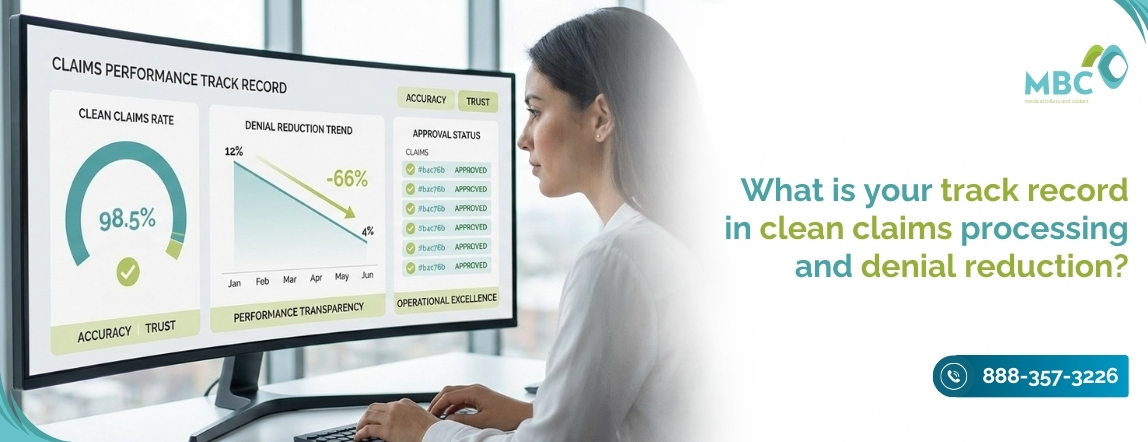
Clean Claims Processing & Denial Reduction: Building a Stronger Healthcare Revenue Cycle
Your track record in clean claims processing and denial reduction measures your organization’s ability to submit accurate, error-free healthcare claims that are accepted and paid by insurers on the first attempt. A strong track record is quantified by achieving a 95% clean claim rate (CCR) benchmark—meaning 95% or more of your submitted claims are processed without rejections, denials, or rework requirements.
Every healthcare organization faces a critical question: Is your billing operation working efficiently, or are denied claims quietly draining your revenue? The answer lies in understanding clean claims processing and implementing denial reduction strategies that protect your bottom line.
A successful track record in clean claims processing and denial reduction is defined by achieving a 95% clean claims rate (CCR), ensuring that the majority of submissions are accepted and paid on the first pass without manual intervention. Maintaining high performance in these areas is a critical indicator of efficient billing and coding processes, leading to faster reimbursements, improved cash flow, and reduced administrative costs. For healthcare decision-makers, a strong track record minimizes the financial strain of the $25 to $117 cost of reworking a single denied claim, while protecting the practice from the risk of CMS or private insurer billing audits.
Introduction
Every healthcare organization faces a critical question: Is your billing operation working efficiently, or are denied claims quietly draining your revenue? The answer lies in understanding clean claims processing and implementing denial reduction strategies that protect your bottom line.
A successful track record in clean claims processing and denial reduction is defined by achieving a 95% clean claims rate (CCR), ensuring that the majority of submissions are accepted and paid on the first pass without manual intervention. Maintaining high performance in these areas is a critical indicator of efficient billing and coding processes, leading to faster reimbursements, improved cash flow, and reduced administrative costs. For healthcare decision-makers, a strong track record minimizes the financial strain of rework costs and protects the practice from the risk of CMS or private insurer billing audits.
For most healthcare practices, the problem is significant. Organizations that struggle with claim accuracy face substantial financial consequences—not just from individual denials, but from the cascading operational costs that follow. This comprehensive guide explores what separates high-performing practices from those left chasing unpaid claims.
What Is Clean Claims Processing?
Clean claims processing refers to the submission of complete, error-free healthcare claims to insurance payers on the first attempt. A clean claim contains all required information—accurate patient demographics, verified insurance eligibility, correct medical coding, necessary authorizations, and compliant documentation—without omissions or discrepancies that might trigger rejection or denial.
The definition is straightforward, but the execution is complex. Every payer has unique requirements. What satisfies Medicare might differ from commercial insurance standards. What works for one specialty might not apply to another. This variability makes clean claims processing both a technical skill and a strategic business function.
According to industry standards, a clean claim is one that not only passes initial validation but is also accepted and paid by the payer. This distinction matters because a claim can technically avoid rejection yet still face denial after reaching the adjudication stage.
The Three Stages of Claim Movement
Understanding the claim journey helps explain why clean processing matters:
- Pre-Submission: Your billing team prepares the claim, checks codes, verifies eligibility, confirms authorizations, and validates patient information.
- Submission to Acceptance: The claim reaches the payer’s system. Automated checks identify syntax errors, missing fields, or format issues. Claims with technical errors face rejection at this “gatekeeping” stage.
- Adjudication to Payment: Claims that pass technical validation enter the review process, where payers assess medical necessity, coverage rules, and benefit limitations. Denials occur here when payers refuse payment for clinical or policy reasons.
Many practices focus solely on the first stage and miss opportunities to prevent later-stage denials. Effective clean claims processing addresses all three stages.
Understanding Denial Reduction
Denial reduction is a systematic, data-driven approach to identifying why payers refuse payment and eliminating the root causes. Rather than treating denials as isolated incidents, denial reduction treats them as signals of underlying process failures.
Common denial triggers include:
- Prior authorization gaps: Services rendered without required pre-approval
- Eligibility mismatches: Coverage terminated or changed without practice awareness
- Coding inaccuracies: Incorrect modifiers, outdated codes, or code-pair violations
- Documentation deficiencies: Medical records lacking sufficient detail to support billed services
- Benefit limitations: Services excluded under the patient’s specific plan
Effective denial reduction requires analyzing denial patterns, understanding payer-specific rules, and implementing preventive controls. The National Correct Coding Initiative (NCCI), established by the Centers for Medicare & Medicaid Services, provides guidelines for proper coding methodology that many organizations use as a foundation for denial prevention.
The Financial Impact: Why This Matters to Your Bottom Line
Healthcare organizations that ignore clean claims processing and denial reduction face measurable financial consequences:
Revenue Loss at Scale
According to industry analysis, claim denials result in average annual losses of approximately $5 million for mid-sized healthcare organizations, representing roughly 5% of net patient revenue. For larger health systems, this figure escalates significantly.
Each denied claim incurs direct rework costs ranging from $25 to $117, depending on complexity. Yet the financial impact extends beyond rework expenses. Denied claims tie up staff resources, delay revenue recognition, and create accounting complications. The cumulative effect destabilizes financial forecasting and strains operational budgets.
The Abandoned Claims Problem
A particularly troubling statistic reveals that approximately 65% of denied claims are never reworked or resubmitted. These “abandoned” claims represent revenue your organization has already earned but fails to collect. Over a year, this compounds into millions of dollars in unrecognized revenue sitting in accounts receivable limbo.
Cash Flow Disruption
High denial rates create unpredictable cash flow patterns. When claims are rejected or denied, payment cycles extend from the expected 30 days to 45, 60, or even 90+ days. This unpredictability makes financial planning difficult and forces organizations to maintain larger cash reserves to cover operational expenses. With automated systems and proper controls, forward-looking organizations maintain predictable reimbursement cycles that align with business planning.
Administrative Waste
The healthcare industry loses substantial resources to administrative inefficiency. The Centers for Medicare & Medicaid Services recognizes that transitioning to fully electronic, integrated workflows can save the healthcare system over $20 billion annually. Much of this waste stems from manual claim processing, redundant verification steps, and reactive (rather than proactive) denial management.
Key Performance Metrics That Drive Success
To evaluate your organization’s track record in clean claims processing, monitor these critical performance indicators:
Clean Claim Rate (CCR)
The clean claim rate measures the percentage of claims submitted without errors on the first attempt. The industry standard benchmark is 95% CCR. Organizations achieving this rate demonstrate operational excellence and earn the financial benefits associated with efficient billing.
Falling below 85% CCR signals serious operational problems. When denials and rejections exceed 15%, the administrative burden becomes substantial. Recovery efforts consume disproportionate resources, staff frustration increases, and cash flow becomes chaotic.
First-Pass Resolution Rate
This metric tracks the percentage of submitted claims that receive full payment on the initial submission without appeals, resubmissions, or adjustments. Best-in-class organizations achieve first-pass resolution rates exceeding 90%.
This metric differs from CCR because it accounts for claims that may be technically clean but still face payment issues due to payer interpretation, documentation disputes, or coverage determinations. Organizations tracking first-pass resolution gain visibility into payer-specific challenges and can adjust submission strategies accordingly.
Days in Accounts Receivable (A/R)
Days in A/R measures the average time elapsed from service delivery to payment receipt. High-performing organizations keep days in A/R under 30. This benchmark reflects efficient processing combined with timely payer reimbursement.
Days in A/R above 45 indicate potential problems with claim submission timing, payer processing delays, or unresolved denials. Organizations that have been in A/R for more than 60 days should investigate root causes immediately, as this directly impacts working capital and financial stability.
First-Payer Acceptance Rate
This metric measures the percentage of claims technically accepted by the payer system (without format errors or syntax issues) on the first submission. Leading healthcare clearinghouses have achieved acceptance rates as high as 99.89%, demonstrating that advanced technology solutions can virtually eliminate technical rejections.
Organizations using modern claim submission platforms consistently achieve 99%+ acceptance rates, while those relying on manual submission or older systems frequently see acceptance rates below 95%.
Three Proven Strategies for Sustainable Improvement
1. Implement Automated Claim Scrubbing
Claim scrubbing uses intelligent software to detect and correct common errors before submission. An effective scrubbing solution identifies:
- Invalid code combinations or pairings that violate NCCI rules
- Missing or incorrect modifiers
- Demographic inconsistencies or missing patient information
- Incomplete authorization documentation
- Missing supporting documentation
AI-powered scrubbing has become increasingly sophisticated, using machine learning to identify patterns that suggest potential denial risks. Rather than simply flagging obvious errors, advanced systems can identify subtle issues that might slip past manual review.
Claim scrubbing reduces claim rejections by 90%+ and significantly lowers denial rates. The time saved on manual error detection allows billing staff to focus on complex cases that require clinical judgment rather than on repetitive verification tasks.
2. Deploy Real-Time Eligibility Verification
Outdated or incorrect insurance information is one of the leading causes of claim denial. Eligibility verification conducted at the time of service—or immediately before claim submission—ensures accurate coverage information.
Modern eligibility verification systems connect directly to payer databases, retrieving real-time information about:
- Active coverage status and plan details
- Benefit limitations and exclusions
- Prior authorization requirements
- Out-of-pocket deductible status
- Coverage effective dates
By verifying eligibility at the point of service, practices can address coverage gaps before delivering care, adjust treatment plans to reflect actual benefits, and prevent denials caused by coverage termination or plan changes the practice wasn’t aware of.
Organizations implementing real-time eligibility verification report 15-25% reductions in eligibility-related denials within the first month.
3. Invest in Continuous Staff Education
Billing and coding rules are not static. The ICD-10 code set receives updates annually. CPT codes change regularly. CMS regulations evolve constantly. Practices that fail to keep staff training current inevitably experience increased coding errors and denials.
High-performing organizations establish ongoing education programs covering:
- ICD-10 and CPT coding updates
- Medical necessity documentation standards
- Payer-specific requirements and policy changes
- Compliance and audit preparation
- Denial appeal processes and strategies
Staff who understand evolving regulations make better coding decisions, catch errors before submission, and can articulate the clinical justification for disputed claims during appeal processes. This expertise protects the organization from both denials and audit risk.
Conclusion: From Managing Claims to Maximizing Revenue
The goal for healthcare providers in 2026 should not be to simply “manage” claim denials, but to optimize your revenue cycle and maximize every dollar you’ve earned. By focusing on clean claims processing, combating denials with advanced technology, and maintaining a rigorous compliance framework aligned with CMS regulations, practices can reclaim hidden revenue currently left on the table.
Your track record in clean claims processing directly impacts your financial health. Moving from 85% CCR to 95% CCR can recover $500,000 to $2 million in annual revenue while reducing staff burden and administrative costs.
How Medical Billers and Coders (MBC) Can Help
With over 25 years of experience as a leading medical billing company, Medical Billers and Coders delivers enterprise-grade solutions designed to strengthen your revenue cycle and protect your EBITDA. Our proven approach combines:
- Advanced technology for automated claim scrubbing and real-time eligibility verification
- Expert compliance aligned with CMS regulations and federal healthcare standards
- Data-driven insights to identify and eliminate the root causes of denial
- Continuous staff education to keep your team current on billing best practices
Ready to optimize your revenue cycle?
Schedule your free strategy call with Medical Billers and Coders today and discover how to elevate your clean claims processing, reduce denials, and build the strong track record your organization deserves.
Frequently Asked Questions About Clean Claims and Denial Reduction
A claim rejection happens before processing due to technical errors such as missing data, incorrect formats, or invalid provider details. The claim is returned without review and can be quickly fixed and resubmitted.
A claim denial occurs after the payer has reviewed the claim. It means the payer decided not to pay due to coverage rules, medical necessity issues, or policy limitations. Denials usually require appeals and supporting documentation.
Key takeaway: Rejections are easy fixes. Denials require deeper review and follow-up.
A 95% clean claim rate shows that billing processes are efficient and well-controlled. Organizations at this level face fewer denials, faster payments, and predictable cash flow.
When the rate drops below 95%, staff spend more time reworking claims, payments slow down, and payer scrutiny increases.
Key takeaway: A high clean claim rate keeps revenue steady and reduces administrative burden.
The most frequent causes include:
Missing prior authorization
Eligibility or coverage errors
Coding mistakes or incorrect modifiers
Incomplete clinical documentation
Medical necessity issues
Key takeaway: Most denials are preventable with accurate data, proper coding, and complete documentation.
Automation prevents errors before submission through claim scrubbing and eligibility checks. It also tracks claim status, flags delays, analyzes denial trends, and prioritizes appeals.
Key takeaway: Automation reduces manual work, speeds up follow-ups, and improves denial recovery.
For clean Medicare claims, payment is typically issued within 30 days.
If a claim contains errors, Medicare notifies the provider within 14 days, and the claim is processed after the errors are corrected.
Commercial payer timelines are similar but vary by contract.
Key takeaway: Knowing payer timelines helps identify when claims need follow-up.
Building Your Path to Operational Excellence
Achieving and maintaining high clean claim rates isn’t a one-time project—it’s an ongoing commitment to operational discipline. Organizations that succeed share common characteristics:
The financial return on these investments is substantial. A practice that improves from 85% CCR to 95% CCR typically recovers $500,000 to $2 million in annual revenue while simultaneously reducing staff frustration and administrative burden.
Your track record in clean claims processing reflects your organization’s operational maturity and financial health. By implementing the strategies outlined here—automated claim scrubbing, real-time eligibility verification, and continuous staff education—you can build a billing operation that protects revenue, maintains predictable cash flow, and positions your organization for sustainable growth.
References
- CMS National Correct Coding Initiative (NCCI)
- Social Security Administration (SSA) – Social Security Act Provisions

Catering to more than 40 specialties, Medical Billers and Coders (MBC) is proficient in handling services that range from revenue cycle management to ICD-10 testing solutions. The main goal of our organization is to assist physicians looking for billers and coders, at the same time help billing specialists looking for jobs, reach the right place.