Specialities
 Services
 Resource Center
 Pricing
 About
 Contact

Last updated: October 21, 2026
The Anti-Markup Rule is a Medicare billing rule that stops a billing physician or supplier from profiting on diagnostic tests performed by someone outside their practice. If your practice orders imaging, cardiology, neurology or other diagnostic tests and bills Medicare for the technical component (TC) or professional component (PC), you need to know when the rule applies, how to pass the ‘substantially all’ test or the ‘site of service’ test, and what Medicare will pay if neither test is met.
Key Takeaways
- The Anti-Markup Rule (42 CFR 414.50) limits Medicare payment for the TC or PC of a diagnostic test that the billing physician orders but someone else performs.
- The rule does not apply when the performing physician ‘shares a practice’ with the billing physician, under either the ‘substantially all’ (75%) test or the ‘site of service’ test.
- Always check the ‘substantially all’ test first, and analyze the TC and PC separately.
- If the rule applies, payment is capped at the lowest of the performer’s net charge, your actual charge, or the fee schedule amount.
- Anti-markup tests must be reported correctly on the claim, including the purchase price, or they risk denials and overpayment recovery.
What Is the Anti-Markup Rule?
The Anti-Markup Rule prohibits a billing physician or other supplier from marking up either the Technical Component (TC) or Professional Component (PC) of a diagnostic test ordered by the billing physician or other supplier (or ordered by a party related to such physician or other suppliers through common ownership or control) unless the performing physician ‘shares a practice’ with the billing physician or other supplier.
The rule is codified at 42 CFR 414.50 and took effect for Medicare Part B on January 1, 2009. CMS adopted it to reduce overall Medicare spending and to remove the financial incentive to order tests that are purchased from, or performed by, an outside supplier and then billed at a higher rate.
If the performing physician shares a practice with the billing physician or other supplier, this rule would not apply to that diagnostic test. CMS adopted a ‘shares a practice’ standard to ensure that there is a sufficient relationship between the billing physician/supplier and the performing physician. There are two alternative options under which a performing physician may be deemed to share a practice with the billing physician or other supplier.
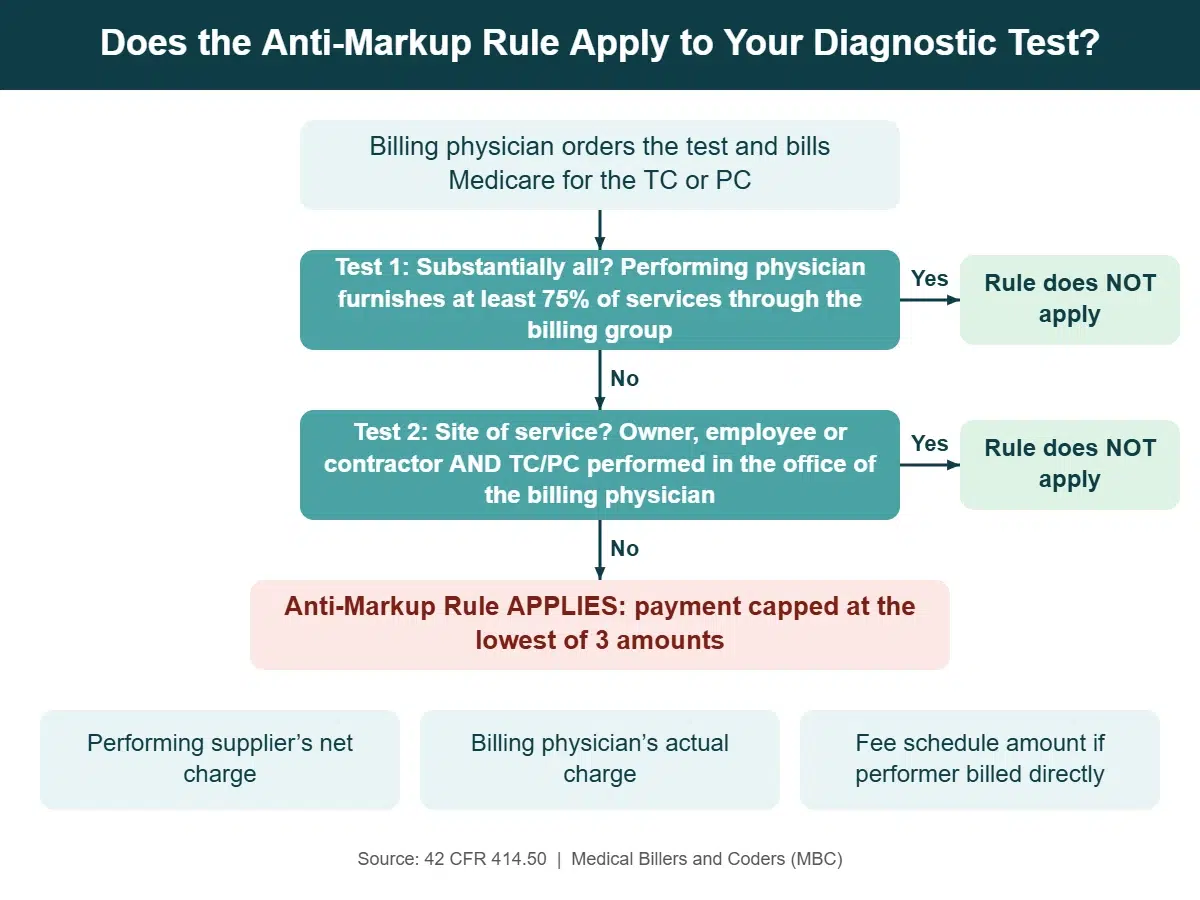
The first alternative is referred to as the ‘substantially all’ test, and the second alternative is referred to as the ‘site of service’ test. CMS states that physicians should first analyze all arrangements under the substantially all test. Each component of the diagnostic test should be analyzed separately.
When Does the Anti-Markup Rule Apply?
The rule comes into play when all of these are true:
- The test is a diagnostic test paid under the Medicare Physician Fee Schedule (for example, imaging, echocardiography, EEG, sleep studies or pulmonary function tests).
- The billing physician or supplier (or a related party) ordered the test.
- The TC or PC was purchased from an outside supplier or performed by a physician who does not ‘share a practice’ with the billing entity, often through reassignment.
Common examples include a multi-specialty group that buys reads from an outside radiologist, a cardiology practice that contracts out echo interpretation, and a practice that leases a mobile imaging unit with its own technologists.
‘Substantially all’ Test
The Anti-Markup Rule does not apply when the performing physician provides substantially all of his/her professional services for the billing physician or other supplier. The performing physician is the physician who supervises the performance of a diagnostic test or is the physician who performs the professional interpretation of a diagnostic test.
‘Substantially all’ means that the performing physician performs at least 75% of his or her professional services for the billing physician or supplier. This requirement is satisfied if the billing physician/group has a reasonable belief at the time the claim was submitted that:
- the performing physician has provided substantially all of his/her professional services through the billing physician/group for the 12 months before the submission of the claim (including the month in which the service was performed); or
- the performing physician will provide substantially all of his/her professional services through the billing physician/group for the next 12 months after the submission of the claim (including the month in which the service was performed).
For example, a physician practice has several office locations where physicians see patients. The practice has a centralized location where it performs all of the diagnostic imaging tests for its patients. The physician practice contracts with a radiologist to supervise the technologists performing the diagnostic imaging test and to perform the professional interpretation of that test.
The radiologist is employed by the physician practice on a full-time basis. The Anti-Markup Rule would not apply to this circumstance. It is important to remember that this alternative is not a location-based test. Rather, it is a test that evaluates the contractual relationship between the billing physician/supplier and the performing physician.
Tip: Keep documentation that supports your ‘reasonable belief’, such as employment agreements, schedules and productivity reports. Auditors will ask for it.
‘Site of service’ Test
If the billing physician/supplier cannot meet the substantially all test, it should evaluate the next alternative. The Anti-Markup Rule does not apply if:
- the performing physician is an owner, employee, or independent contractor of the billing physician or other supplier; and
- the TC or the PC is performed in the office of the billing physician or other supplier.
Under the site of service test, the performing physician does not need to meet the substantially all/75% test. The performance of the TC means both the conducting and supervision of the TC under this site of service test.
The office of the billing physician or other supplier is any medical office space in which the ordering physician/supplier regularly furnishes patient care and includes space where the billing physician/supplier furnishes diagnostic testing services if the space is in the same building.
For a physician organization, this space is where the ordering physician provides substantially the full range of patient care services that the ordering physician provides generally.
For example, a physician has an office located on the first floor of a medical office building. In his office, he performs the full range of services that he provides generally, thus the space meets the criteria for the ‘office of the billing physician or other supplier’.
The physician orders a diagnostic test, which is conducted by a technician and supervised by a radiologist with whom the physician has an independent contractor relationship in an office located in the basement of the medical office building. The radiologist also performs the PC of the test in that office.
The radiologist reassigns her right to bill for the TC and the PC of the test to the physician. The Anti-Markup Rule does not apply because the TC and the PC were performed in the office of the billing physician or other supplier.
It is important to remember that this alternative is not a contractual relationship test. Rather, it is a test that evaluates where the TC or the PC is performed.
Billing Limits Under the Anti-Markup Rule
If the Anti-Markup Rule applies, the payment to the billing physician (less deductibles and coinsurance) for the TC or PC of the diagnostic test may not exceed the lowest of the following amounts:
- The performing supplier’s net charge to the billing physician or other supplier;
- The billing physician or other supplier’s actual charge; or
- The fee schedule amount for the test that would be allowed if the performing supplier billed directly.
The net charge must be calculated without any charge for equipment or space that the billing physician leases to the performing supplier, so a practice cannot inflate the net charge through a lease arrangement.
How to Report Anti-Markup Tests on Medicare Claims
- CMS-1500: In Item 20, answer “Yes” and enter the purchase (net) price of the test.
- Electronic 837P: Report the purchased service and its amount in the line-level purchased service information (Loop 2400, PS1 segment).
- Performing supplier: Report the name, address and NPI of the performing supplier or the location where the test was done, as your Medicare Administrative Contractor (MAC) requires.
- Bill each component correctly: Use modifier TC or 26 when billing a single component, and run the anti-markup analysis for each component on its own.
Reporting rules can vary slightly by MAC, so check your contractor’s guidance before submitting claims for purchased diagnostic tests.
Common Anti-Markup Compliance Mistakes
- Assuming that an independent contractor relationship alone satisfies the rule.
- Treating a mobile imaging unit parked outside the building as the ‘office of the billing physician’.
- Analyzing the TC and PC together instead of separately.
- Billing the full fee schedule amount for a purchased test without entering the purchase price.
- Not keeping records that show the 75% threshold was met.
Anti-Markup Rule vs. Stark Law
The Anti-Markup Rule and the Stark Law are separate requirements. Meeting a Stark exception, such as the in-office ancillary services exception, does not mean the Anti-Markup Rule is satisfied, and the reverse is also true. Diagnostic testing arrangements should be reviewed under both rules, along with any state-specific self-referral laws.
Conclusion
The Anti-Markup Rule has been in place since 2009, yet many practices still struggle to apply the ‘substantially all’ test and the ‘site of service’ test correctly. Getting it wrong can lead to underpayments, denials or overpayment recovery during an audit. Review every purchased or reassigned diagnostic test arrangement, document how it meets one of the two tests, and report the purchase price correctly on the claim.
Need Help Billing Diagnostic Tests Correctly?
Medical Billers and Coders (MBC) helps practices code, bill and audit diagnostic tests in line with Medicare rules, including the Anti-Markup Rule. Explore our pathology billing services and neurology medical billing services, or contact us for a free billing review. Email info@medicalbillersandcoders.com or call 888-357-3226.
The Anti-Markup Rule (42 CFR 414.50) prevents billing physicians from marking up the Technical or Professional Components of diagnostic tests they order unless the performing physician shares a practice with the billing physician.
This test states that the Anti-Markup Rule doesn’t apply if the performing physician provides at least 75% of their professional services through the billing physician/group for the past or next 12 months.
The Anti-Markup Rule doesn’t apply if the performing physician is an owner, employee or independent contractor of the billing physician and the diagnostic test is performed in the office of the billing physician.
The payment for the Technical or Professional Components of a diagnostic test cannot exceed the lowest of the performing supplier’s net charge, the billing physician’s actual charge, or the fee schedule amount if the performer billed directly.
On the CMS-1500, answer “Yes” in Item 20 and enter the purchase price. On the 837P, report the purchased service in Loop 2400 (PS1 segment) and include the performing supplier details your MAC requires.
The Anti-Markup Rule is a Medicare rule. Commercial payers follow their own contracts and policies, so check each payer agreement for purchased-service limits.
Physicians often find the ‘substantially all’ and ‘site of service’ tests confusing because each component of a test must be analyzed separately and the office definition is narrow.

Catering to more than 40 specialties, Medical Billers and Coders (MBC) is proficient in handling services that range from revenue cycle management to ICD-10 testing solutions. The main goal of our organization is to assist physicians looking for billers and coders, at the same time help billing specialists looking for jobs, reach the right place.