Specialities
 Services
 Resource Center
 Pricing
 About
About
 Contact

Net Collection Rate is the single most important metric in medical billing performance management. It is not the most commonly reported metric — billing companies prefer to lead with first-pass acceptance rates and days in AR — but it is the only number that directly answers the question every CFO and practice administrator actually needs answered: “Of all the revenue we are contractually entitled to collect, how much are we actually collecting?”
According to MGMA, practices achieving a 95%+ Net Collection Rate consistently outperform their peers by $50,000–$200,000+ in annual collections at identical charge volumes. The difference is not payer behavior. It is billing performance. This guide explains what Net Collection Rate is, how to calculate it, what benchmarks to use by specialty, and how to identify the specific billing failures that most commonly suppress NCR below world-class performance.
Key Takeaways
- Net Collection Rate (NCR) is the key metric for assessing medical billing performance; it shows actual revenue collected versus what is contractually owed.
- To calculate NCR, use the formula: NCR = (Total Payments Received ÷ (Gross Charges − Contractual Adjustments)) × 100.
- World-class NCR benchmarks range from 94% to 98% depending on specialty; below 90% signals issues that could cost your practice significantly.
- Common issues suppressing NCR include denial write-offs without appeal, underpayment acceptance, and patient balance write-offs.
- Understanding NCR helps practices identify revenue performance and improve collections through better billing management.
What Is Net Collection Rate?
Net Collection Rate (NCR) is the percentage of contractually collectible revenue that a medical practice actually recovers in a given period. It is calculated after removing contractual adjustments — the payer-negotiated discounts that reduce gross billed charges to the contracted allowed amount.
NCR measures billing performance against what you are actually owed — not against inflated gross charges that no payer ever pays.
The Net Collection Rate Formula
NCR = (Total Payments Received ÷ (Gross Charges − Contractual Adjustments)) × 100
Or equivalently:
NCR = (Total Payments Received ÷ Net Collectible Revenue) × 100
NCR Calculation Example
| Revenue Component | Amount |
|---|---|
| Gross Charges Billed | $1,000,000 |
| Less: Contractual Adjustments (payer-negotiated discounts) | $400,000 |
| Net Collectible Revenue | $600,000 |
| Total Payments Received | $570,000 |
| Net Collection Rate | 95.0% |
| Uncollected Revenue (revenue gap) | $30,000 |
The $30,000 gap in this example represents revenue that was contractually collectible but not recovered. At a $5M annual collection practice, a 5% NCR gap is $250,000 in annual recoverable revenue written off silently.
NCR Benchmarks by Specialty (MGMA 2025)
| Specialty | World-Class NCR | National Median NCR | Below-Average NCR (Signals Problems) |
|---|---|---|---|
| Orthopedic Surgery | 96%–98% | 93%–94% | Below 91% |
| Wound Care | 94%–97% | 91%–93% | Below 89% |
| Ambulatory Surgical Center (Facility) | 95%–98% | 92%–94% | Below 90% |
| Family Practice | 96%–98% | 94%–95% | Below 91% |
| OB-GYN | 95%–97% | 92%–94% | Below 90% |
| Dermatology | 96%–98% | 93%–95% | Below 91% |
| Optometry | 95%–97% | 92%–94% | Below 90% |
Sources: MGMA 2025 Cost and Revenue Survey; VMG Health ASC Benchmarking Report 2024.
NCR vs. Gross Collection Rate: Why the Difference Matters
Gross Collection Rate (GCR) divides total payments by total gross charges — without subtracting contractual adjustments. Because gross charges are set above actual contracted rates, GCR is not a reliable performance metric.
A practice that aggressively sets high charge masters will show a lower GCR than a practice with identical actual collections but more conservative charge setting — even though both practices collect the same amount of real revenue.
GCR is the metric billing companies use when they do not want you to see their actual performance. If your billing company reports GCR as its primary performance indicator, ask for NCR instead. If they cannot produce it, that is a red flag.
NCR vs. First Pass Rate: Understanding the Difference
First Pass Rate (FPR) — also called First Pass Acceptance Rate (FPAR) — measures the percentage of claims accepted by payers on first submission. FPR measures clean claim submission quality, not revenue recovery.
A practice can have a 98% FPR and a 90% NCR simultaneously. That means: nearly all claims are submitted cleanly, but 10% of collectible revenue is being lost downstream — through authorization denials after acceptance, underpayments that go unappealed, patient balances written off without collection attempts, or timely filing violations on resubmitted claims.
FPR tells you how good your billing company is at submitting claims. NCR tells you how good your billing company is at collecting revenue. Both matter, but NCR is the definitive performance metric.
The Five Most Common NCR Suppressors
When a practice’s NCR falls below benchmark, the cause is almost always one of five specific revenue failure categories:
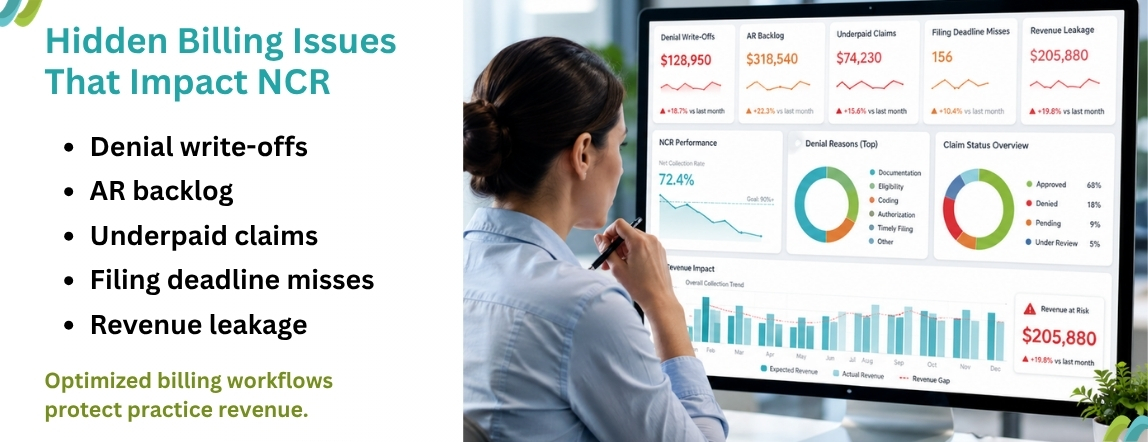
1. Denial Write-Offs Without Appeal:
Claims denied by payers are written off as uncollectible without a systematic appeal process. The most recoverable denial category — incorrect coding denials, authorization denials with retroactive approval potential, and medical necessity denials with documentation available — gets written off instead of appealed. A billing company with a structured denial appeal protocol recovers 40%–60% of initially denied claims that would otherwise become write-offs.
2. Underpayment Acceptance:
Payers pay claims below the contracted allowed amount, and the billing company posts the underpayment as correct payment without flagging it for contract rate dispute. Underpayment acceptance is invisible to NCR tracking unless payment posting includes a contract rate audit against the payer fee schedule. MGMA estimates that 5%–10% of commercial payer payments are underpayments — systematic underpayment acceptance suppresses NCR by 1–3 percentage points over time.
3. Timely Filing Violations:
Claims approaching payer-specific timely filing deadlines (typically 90–180 days for commercial payers, 12 months for Medicare) are written off instead of corrected and resubmitted. Practices with high resubmission volumes and inadequate AR follow-up infrastructure generate timely filing write-offs that accumulate into five-to-six figure annual losses.
4. Patient Balance Write-Offs:
Self-pay balances and high-deductible patient responsibility amounts are written off after one or two statements without systematic collection follow-up. As patient cost-sharing has increased — the Kaiser Family Foundation reports that average deductibles have risen 111% over the past decade — patient balance collection has become a primary NCR driver for practices with commercial-heavy payer mixes.
5. Coding Errors Generating Preventable Denials:
Incorrect CPT code selection, modifier errors, and diagnosis code mismatches generate denial volumes that suppress NCR directly. Specialty-specific coding errors — orthopedic global period modifiers, wound care debridement unit selection, ASC APC grouping errors — generate the highest-value individual denials because they occur on high-reimbursement procedures.
How to Calculate NCR from Your Practice Data
To calculate NCR for your practice, you need three numbers from your practice management system for a defined period (typically monthly or quarterly):
- Total Gross Charges Billed: The sum of all charges submitted to payers at your standard fee schedule rates before any adjustments.
- Total Contractual Adjustments Posted: The sum of all contractual write-offs posted when you accept payer-contracted rates below your fee schedule. Do not include bad debt write-offs or small balance adjustments in this number.
- Total Payments Received: The sum of all insurance and patient payments posted, including EFT, check, and patient portal payments.
Apply the formula: NCR = Total Payments ÷ (Gross Charges − Contractual Adjustments) × 100.
If your practice management system cannot produce these three numbers separately and accurately, your billing infrastructure has a reporting gap that needs immediate correction — you cannot manage revenue performance you cannot measure.
What NCR Below Benchmark Actually Costs Your Practice
| Annual Collections | Current NCR | Target NCR | Annual Revenue Gap |
|---|---|---|---|
| $2,000,000 | 91% | 96% | $100,000 |
| $3,000,000 | 92% | 97% | $150,000 |
| $5,000,000 | 93% | 97% | $200,000 |
| $8,000,000 | 91% | 96% | $400,000 |
| $10,000,000 | 92% | 97% | $500,000 |
These are not theoretical figures. They represent revenue that exists in your payer contracts and your patient balances — revenue that a billing company operating at below-benchmark NCR is writing off on your behalf without your visibility into the specific failure causing it.
Know Your NCR. Know Your Revenue Performance.
If you do not have a clear, current NCR for your practice — or if your billing company cannot produce it — you are managing your revenue cycle without the one metric that reveals whether you are collecting what you are owed. MBC provides CFO-grade NCR reporting with payer-level and specialty-level segmentation as a standard component of every client engagement.
Request an AR analysis to benchmark your current NCR against MGMA standards for your specialty and identify the specific failure points suppressing your revenue performance.
FAQs: Net Collection Rate in Medical Billing
Net Collection Rate is the percentage of the revenue a medical practice is contractually eligible to collect that it actually collects. It is calculated by dividing total payments received by gross charges minus contractual adjustments, then multiplying by 100. NCR measures revenue recovery efficiency after accounting for payer-negotiated write-offs — making it the definitive indicator of billing company performance.
According to MGMA benchmarking data, 95%–98% is world-class performance across most medical specialties. An NCR of 90%–94% is average but indicates recoverable revenue loss. An NCR below 90% signals systemic billing failures — denial mismanagement, coding errors, timely filing violations, or inadequate patient collections — that are generating significant annual revenue loss.
Effective revenue cycle management directly impacts Net Collection Rate by reducing claim denials, preventing payer underpayments, improving patient balance collections, and ensuring timely claim submission and AR follow-up. Strong RCM processes help medical practices maximize collectible revenue and reduce reimbursement leakage.
Gross Collection Rate divides total payments by total gross charges without subtracting contractual adjustments — making it unreliable as a performance metric because gross charges are set above contracted rates. Net Collection Rate strips out contractual adjustments and measures performance against what the practice is actually entitled to collect. NCR is the only revenue metric that accurately reveals billing company performance.
First Pass Rate measures the percentage of claims accepted on first submission — it measures clean claim quality, not revenue recovery. A practice with 98% FPR and 90% NCR is submitting clean claims but failing to collect on accepted claims downstream. NCR is the definitive performance metric; FPR is a secondary indicator of submission quality only.
NCR decline without visible denial increase typically signals underpayment acceptance (payers paying below contracted rates that go unappealed), patient balance write-offs increasing with high-deductible enrollment, or timely filing violations accumulating on aged claims. Any NCR decline warrants a root-cause AR analysis segmented by denial reason, payer, and write-off category — not just a denial rate report.
Professional medical billing services improve Net Collection Rate through accurate coding, denial management, underpayment recovery, payer contract audits, AR follow-up, and patient collection workflows. Effective medical billing and revenue cycle management services help practices recover more collectible revenue while reducing administrative burden.

With almost 12 years of experience in healthcare revenue cycle management, this Revenue Cycle Specialist brings deep expertise in medical billing, claims optimization, and practice profitability. Shares industry-backed insights focused on improving collections, reducing denials, and driving operational excellence.