Specialities
 Services
 Resource Center
 Pricing
 About
About
 Contact
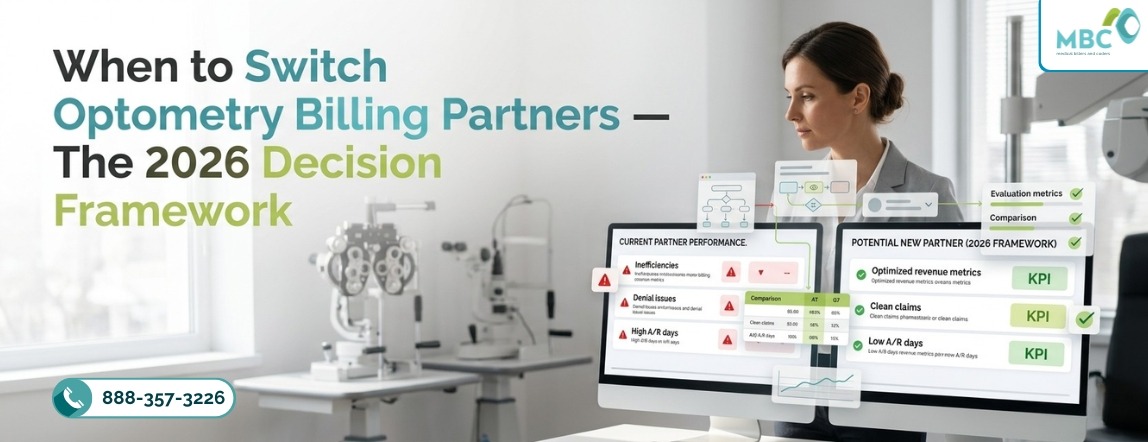
You should switch optometry billing partners when your Net Collection Ratio falls below 93%, Days in AR exceed 35 days, or your current vendor has not updated billing protocols for the CY 2026 MPFS Final Rule, new CPT codes, and the FY 2026 ICD-10 changes — because each of these gaps is silently compounding revenue loss at the encounter level, every single day.
Multi-provider eye care groups and PE-backed optometry networks operate in a fundamentally different regulatory environment in 2026 than they did even 18 months ago.
The CMS CY 2026 MPFS Final Rule (CMS-1832-F), finalized October 31, 2025, introduced two separate Medicare conversion factors for the first time — $33.57 for qualifying APM participants and $33.40 for non-qualifying practitioners — alongside a –2.5% efficiency adjustment applied to nearly all non-time-based services (Federal Register, November 5, 2025).
For groups billing significant Medicare volume, whether your vendor has already modeled this into your fee schedule — or hasn’t — is a direct EBITDA event.
The question isn’t whether to switch optometry billing company operations if something feels off. The question is whether your current vendor is architected for what 2026 actually demands.
The Triple Threat to Optometry Revenue in 2026
Three compounding failures define the gap between a generic RCM vendor and a genuine revenue integrity partner — and all three are accelerating this year.
1. Medical vs. Vision Plan Misclassification
At 30 encounters daily, defaulting to routine vision codes (92004, 92014) for encounters driven by medical complaints — glaucoma, diabetic retinopathy, acute floaters — forfeits $120–$180 per medical encounter in favor of a $45–$70 vision plan payment.
Across a multi-provider group, that single coding failure eliminates $200,000–$275,000 in annual collections. A qualified revenue integrity partner deploys chief complaint routing that correctly assigns each encounter to its highest-reimbursing eligible plan before a single claim reaches the clearinghouse.
2. 2026 CPT and ICD-10 Transition Risk
Effective January 1, 2026, CPT 92284 was revised and new CPT 92288 was established to separately capture diagnostic dark adaptation testing from screening services (CMS CY 2026 MPFS Fact Sheet).
Practices that haven’t updated billing protocols to distinguish diagnostic from screening intent face automatic denials on these codes — compounding on top of existing medical vs. routine misclassification losses.
Separately, effective October 1, 2025, CMS released 487 new ICD-10-CM diagnosis codes, including 17 new eye and adnexa codes covering Demodex blepharitis, neovascular glaucoma, and thyroid eye disease (CMS ICD-10-CM FY 2026 Update). Practices still using legacy codes on affected diagnoses face claim rejection at the clearinghouse level.
3. Coordination of Benefits (COB) Abandonment
Specialized optometry billing services deploy dual-billing COB workflows that legally bill medical insurance for the comprehensive exam and the vision plan for the refraction on the same encounter — recovering an average of $55–$110 per qualifying visit.
Most generic vendors file one claim to one plan. Across a 30-provider group with 25,000 annual encounters, COB abandonment alone represents $1.375M–$2.75M in forfeited annual revenue.
The 2026 Decision Framework: When to Switch
| Performance Indicator | Hold — Vendor Is Performing | Switch — Revenue Leakage Confirmed |
| Net Collection Ratio | ≥ 94% | < 93% for 2+ consecutive quarters |
| Days in AR | < 30 days | > 35 days with no improvement trend |
| First-Pass Claim Acceptance | ≥ 97% | < 95% or vendor cannot report it |
| 2026 CPT/ICD-10 Updates | Implemented by Jan 1 / Oct 1 | Still on prior-year fee schedule |
| COB Dual-Billing | Deployed on qualifying encounters | Single-plan filing only |
| MIPS Reporting | Automated for qualifying practices | Manual or not tracked |
| Reporting Access | Real-time CFO-grade dashboard | Monthly PDFs or restricted access |
If three or more indicators fall in the right column, the cost of staying exceeds the cost of switching — and the switch should begin immediately.
The 90-Day Transition That Protects Cash Flow
A properly executed decision to switch optometry billing partners does not create a cash flow gap. The architecture is straightforward: the outgoing vendor handles run-out of existing claims under a defined 90-120 day window, while the new partner assumes all new dates of service from day one. Parallel processing — both systems operating simultaneously for 60 days — ensures no claims fall through during the handoff.
What separates a high-value transition from a disruptive one is what the incoming vendor brings before they touch a single claim: a signed Business Associate Agreement, system-agnostic EHR integration (RevolutionEHR, Compulink, Eyefinity — no forced migration), and an encounter-level audit that quantifies exactly what your current vendor has been missing.
That audit output — identifying chief complaint misclassification patterns, COB abandonment rates, 2026 CPT exposure, and your current NCR against specialty benchmarks — is the financial case for the switch, presented to your CFO before the transition even begins.
Revenue integrity solutions worth evaluating in 2026 are not process outsourcers. They are operational infrastructure partners — architecting the encounter-level systems that protect your group’s margins across every payer, every plan, and every regulatory update cycle.
MBC’s Optometry RCM: Performance-Based and Aligned with Your EBITDA
Medical Billers and Coders (MBC) has delivered specialty rcm services for optometry and multi-provider eye care groups for over 26 years. MBC evaluates your revenue cycle at the encounter and payer level — identifying every gap your current vendor has left open — and delivers a 90-day revenue diagnostic before you sign anything.
Multi-provider eye care groups working with MBC average a 16% improvement in Net Collection Ratio within the first 90 days. Our optometry-specific infrastructure is already updated for CY 2026 MPFS, the new CPT dark adaptation codes, and the FY 2026 ICD-10 eye and adnexa additions — so your group absorbs these regulatory transitions without a single claim disruption.
Request Your 90-Day Optometry Revenue Diagnostic Today
Identify what your current vendor is costing you — before you make any commitment.
Call: 888-357-3226 | Email: info@medicalbillersandcoders.com
FAQs
When your Net Collection Ratio falls below 93%, Days in AR exceed 35 days, or your vendor has not updated for 2026 CPT and ICD-10 changes, the performance gap is structural — not fixable with internal adjustments. Three or more indicators from the decision framework above signal a switch, not a patch.
Not with a parallel processing model. Your outgoing vendor runs out existing claims over 90–120 days; your new partner takes all new dates of service from day one. A 60-day overlap eliminates cash flow disruption entirely.
Yes — a qualified partner operates system-agnostically within your existing EHR (RevolutionEHR, Eyefinity, Compulink, and others) with no forced migration. Any vendor requiring an EHR change is adding months of operational disruption to a process that should protect continuity.
Target Net Collection Ratio above 94%, Days in AR under 30 days, first-pass claim acceptance at or above 97%, and COB dual-billing deployed on all qualifying encounters. If your new vendor cannot report these metrics in real time through a CFO-accessible dashboard, the infrastructure gap still exists — regardless of who is billing.
The right time to switch optometry billing partners is whenever your performance indicators breach the thresholds — NCR below 93%, Days in AR above 35, or a vendor not updated for 2026 MPFS and CPT changes — not when the calendar says so. Revenue leakage compounds daily.

With almost 12 years of experience in healthcare revenue cycle management, this Revenue Cycle Specialist brings deep expertise in medical billing, claims optimization, and practice profitability. Shares industry-backed insights focused on improving collections, reducing denials, and driving operational excellence.