Specialities
 Services
 Resource Center
 Pricing
 About
About
 Contact
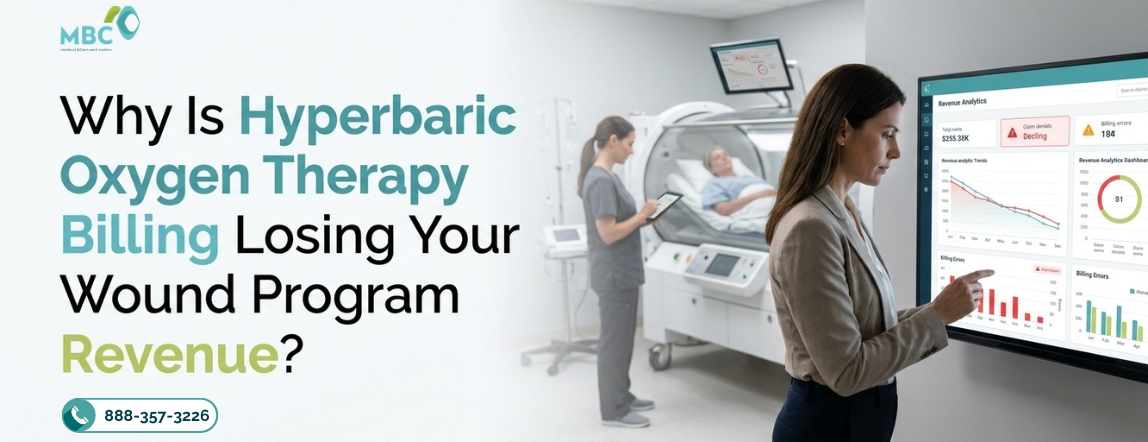
Hyperbaric oxygen therapy billing is draining revenue from wound care programs across the country — not because of low patient volume, but because of three structural gaps that generic RCM vendors consistently fail to close: incorrect place-of-service coding, unsupported medical necessity documentation, and missed facility billing on the HCPCS G0277 line.
For multi-site wound care programs, hospital outpatient departments, and freestanding hyperbaric clinics, the financial exposure is significant. A single denial cascade on HBOT claims can suppress Net Collection Ratio by 6–9 percentage points — translating to $200K–$400K in unrecovered revenue annually for programs running 10+ active chambers.
The Three Revenue Threats Hidden in HBOT Claims
Threat 1: Place-of-Service Mismatch
Place-of-service (POS) codes directly affect reimbursement rates and denial rates — yet they remain one of the most common errors in hyperbaric oxygen therapy billing. Facility-based HBOT programs must report POS 22 (outpatient hospital) or POS 24 (ambulatory surgical center). Freestanding clinics use POS 11 (office).
Mismatching POS to the billing entity triggers automatic payer edits and, in Medicare claims, flags the encounter for medical review.
Threat 2: NCD 20.29 Documentation Gaps
Under CMS National Coverage Determination 20.29, Medicare covers HBOT for 14 specific conditions. For the most common wound care indication — diabetic wounds of the lower extremities — the criteria are precise: the patient must have Type 1 or Type 2 diabetes, the wound must be Wagner Grade III or higher, and there must be documented failure of standard wound care for at least 30 consecutive days with no measurable signs of healing.
Every element must appear in the medical record before the first HBOT session is authorized and billed. Per Noridian Medicare’s HBO guidance, wound evaluations must occur at minimum every 30 days during therapy to confirm ongoing medical necessity — a requirement frequently missed in high-volume programs, triggering retroactive denial of entire HBOT episodes.
Threat 3: The CPT 99183 / G0277 Split
Physician supervision during HBOT is billed under CPT 99183 — one unit per session, regardless of session duration. Hospitals and HOPDs bill the facility component separately under HCPCS G0277.
When both charges aren’t coordinated — or when the professional and facility bills submit under different diagnosis codes — payers interpret the inconsistency as a documentation failure and deny both claims.
This dual-billing gap is where wound programs lose the most: each uncoordinated session represents lost reimbursement on two separate claim lines.
For a deeper breakdown of code-level requirements, MBC’s HBOT Billing and Coding guide covers the complete CPT/HCPCS framework.
HBOT Billing: Medicare vs. Commercial Payer Requirements
| Requirement | Medicare (NCD 20.29) | Commercial Payers |
| Coverage basis | 14 specific conditions only | Varies; often mirrors NCD 20.29 |
| Diabetic wound threshold | Wagner Grade III+ required | Grade II accepted by some payers |
| Prior authorization | Not required by Medicare; MAC-level variance | Typically required; often per-session |
| Session documentation | Every session + 30-day wound eval | Varies; some require weekly notes |
| Facility billing code | HCPCS G0277 | CPT 99183 (facility) or G0277 |
| Session limit (diabetic wounds) | 30–40 sessions standard; extended with documentation | 20–30 sessions typical; strict cap |
| Topical oxygen coverage | Excluded from NCD; MAC discretion only | Generally non-covered |
Where HBOT Revenue Integrity Breaks Down at Scale
Multi-site wound programs face a compounding problem: each facility may operate under a different MAC jurisdiction, with different LCD requirements layered on top of NCD 20.29. Noridian, CGS, and Palmetto GBA each publish distinct billing and coding articles for HBO therapy — and claim edits that pass in one jurisdiction may be auto-denied in another.
Enterprise wound care programs running HBOT across multiple facilities need medical billing services that are jurisdiction-aware — meaning every claim is validated against the MAC-specific LCD, not just the national NCD, before submission. Without this layer, programs routinely absorb denials that are appealed months later at 40–60 cents on the dollar.
The HBOT Billing fundamentals are well established — the revenue gap lies in execution at the enterprise level.
The 90-Day Revenue Diagnostic: What We Find in HBOT Programs
MBC’s Revenue Diagnostic consistently surfaces the same patterns in wound programs relying on generic rcm services:
- 34% of HBOT encounters missing required 30-day wound reassessment documentation
- G0277 and CPT 99183 submitted under mismatched diagnosis codes on 18% of dual-billing claims
- Authorization lapses on commercial payers accounting for 22% of total HBOT denials
Within 90 days of implementing MBC’s hyperbaric oxygen therapy billing protocols, programs typically recover 15–22% of previously written-off HBOT revenue and reduce Days in AR on these claims by an average of 11 days.
Protect your wound program’s HBOT revenue.
Contact Medical Billers and Coders (MBC) for a complimentary AR Analysis: 888-357-3226 | info@medicalbillersandcoders.com
Our specialized medical billing services for wound care and hyperbaric programs close the documentation, coding, and payer-variance gaps that suppress HBOT reimbursement.
FAQs
CPT 99183 covers physician attendance and supervision per HBOT session. Hospitals bill the facility component under HCPCS G0277. Both must align on diagnosis codes to avoid dual-billing denials.
Medicare typically covers 30–40 sessions for diabetic lower extremity wounds meeting NCD 20.29 criteria (Wagner Grade III+, 30 days failed standard care). Extended sessions require documented ongoing medical necessity per CMS NCD 20.29.
The most common denial triggers are missing 30-day wound reassessments, POS code mismatches, prior authorization lapses with commercial payers, and misaligned diagnosis codes between the professional and facility claims.
No. Topical oxygen was formally removed from NCD 20.29 effective April 3, 2017. Coverage for topical oxygen is now at MAC discretion under LCD — and physician professional billing for topical oxygen is explicitly excluded regardless of MAC policy.
NCD 20.29 sets the national floor, but each MAC publishes jurisdiction-specific LCDs with additional documentation and coding requirements. Programs billing in Noridian, CGS, or Palmetto jurisdictions face different claim edits — making multi-site HBOT programs particularly vulnerable to jurisdiction-specific denials without a specialized billing partner.

With almost 12 years of experience in healthcare revenue cycle management, this Revenue Cycle Specialist brings deep expertise in medical billing, claims optimization, and practice profitability. Shares industry-backed insights focused on improving collections, reducing denials, and driving operational excellence.