Specialities
 Services
 Resource Center
 Pricing
 About
About
 Contact
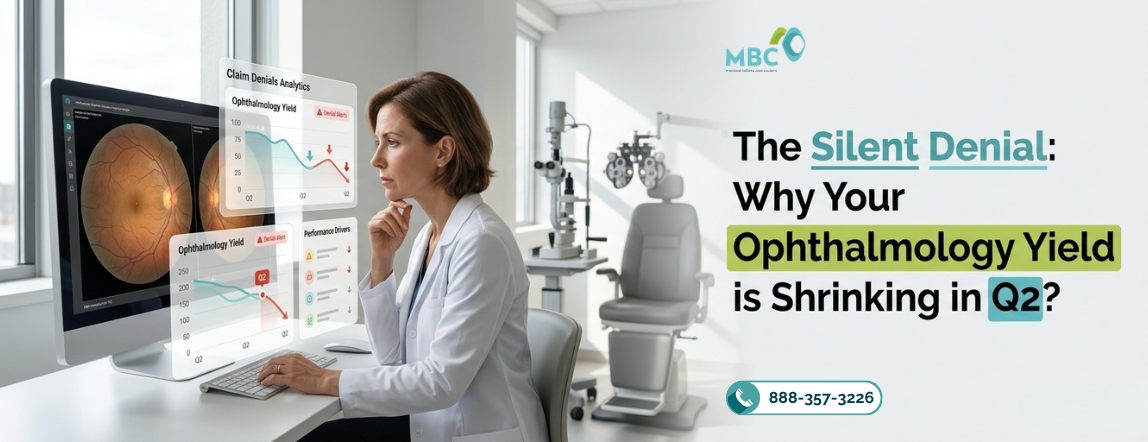
Your Ophthalmology Yield is shrinking in Q2 2026 because three structural forces — a CMS-mandated efficiency cut to surgical RVUs, an expanding prior authorization pilot across 10 states, and payer-driven underpayment tactics that never surface as formal denials — are quietly compressing your net revenue per case, even as patient volumes stay strong.
This is not a billing error. It is a policy-driven revenue problem that most practices are not catching in time.
The 11% Surgeon Payment Cut No One Warned Your CFO About
The biggest direct threat to your Ophthalmology Yield in 2026 is the CMS CY 2026 Medicare Physician Fee Schedule Final Rule (CMS-1832-F), effective January 1, 2026.
CMS applied a -2.5% efficiency adjustment to work RVUs for nearly all non-time-based CPT codes. For ophthalmology practices built on surgical volume, the impact is severe. The 2026 Medicare payment rate for cataract surgery (CPT 66984) dropped to $462.94 — an 11% decrease from the 2025 rate of $521.75, the largest single-year cut to this code in three decades, per ASCRS.
The logic: CMS argues surgeons get faster and more efficient over time, so reimbursement should drop accordingly. The reality: your overhead, staffing costs, and equipment expenses did not.
There is partial relief on the ASC facility side. After advocacy from the ophthalmology community, CMS corrected its preliminary error and finalized the 2026 ASC facility rate for CPT 66984 at $1,255.73 — a 3.4% increase. But that facility gain does not offset the surgeon payment loss for practices relying on professional fee income.
Prior Authorization Is Stalling Your Q2 Schedule
Starting January 19, 2026 (Phase 1) and February 16, 2026 (Phase 2), CMS launched a five-year ASC Prior Authorization demonstration targeting blepharoplasty and botulinum toxin injections — two high-volume ophthalmology procedures — in 10 states: California, Florida, Tennessee, Pennsylvania, Maryland, Georgia, New York, Texas, Arizona, and Ohio.
This directly impacts your Ophthalmology Yield if your ASC is in any of these states. The mechanics matter: participation is technically voluntary, but opting out means your claims go to prepayment review — and if the ASC claim is denied, associated professional claims are also denied.
UTNs (Unique Tracking Numbers) are valid for only 120 days. Practices without a clean PA workflow are already seeing scheduling delays and increased Days in AR entering Q2.
The Underpayment That Never Shows as a Denial
This is where the real Ophthalmology Yield loss hides. Payers in 2026 are increasingly using automated edits to quietly reduce payments rather than issue clean denials. Your team sees a “paid” status. The claim closes. No one appeals.
Common silent underpayment patterns in ophthalmology right now:
- Laterality mismatches (right vs. left eye) triggering single-eye payment when both were treated
- Modifier -25 documentation gaps causing E/M downcoding without a denial notice
- Frequency limit enforcement on OCT and visual field testing with no rejection — just a reduced allowable
- CPT 92284 vs. 92288 dark adaptation code confusion resulting in incorrect reimbursement
Without real-time coding audits and payer trend tracking, these losses compound quietly across hundreds of claims per quarter.
2025 vs. 2026 Ophthalmology Reimbursement Snapshot
| Procedure | CPT Code | 2025 Medicare Rate | 2026 Medicare Rate | Change | Driver |
| Cataract Removal (Facility) | 66984 | $521.75 | $462.94 | -11% | Efficiency adj. + PE RVU cut |
| ASC Facility Rate – Cataract | 66984 | $1,215 (approx.) | $1,255.73 | +3.4% | APC correction post-advocacy |
| Blepharoplasty (Facility) | 15820 | Varies | +15% ASC facility rate | +15% (ASC) | APC reclassification |
| MIGS Procedures | 66989/66991 | Device-intensive pending | Device-intensive confirmed | Improved | APC 5493 designation |
Sources: ASCRS 2026 MPFS Final Rule Summary; Ophthalmology Management, March 2026
What This Means for Multi-Site and ASC-Heavy Practices
If your group runs multiple ASCs or has high cataract and blepharoplasty volume, the 2026 payment geometry hits you on two fronts simultaneously: surgeon fees drop while PA administrative burden rises. The practices absorbing this quietly are the ones without a revenue integrity partner reviewing payer behavior at the claim level — not just submitting and posting.
Specialty-Specific RCM built for ophthalmology approaches this differently. It means your coding team knows the difference between CPT 92284 and 92288 before a claim is submitted. It means your PA workflow is built into scheduling, not handled reactively after a claim is denied. And it means your CFO sees Days in AR by procedure type and payer — not just a monthly summary.
Generic medical billing services were not built for an environment where an 11% payment cut on your highest-volume code arrives alongside a new five-state PA pilot. Ophthalmology billing services designed specifically for this specialty operate with that reality built in from day one.
What You Should Audit Before Q2 Closes
Three areas where Ophthalmology Yield is most recoverable right now:
- Cataract professional fee capture: Are your facility and professional claims correctly separated, and is your site-of-service documentation supporting the correct PE RVU allocation?
- Blepharoplasty PA compliance: If you are in one of the 10 PA pilot states, do you have a UTN on every applicable ASC facility claim for dates of service after January 19 or February 16, 2026?
- Silent underpayment review: When did you last compare contracted allowables to posted payments for your top 15 CPT codes by volume? If the answer is “last quarter,” that gap is costing you.
This is exactly what revenue integrity solutions address — and it requires the kind of payer-specific, code-level analysis that takes internal teams months to build, if they build it at all.
Take Control of Your Ophthalmology Revenue Before Q2 Ends
MBC’s ophthalmology-specialized RCM services team is identifying six-figure revenue recovery opportunities for multi-site practices right now — across cataract coding, PA compliance, and silent underpayment patterns.
Request a complimentary 90-Day Revenue Diagnostic and find out exactly where your Ophthalmology Yield is leaking — before it shows up on your year-end balance sheet.
Call: 888-357-3226 | Email: info@medicalbillersandcoders.com
FAQs
CMS finalized an 11% reduction in the Medicare payment rate for CPT 66984 (cataract surgery) — from $521.75 to $462.94 — driven by a -2.5% efficiency adjustment to work RVUs and a cut to indirect practice expense RVUs for facility-based services, per the CY 2026 MPFS Final Rule (CMS-1832-F).
The 10 states are California, Florida, Tennessee, Pennsylvania, Maryland, Georgia, New York (Phase 1 — effective January 19, 2026) and Texas, Arizona, and Ohio (Phase 2 — effective February 16, 2026), per CMS’s official ASC PA demonstration.
A silent denial is when a payer pays a reduced amount — due to laterality errors, modifier gaps, or frequency limits — without issuing a formal denial. The claim shows as “paid,” so it is never appealed, and the revenue is permanently lost.
No. The ASC facility rate for CPT 66984 was corrected to $1,255.73 for 2026 — a 3.4% increase over 2025 — after advocacy from the ophthalmology community identified a CMS calculation error in the preliminary rate.
Specialty-specific ophthalmology billing services provide real-time denial pattern detection, PA workflow integration, and payer contract auditing — catching silent underpayments and coding errors before they permanently reduce your net collection ratio, unlike general-purpose billing vendors.
Source: CMS ASC Prior Authorization Demonstration — Official CMS Page

With almost 12 years of experience in healthcare revenue cycle management, this Revenue Cycle Specialist brings deep expertise in medical billing, claims optimization, and practice profitability. Shares industry-backed insights focused on improving collections, reducing denials, and driving operational excellence.