Specialities
 Services
 Resource Center
 Pricing
 About
About
 Contact
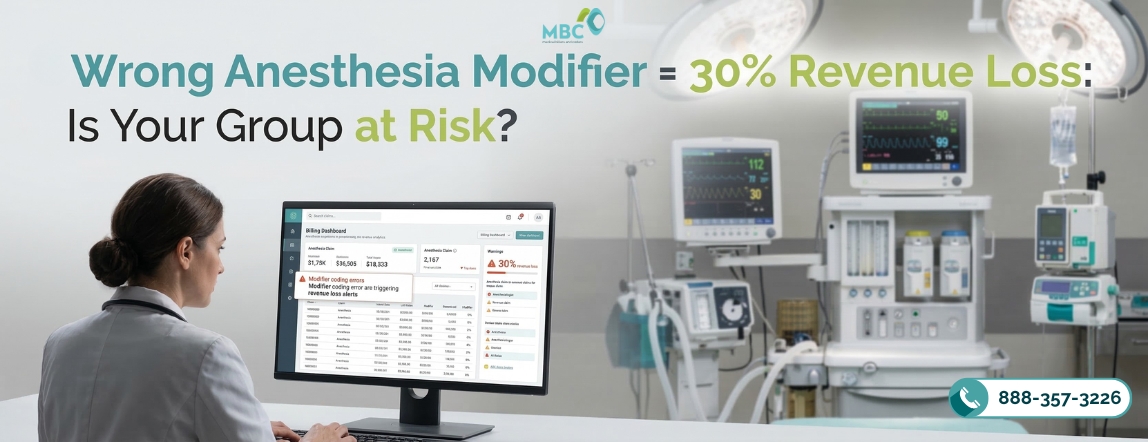
Yes — a wrong anesthesia modifier can directly trigger 30% or greater revenue loss for your group through immediate claim denials, medical direction downcodes, and retroactive payer clawbacks on cases already closed.
For multi-provider anesthesia groups and hospital-based practices operating in 2026, modifier precision is not a billing department concern — it is a CFO-level margin protection issue.
The stakes escalated further when CMS released the CY 2026 Physician Fee Schedule Final Rule (CMS-1832-F), effective January 1, 2026.
The rule established a two-tier anesthesia conversion factor — $20.5998 per unit for Qualifying APM Participants and $20.4976 for all others — while also applying a –2.3% cut to practice expense and malpractice components. In that margin-compressed environment, even a single modifier field error triggers a revenue event your group cannot afford to absorb silently.
The Three Modifier Errors Destroying Anesthesia Group Margins
Most anesthesia modifier errors revenue loss traces back to three structural failures — not random typos.
1. Undetected Concurrency Threshold Breach
Medical direction (Modifier QK) covers up to four concurrent cases. The moment a fifth case opens before one of the four closes, CMS rules require all affected cases to convert to medical supervision — billed under Modifier AD, which pays only three base units plus one additional unit if present at induction.
No time units. No 50% split. For a six-OR group running 5,000 cases annually, a single unmonitored overlap costs $15,000–$22,000 per quarter in collapsed reimbursement. According to the CMS NCCI Policy Manual 2026, Chapter II, this rule applies to CPT codes 00100–01999 without exception.
2. Missing or Incomplete Seven-Step Medical Direction Documentation
Using QK or QY is a legal attestation that the anesthesiologist completed all seven CMS-mandated steps of medical direction, as defined in the Medicare Claims Processing Manual, Chapter 12, Section 50.
Failure to document even one step — a missed post-anesthesia care note, an undocumented induction presence — converts the case to medical supervision retroactively during audit. Payers do not require a billing error on the original claim. They require documentation proof at the time of review.
3. Physical Status Modifier Omission on High-Acuity Cases
ASA Physical Status modifiers (P1–P6) in the second modifier field do not drive Medicare reimbursement directly, but they establish medical necessity for complexity and are required documentation for commercial payer contracts that do pay differentially by P-status.
Omitting P3 or P4 on eligible cases suppresses contract-negotiation leverage and creates a documentation gap that commercial payers use to justify denial or downgrade.
Modifier Decision Framework: What Each Code Actually Pays
| Anesthesia Modifier | Clinical Scenario | CMS Payment Rate |
| AA | Anesthesiologist personally performed | 100% of allowed rate |
| QK | Medical direction of 2–4 concurrent cases | 50% to physician |
| QY | Medical direction of 1 CRNA or AA | 50% to physician |
| QX | CRNA/AA under medical direction | 50% to CRNA/AA |
| QZ | CRNA without medical direction | 100% to CRNA |
| AD | Supervision — more than 4 concurrent cases | 3 base units only; no time units |
Source: CMS Medicare Claims Processing Manual, Chapter 12 and CMS NCCI Policy Manual 2026
The column that destroys margin is the last one. Modifier AD is not a coding nuance — it is the financial penalty for exceeding a concurrency threshold that most groups track reactively, not in real time.
The 2026 Regulatory Context: Why Modifier Accuracy Is Non-Negotiable Now
The ASA responded to the CY 2026 Final Rule by noting the net anesthesia conversion factor update is only 0.88% for non-APM practitioners — far below the inflationary cost curve anesthesia groups are operating against.
With the American Society of Anesthesiologists projecting a shortage of 12,500 anesthesiologists by 2033, CRNA utilization and the medical direction billing model are becoming the operational standard for high-volume groups.
This makes QK/QX/QY modifier precision the single highest-leverage point in your revenue cycle — and the most frequently exploited gap by payer audit teams.
Groups still using internal billing teams without real-time concurrency monitoring are submitting claims against assumptions that no longer match what CMS is auditing for.
What Enterprise-Grade Anesthesia Billing Services Actually Do Differently
Generic medical billing services flag modifier errors after denial. Specialized anesthesia billing services prevent them before the claim touches a payer. The operational difference translates directly to Net Collection Ratio outcomes:
- Pre-submission concurrency monitoring — real-time OR log integration that catches the fifth concurrent case before the claim is built, not during a 90-day audit cycle.
- Seven-step documentation verification — claim-level review against the medical record confirming each of the seven CMS medical direction criteria is documented before QK or QY is applied.
- Physical status protocol enforcement — systematic P-modifier assignment based on documented comorbidities, ensuring high-acuity commercial cases carry the complexity indicators that support contract-rate reimbursement.
These capabilities are what separates a true revenue integrity partner from a transactional billing vendor. Groups averaging 85–89% Net Collection Ratio are almost always running without one of these three safeguards in place.
Deploying specialized RCM services with anesthesia-specific infrastructure consistently moves multi-provider groups from the 85–89% NCR range to 94–97% — a gap that represents $400,000–$600,000 in annual recovered revenue for a group billing $5M.
Request Your Anesthesia Modifier Risk Assessment
If your group’s case volume is growing but your Net Collection Ratio is flat — or if you’ve had a concurrency-related denial in the last 90 days — the modifier infrastructure supporting your claims is likely the source.
MBC’s Anesthesia Center of Excellence conducts a focused modifier audit across your last 90 days of claims, identifying QK-to-AD conversion events, seven-step documentation gaps, and physical status omissions with dollar-impact quantification.
Request Your 90-Day Anesthesia Modifier Risk Assessment
FAQs
QK pays 50% of the allowed rate to the directing anesthesiologist across all medically directed cases. AD pays only three base units total with no time units — a reduction that can exceed 60–70% of expected reimbursement on a complex, high-acuity case.
Per the CMS NCCI Policy Manual 2026, Chapter II, an anesthesiologist may medically direct up to four concurrent procedures performed by CRNAs or AAs. Directing a fifth simultaneously — even briefly — converts all affected cases to medical supervision for the physician’s billing portion.
As defined in CMS Claims Processing Manual, Chapter 12, Section 50: pre-anesthetic exam, anesthesia plan prescription, participation in the most demanding procedure phases including induction and emergence, ensuring a qualified individual performs any undirected portions, frequent interval monitoring, physical availability for emergencies, and documented post-anesthesia care.
Yes, using Modifier QZ, a CRNA who performs the service without medical direction bills and receives 100% of the allowed rate. State opt-out regulations — currently applicable in 14 states per CMS — govern whether physician supervision is required at all; in opt-out states, QZ is the standard billing path for independent CRNA practice.
Physical status modifiers belong in the second modifier field, following the pricing modifier (AA, QK, QY, etc.) in the first position. Medicare treats them as informational. Most commercial payers, however, apply them in contract-rate calculations for high-acuity cases — making accurate P-modifier placement essential for multi-payer anesthesia billing services operations.
Sources:

With almost 12 years of experience in healthcare revenue cycle management, this Revenue Cycle Specialist brings deep expertise in medical billing, claims optimization, and practice profitability. Shares industry-backed insights focused on improving collections, reducing denials, and driving operational excellence.