

 Specialities
 Services
 Resource Center
 Pricing
 About
About
 Contact
Federal claims data shows roughly 84 percent of TCM-eligible discharges went unbilled in the most recent published analysis, with only 16 percent of 8.4 million eligible episodes receiving a billed TCM service between 2018 and 2019.
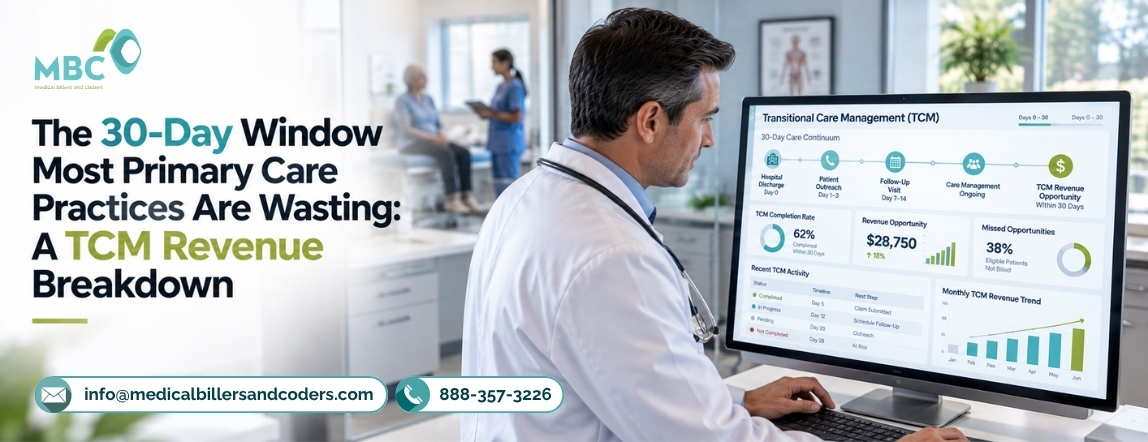
The 30-day window most primary care practices are wasting is the full Transitional Care Management service period itself, not just the visit inside it: national claims data shows the large majority of TCM-eligible discharges are never billed at all, and most groups that do capture the code stop at the visit without documenting the non-face-to-face care management minutes the same 30 days allow.
This kind of leakage shows up most in practices that manage primary care billing services in-house without a dedicated workflow for tracking the 30-day post-discharge clock.
What the 30-Day Period Actually Contains
TCM is not a single visit billed once. It is a 30-day service period covering three connected components: interactive contact within 2 business days of discharge, a face-to-face visit within 7 or 14 days depending on complexity, and ongoing non-face-to-face care management for the remainder of the period, including medication reconciliation, referral coordination, and caregiver communication.
The code reimburses the entire 30-day episode of coordination, not the appointment slot. A group that only captures the visit is billing a fraction of what the period is worth.
Practices that have already centralized their broader medical billing services typically fold TCM tracking into the same discharge-to-claim workflow instead of managing it as a separate task.
The National Utilization Gap
Federal claims research gives CFOs a clear benchmark for how much of this window goes unbilled across the industry. A 2018 to 2019 Medicare fee-for-service analysis found that of 8.4 million TCM-eligible discharges, only 16 percent received TCM services. A separate JAMA Health Forum analysis of 77 million Medicare discharges found that by 2019, just 11 percent of eligible patients received a billed TCM service, even after primary care follow-up rates had improved industry-wide.
That gap holds even at large primary care organizations with dedicated billing staff, because the failure point isn't clinical capability. It's the handoff between hospital discharge data, scheduling, and coding review inside a 30-day clock that most practice workflows aren't built to track.
Three Forces Behind the Wasted Window
The clock starts before the practice knows. The 2-business-day contact requirement begins at discharge, not when the practice receives notification, so any delay in the discharge feed shortens the usable window before staff act on it.
Non-face-to-face minutes go undocumented. Medication reconciliation calls, caregiver check-ins, and referral coordination performed during the 30 days often happen but never get logged against the TCM period, so the supporting documentation for the code is incomplete even when the work was done.
Capacity gets prioritized over the deadline. When the face-to-face visit competes with a full daily schedule, practices default to the next open slot rather than protecting a reserved window for TCM-eligible patients, and complexity-appropriate visits slip past day 7 or day 14.
Closing this kind of structural gap is usually a workflow problem rather than a coding one, which is why groups increasingly bring in outsourced RCM services to keep the discharge-to-claim handoff on schedule.
What This Costs an Enterprise Primary Care Group
For a 20-provider primary care group discharging 60 TCM-eligible patients each month, capturing TCM on only the national average of 16 percent of those discharges, instead of a realistic 60 percent capture rate achievable with a dedicated workflow, leaves more than 300 billable discharges uncoded every 12 months. At a blended CPT 99495 and 99496 average of roughly $250 per case, that gap represents over $75,000 in reimbursement left on the table every 12 months, before accounting for the downstream value of reduced readmissions in value-based contracts.
Note: illustrative revenue figures require Sampada's finance sign-off before publishing, per standard MBC dollar-figure sourcing rules.
Before deciding whether to build this tracking internally or outsource it, it helps to understand a typical medical billing pricing structure and how it compares to the reimbursement currently going uncaptured.
National TCM Utilization Benchmark
| Data Point | Finding | Source |
|---|---|---|
| TCM-eligible discharges billed (2018 to 2019) | 16% of 8.4 million eligible episodes | ASPE/HHS PTAC analysis |
| Eligible patients receiving TCM (2019) | 11% | JAMA Health Forum, 77 million discharge analysis |
| Dual-eligible beneficiary TCM billing rate | Under 10% of eligible discharges | Peer-reviewed hospital outcomes study |
| Practices billing TCM for at least one eligible patient | 45.6% of practices, averaging 22.6% of their own eligible volume | HHS CCM/TCM descriptive analysis |
Revenue at Stake by Group Size
| Group Size | TCM-Eligible Discharges per 12 Months | Revenue at Stake vs. National Average Capture |
|---|---|---|
| 10 providers | Approximately 360 | Requires finance sign-off |
| 20 providers | Approximately 720 | Requires finance sign-off |
| 50 providers | Approximately 1,800 | Requires finance sign-off |
Missing timestamps and incomplete non-face-to-face documentation are also common triggers for claim denials on TCM codes, since payers routinely scrutinize these claims for supporting detail.
Key Takeaways
- The 30-day TCM period is a full episode of reimbursable coordination, not a single visit, and most primary care groups only bill the visit portion.
- Federal claims analyses put national TCM capture at roughly 11 to 16 percent of eligible discharges, a gap that persists even at large, well-resourced practices.
- The failure point is structural: discharge data delays, undocumented non-face-to-face work, and scheduling that doesn't protect the 7-day and 14-day windows.
- TCM capture has downstream value beyond the CPT reimbursement itself, tied to readmission reduction in value-based and ACO contracts.
That downstream value is exactly what value-based care RCM services are built to capture, tying TCM completion to broader readmission-reduction metrics in ACO and shared-savings contracts.
A structured denial management process matters too, since TCM claims rejected for missing timestamps are often recoverable through appeal rather than written off as lost revenue.
MBC Spotlight
MBC's Enterprise Revenue Integrity Framework was built to close exactly this kind of structural gap: a discharge-to-claim workflow that tracks the full 30-day TCM period, not just the visit, with dedicated documentation protocols for non-face-to-face care management minutes. Groups on this framework see a 97% clean claim rate and a 30% reduction in Days in AR within 90 days, backed by 25+ years of specialty-specific RCM experience.
Many of the same recently discharged patients are also eligible for chronic care management billing in the months that follow, extending the reimbursable relationship well beyond the 30-day TCM window.
Request a Financial Yield Assessment to quantify how much of your group's TCM-eligible discharge volume is currently going unbilled.
