

 Specialities
 Services
 Resource Center
 Pricing
 About
About
 Contact
Yes, but unevenly. Organizations that deploy AI specifically for denial prevention, not just documentation or coding, report meaningfully fewer denials, while industry-wide denial rates continue rising because most AI investment is directed elsewhere in the revenue cycle management process.
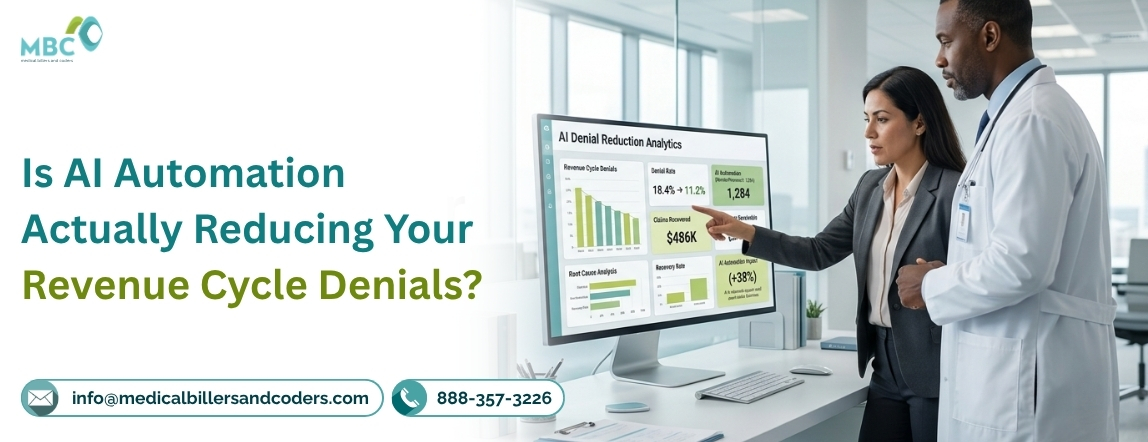
AI revenue cycle denial management is reducing denials, but only for the small share of healthcare organizations that have actually deployed it correctly; most facilities are still watching their denial rates climb while the technology sits in pilot mode. Hospital claim denials averaged 11.6% in 2025, driving an estimated $48.4 billion in revenue leakage across the industry in a single year, and the CMS Comprehensive Error Rate Testing (CERT) program reported a 6.55% Medicare Fee-for-Service improper payment rate totaling $28.83 billion in FY2025.
The gap between what AI promises on a vendor slide and what it delivers on a live claims floor is exactly where multi-site groups and PE-backed health systems are losing margin right now. For CFOs and revenue cycle management leaders evaluating whether to invest in AI-driven denial prevention, the honest answer is that it depends entirely on how the technology is deployed, governed, and staffed.
This article breaks down what the data actually shows, where AI is delivering measurable ROI, and where facilities are burning budget on automation that never touches the claims that matter most. Providers weighing this decision are also comparing it against the cost of outsourced medical billing services, since the two options increasingly overlap.
Why Denial Rates Are Rising Even as AI Adoption Grows
The uncomfortable pattern in 2026 is that AI adoption and denial rates are climbing together. Industry-reported figures put initial claim denials at 11.8%, up from 10.2% a few years earlier, even as roughly two-thirds of provider organizations report using some form of AI or automation somewhere in the revenue cycle. Only about 15% of those organizations report a positive return on that AI investment.
The disconnect comes down to where AI dollars are actually being spent. Industry-reported analysis of 2025 provider AI investment shows the overwhelming majority of budget going toward ambient clinical documentation and coding assistance, while only a small fraction is directed at denials management itself. In other words, most facilities have automated the parts of the revenue cycle that generate paperwork faster, not the parts that prevent a claim from being rejected in the first place.
Facility administrators frequently mistake "we bought an AI tool" for "we reduced our denials." Those are not the same investment, and treating them as interchangeable is how a $3M ambulatory facility ends up with a six-figure AI subscription and an unchanged Days in AR. It's also why more groups are pairing internal AI tools with specialty-certified medical billing services rather than replacing one with the other.
Where AI Denial Prevention Actually Moves the Needle
When AI revenue cycle denial management is implemented with proper governance (trained models, clean claims data, and staff who can act on the output), the results are measurable. Industry-reported data shows organizations using AI for denial reduction report meaningfully fewer denials or more successful resubmissions, and predictive analytics deployments have been associated with 20% to 30% reductions in denial rates. Some scaled AI revenue cycle operations report sub-15% denial rates and accelerated Days in AR against national averages closer to 12% to 15% denial rates and 45 to 50 days in AR.
The mechanism matters more than the marketing. Effective AI denial prevention operates upstream of claim submission, not after. That means:
Real-time eligibility and benefits verification that flags coverage gaps before the encounter happens, rather than after the claim bounces back 30 days later. Predictive denial scoring at the claim level, which routes high-risk claims to human review before submission instead of after payer rejection.
Natural language processing that cross-references clinical documentation against payer medical necessity criteria, catching the documentation gaps that trigger the majority of preventable denials. Automated appeal drafting that shortens the rework cycle on claims that do get denied, without replacing the physician-level judgment that complex appeals still require.
Facilities that treat AI as a triage layer feeding an experienced, credentialed human team consistently outperform facilities that treat AI as a replacement for that team. The average cost to rework a single denied claim runs from roughly $25 for straightforward cases to well over $57 for complex ones, once staff time, resubmission delays, and write-off risk are factored in, which is precisely the cost AI is supposed to prevent, not just process faster.
What "AI-Powered" Actually Means for Your Facility's Bottom Line
For a multi-OR facility or multi-site group evaluating vendors, the specific capability of an AI tool matters more than whether a vendor uses the term "AI" in a sales deck. The comparison below reflects the operational difference between generic automation and denial management infrastructure built to actually prevent revenue leakage.
|
Capability |
Generic Automation |
Denial Management Infrastructure |
|
Eligibility verification |
Batch checks, often post-encounter |
Real-time verification before the encounter |
|
Denial prediction |
Reactive: flags issues after payer rejection |
Predictive scoring before claim submission |
|
Documentation review |
Manual spot-checks |
NLP-driven review against payer medical necessity criteria |
|
Appeal management |
Templated letters, minimal tracking |
AI-drafted appeals with physician oversight and overturn analytics |
|
Reporting |
Monthly denial summaries |
Real-time dashboards with root-cause and payer-specific trending |
|
Human oversight |
Minimal, reactive |
Continuous, with credentialed coders reviewing high-risk claims |
The Governance Gap No One Talks About
HHS-OIG has increasingly scrutinized automated claims and coding systems for accuracy and compliance risk, and facilities deploying AI without a documented human-in-the-loop review process are exposed on two fronts simultaneously: unresolved denials and audit risk.
An AI model trained on incomplete or biased historical claims data will replicate, and sometimes accelerate, the same coding errors that created denials in the first place. Facilities need documented oversight protocols, not just a dashboard, before treating AI output as production-ready.
This is the piece most vendor pitches skip. Reducing your denial rate 10% while increasing your OIG audit exposure is not a win for a CFO managing enterprise risk. Real denial reduction infrastructure pairs the technology with specialty-certified coders who can validate what the model flags, correct what it misses, and maintain the audit trail regulators expect.
Building an AI-Enabled Denial Prevention Strategy That Actually Works
The facilities seeing genuine denial reduction aren't the ones that bought the most sophisticated software. They're the ones that paired predictive technology with revenue cycle infrastructure built around their specific payer mix, service lines, and documentation patterns.
That combination, not the AI label alone, is what moves Net Collection Ratio and Days in AR in a direction a CFO can defend to a board. This is the same infrastructure MBC applies across its medical billing and coding services, regardless of specialty.
MBC's approach layers real-time claim scrubbing and predictive denial scoring on top of specialty-certified coding teams, so every high-risk claim gets both machine-speed triage and human-level judgment before it reaches a payer. That combination is what separates a 10% denial reduction from a 30-40% one.
Request a Facility Yield Audit to identify exactly where your current claims process, AI-enabled or not, is leaking revenue before you sign another vendor contract.
Phone: 888-357-3226 | Email: info@medicalbillersandcoders.com
Facilities researching denial trends by specialty can also review MBC's specialty-specific revenue cycle services or check state-specific billing regulations that affect payer behavior in their market. For a breakdown of engagement models, visit the pricing page.
