



Yes. Reputable medical billing companies provide monthly collection reports and performance analytics as a standard deliverable. At minimum, you should receive a net collection rate, AR aging breakdown, denial rate by payer, and clean claim rate every month. If your billing company does not provide these reports automatically, unprompted, on a fixed schedule — that is not a reporting gap, it is an accountability gap.
Why Monthly Reporting Is Not Optional
Revenue cycle management is not a set-and-forget function. Every month without structured reporting is a month in which denial patterns compound, aging AR drifts past the 120-day recovery window, and payer-specific underpayments go undetected. A billing company that does not report monthly is not managing your revenue cycle — it is processing your claims and hoping you do not notice the difference.
The operational reality is this: payer contracts change, claim adjudication logic shifts with code updates, and authorization rules tighten without notice. Monthly analytics are the only mechanism by which a practice administrator or CFO can confirm that the billing company's performance is moving in the right direction — or catching a problem before it becomes a write-off.
Medical Billers and Coders delivers a structured performance analytics package to every client on a monthly cadence, without waiting to be asked. The reports are benchmarked against specialty-specific standards — not generic national averages that obscure how a dermatology practice differs from an orthopedic group in collection dynamics.
The Seven Reports Your Billing Company Should Deliver Every Month
Not all reports are equal. The following seven are the minimum acceptable standard for any billing organization managing collections above $1M annually.
Monthly Reporting Minimum Standard
1. Net Collection Rate Report
Payments collected as a percentage of allowable charges after contractual adjustments. This is the single most important metric in your revenue cycle. It should be benchmarked against your specialty, not a generic industry average.
2. AR Aging Report — Five-Bucket Waterfall
Balances segmented into 0-30, 31-60, 61-90, 91-120, and 120+ day buckets, shown as both dollar value and percentage of total AR. The 120+ day trend is your early warning signal for systemic denial or follow-up failure.
3. Denial Rate Report by Payer and Reason Code
Denial percentage broken out by insurance payer and by denial reason code (CO-4, CO-97, PR-96, etc.). An aggregate denial rate with no payer segmentation tells you nothing actionable.
4. First-Pass Acceptance Rate (Clean Claim Rate)
Percentage of claims accepted by the payer on the first submission without rejection or denial. Industry standard is 96% or above. Below 93% indicates upstream coding or eligibility verification failures.
5. Payer Mix and Collections Analysis
Revenue distribution by payer category (Medicare, Medicaid, commercial, self-pay) alongside collection performance per payer. Payer mix shifts quietly and materially affect average reimbursement per encounter.
6. Procedure-Level (CPT) Collection Performance
Payment rates by CPT code against contracted fee schedule allowables. This surfaces underpayment patterns — payers routinely pay below contracted rates on specific codes, and without CPT-level reporting, it is invisible.
7. Year-over-Year and Month-over-Month Trending
A single month's data is context-free. Trending across 12 months reveals seasonal collection patterns, the impact of payer contract renegotiations, and whether corrective actions are producing measurable improvement.
Industry Benchmarks: What the Numbers Should Actually Look Like
Reporting without benchmarks is noise. The table below reflects performance standards drawn from MBC's 25+ years managing revenue cycles across seven core specialties. Use these as the baseline against which your billing company's reported numbers should be evaluated.
| Metric | High Performance | Acceptable | Requires Intervention |
| Net Collection Rate | 95% or above | 90–94% | Below 90% |
| First-Pass Acceptance Rate | 96% or above | 93–95% | Below 93% |
| Claim Denial Rate | Below 5% | 5–10% | Above 10% |
| AR Over 120 Days (% of Total AR) | Below 10% | 10–15% | Above 20% |
| Days in AR | Below 35 days | 35–45 days | Above 50 days |
| Appeal Success Rate | Above 85% | 70–85% | Below 65% |
| Underpayment Recovery Rate | Above 90% | 75–90% | Below 70% |
These benchmarks apply across specialties as a baseline. Family medicine and primary care typically carry higher denial rates from complex payer mix. Orthopedics and ASC billing carry higher risk of authorization-related denials. A billing company that cannot tell you how your metrics compare to your specialty peer group is not providing analytics — it is providing data entry.
Understanding the AR Aging Waterfall
AR aging is the most abused metric in medical billing reporting because it can be presented in a way that conceals how badly a practice's cash flow is deteriorating. The correct way to read AR aging is as a waterfall: money should flow rapidly through the early buckets and the 120+ day bucket should represent a small fraction of total outstanding balances.
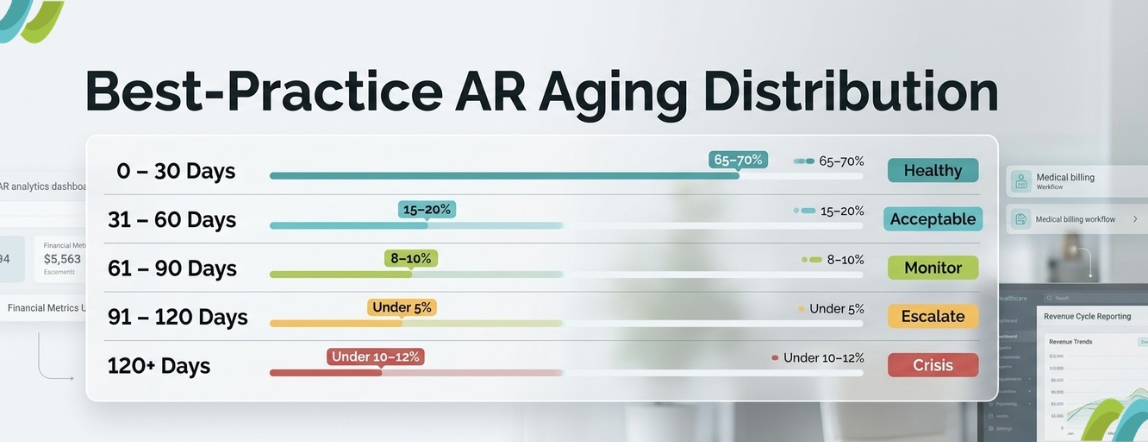
When 120+ day AR exceeds 15–20% of total AR, the practice is losing recoverable revenue every month. Claims in this bucket have a materially lower recovery rate and many payers impose filing limit deadlines that extinguish the right to collect entirely.
The Gross vs. Net Collection Rate Problem
One of the most common ways a billing company's reporting obscures poor performance is the use of gross collection rate instead of net collection rate. These are not interchangeable metrics and a billing company that reports one while burying the other is not giving you an accurate picture of performance.
Gross collection rate measures payments collected as a percentage of gross charges billed — charges that were never meant to be collected at their billed amount because contractual adjustments reduce them before collection begins. A practice with a high gross collection rate can still have catastrophic revenue loss.
Net collection rate measures what was actually collected against what the practice was contractually entitled to collect after adjustments. This is the metric that tells you whether your billing company is recovering every dollar it should. Practices should receive a 95%+ net collection rate from a high-performing billing partner. Anything below 90% should trigger an immediate conversation about where revenue is being lost and why.
Red Flags in Billing Company Reporting
- Reporting gross collection rate but not net collection rate in monthly summaries
- AR aging reports that stop at the 90-day bucket and exclude 91-120 and 120+ day balances
- Denial reports that show total denials but no payer-level or reason-code breakdown
- Monthly reports delivered without commentary, trending, or action items
- Inability to provide raw data export on request — your data belongs to your practice
- Reports that show charges and payments but omit adjustment detail, making net calculation impossible
- Performance reports that arrive more than 15 days after month close
- No specialty-specific benchmarking — comparing your orthopedic practice to a national "all specialties" average is analytically meaningless
What Specialty-Specific Benchmarking Looks Like in Practice
Generic benchmarks do not hold when specialty billing dynamics diverge significantly. A denial rate that would be acceptable for a family medicine practice is catastrophic for an ASC. Days in AR for a wound care practice will differ materially from an optometry group because of the payer mix and authorization requirements in each specialty.
MBC manages billing across seven core specialties — ASC, Dermatology, Family Practice, OB-GYN, Optometry, Orthopedic, and Wound Care — and each specialty's performance analytics are calibrated against actual peer-group data, not national averages that flatten specialty-specific patterns into noise.
When requesting monthly analytics from your billing company, ask specifically: "Are these benchmarks drawn from my specialty, or from a general industry average?" If the answer is general industry, your performance picture is being evaluated against the wrong baseline.
Questions Every Practice Administrator Should Ask Before Signing a Billing Contract
The time to establish reporting expectations is before a billing relationship begins — not after a year of receiving summary PDFs that cannot be exported or cross-referenced. Ask these questions during your evaluation process.
- What reports do you deliver monthly, and what is the delivery timeline after month close?
- Do you report net collection rate separately from gross collection rate?
- Can I access raw data exports from my account at any time, or only on your reporting schedule?
- Are denial rates broken out by payer and by denial reason code?
- Do you provide year-over-year trending, not just the current month snapshot?
- Are your benchmarks specialty-specific or general industry averages?
- Who interprets the reports — do I receive analysis alongside the numbers?
- What happens to my historical reporting data if I terminate the contract?
How MBC Structures Monthly Performance Analytics
Medical Billers and Coders (MBC) delivers monthly performance analytics on a fixed schedule, no later than the 10th business day after month close.
The package includes a net collection rate benchmarked against the client's specialty, a five-bucket AR aging waterfall with month-over-month trending, a denial rate analysis segmented by payer and reason code, a clean claim rate with root-cause commentary where rates fall below the 96% threshold, and a payer mix analysis highlighting any material shifts in reimbursement distribution.
Every client receives a dedicated billing manager who reviews the monthly report before delivery and flags any metrics requiring attention — not as an after-thought, but as a structured part of the monthly close process. The report is not a static PDF: clients receive data they can interrogate, export, and bring to their own finance or administrative teams.
For physician group owners and practice administrators evaluating billing partners, the willingness to deliver comprehensive, benchmarked, exportable analytics on a fixed schedule is one of the most reliable signals of whether a billing company is genuinely accountable for performance — or simply processing claims and hoping the numbers hold.
See What Your Collections Are Actually Leaving Behind
MBC provides a no-obligation revenue cycle assessment — with specialty-benchmarked analytics — for practices evaluating their current billing performance.
Request Your Revenue Assessment
Medical Billers and Coders (MBC)
MBC is a national Revenue Cycle Management company with 25+ years of experience managing billing operations for physician groups, ambulatory practices, and health systems across all states. MBC specializes in ASC, Dermatology, Family Practice, OB-GYN, Optometry, Orthopedic, and Wound Care billing.
FAQs
1. Do billing companies provide monthly collection reports?
Reputable medical billing companies provide monthly collection reports as a standard deliverable. These reports should include gross charges, net collections, adjustment breakdowns, denial rates by payer, AR aging by bucket (30/60/90/120+ days), and clean claim rates. If your billing company does not provide monthly reporting automatically — without you asking — treat that as a serious accountability problem, not a minor administrative gap.
2. What is a good net collection rate for a medical practice?
A net collection rate of 95% or above is the industry benchmark for a high-performing medical practice. Rates below 90% indicate systemic revenue loss in the billing cycle. Net collection rate is calculated as: (Payments Received / (Gross Charges minus Contractual Adjustments)) x 100. A billing company that does not proactively report this figure monthly should be asked directly — and one that cannot explain a sub-95% rate is not managing your revenue cycle effectively.
3. What is a good denial rate for medical billing?
Industry standard for medical claim denial rates is below 5%. A denial rate above 10% indicates systemic coding, eligibility, or authorization failures. High-performing billing organizations target a first-pass acceptance rate of 96% or higher. Denial rates should be reported monthly, segmented by payer and denial reason code, so root causes can be identified and corrected — not just appealed repeatedly.
4. What is the difference between gross collection rate and net collection rate?
Gross collection rate measures payments collected as a percentage of gross charges billed — it includes contractual write-offs and is not a useful standalone metric. Net collection rate measures payments collected against what the practice was actually entitled to collect after contractual adjustments, making it the definitive indicator of billing performance. A practice with a 60% gross collection rate and a 97% net collection rate is performing well. A practice with a 95% gross collection rate and an 88% net collection rate has a serious uncaptured revenue problem.
5. What AR aging benchmark should a medical practice maintain?
Best-practice AR aging benchmarks: 0–30 days should hold 65–70% of total AR; 31–60 days should hold no more than 15–20%; 61–90 days should hold no more than 8–10%; 91–120 days should hold under 5%; and 120+ days should hold under 10–12% of total AR. When 120+ day AR exceeds 15–20% of total AR, it typically indicates a denial management or follow-up failure that is compounding monthly — and claims in this bucket have a materially lower recovery probability.
6. How do I know if my billing company is hiding poor performance?
Warning signs that a billing company may be obscuring poor performance include: reporting gross collection rate instead of net collection rate; AR aging reports that exclude 90+ day balances; no denial rate breakdown by payer or reason code; monthly reports delivered without context or trending; inability to export raw data on request; and reports that show only charges and payments without adjustment detail. If your billing company cannot produce a specialty-benchmarked net collection rate, a payer-level denial report, and an AR aging waterfall on demand, treat that as a reporting failure — not a reporting gap.
7. How often should I review billing performance reports with my billing company?
Monthly review is the minimum. High-volume practices — those processing more than 500 claims per month — benefit from bi-weekly check-ins that surface denial spikes or AR aging deterioration before they compound. Quarterly strategic reviews should assess payer contract performance, underpayment patterns, and year-over-year collection trends. The billing company should be initiating these reviews, not waiting to be scheduled.