

 Specialities
 Services
 Resource Center
 Pricing
 About
About
 Contact
Request a sample executive dashboard, the vendor's written compliance program, their specialty-specific coding protocol for your highest-volume service lines, and a contract draft with defined clean claim rate SLAs.
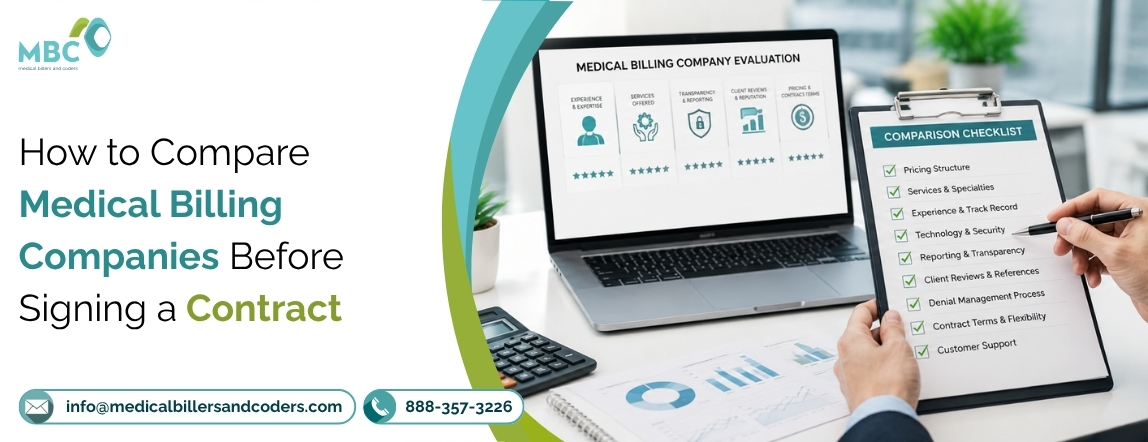
Most healthcare CFOs evaluate revenue cycle vendors the same way they evaluate a copier lease: compare the quoted rate, check a reference or two, sign. For a multi-site group or a PE-backed platform processing tens of millions in annual claims, that approach is how facilities end up locked into a three-year contract with a vendor that cannot explain its own denial trends. Choosing how to compare medical billing companies is a margin decision, not a procurement task.
The wrong vendor does not simply under-perform. It embeds itself into your claims workflow, your payer relationships, and your compliance exposure for the length of the contract, and unwinding a bad fit mid-term costs a facility months of disrupted cash flow. Before you sign anything, you need a structured way to compare medical billing companies against the operational realities of a high-volume, multi-specialty enterprise, not against a rate sheet.
A thorough medical billing company evaluation looks past the sales pitch and into how a vendor actually operates day to day: what its coders know about your specialties, what its compliance program looks like on paper, and how its technology talks to your existing systems. Facilities that skip this step tend to discover the gaps only after go-live, when denial patterns and reporting blind spots start showing up in the numbers.
Why the Standard Way to Compare Medical Billing Companies Falls Short
Most RFP processes for medical billing services reduce the decision to a single variable: cost per claim or percentage of collections. That framing hides the two things that actually determine ROI: claim acceptance performance under your specific payer mix, and how the vendor's infrastructure scales as case volume grows.
A facility comparing vendors purely on price is comparing quotes, not capability. The better approach to any revenue cycle management vendor selection is to weigh a fixed set of operational criteria and let cost fall out as one input among several, not the deciding one.
Financial Transparency and Reporting Depth
The first test when you compare medical billing companies is whether they will show you their numbers before you sign, not after. Ask for a sample of the executive dashboard you would actually receive: Net Collection Ratio trended by month, Days in AR by payer, denial rate by CPT family, and write-off detail broken out by reason code.
A vendor that offers only a monthly PDF summary is telling you, in advance, how much visibility your CFO will have once the contract is live. Enterprise groups should require real-time or near-real-time access, not a static report generated on the vendor's schedule.
Ask, too, how the vendor handles month-end close and how quickly a facility-level anomaly gets escalated to a human being rather than sitting in a dashboard nobody reviews. A reporting platform is only as useful as the accountability process built around it, and vendors that cannot describe who owns that escalation internally are unlikely to catch problems before they compound.
Specialty-Specific Coding Expertise
Generic billing companies market "experienced coders" without specifying experience in what. When you compare medical billing companies for a multi-specialty group, ask each vendor to walk through their coding protocol for your highest-volume, highest-complexity service lines: implant-heavy orthopedic cases, high-acuity ASC procedures, or E/M coding under current documentation guidelines.
A vendor without a documented, specialty-specific coding methodology will default to generalist handling, and generalist handling is where bundling errors and modifier mistakes originate. This is also where a facility should ask each finalist for a real medical billing company evaluation of past performance in your specialty mix, not a generic client list.
Compliance Infrastructure and OIG Alignment
Every third-party billing vendor operates under the same regulatory exposure your organization does. The Department of Health and Human Services' Office of Inspector General maintains dedicated compliance program guidance directed specifically at third-party medical billing companies, flagging risk areas such as unbundling, billing for non-covered services, and claims submitted for services that were never actually rendered (see References below).
When you compare medical billing companies, ask each finalist to produce their written compliance program, their internal audit cadence, and their process for self-reporting overpayments. A vendor that cannot produce this documentation is asking your facility to absorb compliance risk it has not itself planned for.
OIG's broader compliance program guidance also calls for role-specific training that addresses coding accuracy risks for billing staff, which is a reasonable baseline to hold any revenue cycle management vendor to before a contract is signed.
Technology Integration and OR/EHR Connectivity
For surgical and procedural specialties, the biggest source of revenue leakage is not coding error. It is disconnection between the OR log, the EHR, and the billing system.
Ask each vendor how their platform ingests implant and supply data directly from OR systems, and how quickly a documentation gap surfaces to a coder versus sitting unbilled for weeks. Vendors relying on manual data entry between systems introduce delay and error at exactly the point where high-dollar charges are most likely to be missed.
Also ask what happens during a system migration. Facilities switching EHR or practice management platforms need a vendor whose technology can adapt without a lapse in claim submission, and a vendor's answer to this question tells you a great deal about how they will handle change management once the contract is active.
Contract Terms, SLAs, and Exit Provisions
The final comparison point is the one most groups skip until it is too late: what happens if the relationship does not work. Review the contract for clean claim rate SLAs with defined remedies, data ownership and portability language, and a termination clause that does not trap your claims data with the outgoing vendor during a transition.
A vendor confident in its own performance will accept measurable SLAs; a vendor that resists them is signaling how the relationship will go under pressure.
|
Evaluation Criteria |
Generic RCM Vendor |
Internal Billing Team |
MBC Revenue Performance Management |
|
Reporting Visibility |
Monthly PDF summary |
Manual spreadsheet tracking |
Real-time executive dashboard with drill-down |
|
Specialty Coding Depth |
General coding staff |
Limited cross-specialty coverage |
Specialty-certified Centers of Excellence |
|
Compliance Documentation |
Generic policy template |
Ad hoc, owner-dependent |
Documented OIG-aligned compliance program |
|
OR/EHR Integration |
Manual data entry |
Rarely integrated |
Direct OR system and EHR connectivity |
|
Contract SLAs |
Vague or absent |
Not applicable |
Defined clean claim rate and AR benchmarks |
Summary
Comparing medical billing companies before you sign a contract means evaluating financial transparency, specialty-specific coding depth, compliance infrastructure, technology integration, and contract terms as a single decision, not five separate conversations.
Facilities that reduce the comparison to cost per claim tend to discover the real cost of the vendor relationship only after the contract is signed, when reporting gaps, coding errors, or unclear SLAs surface as margin erosion. A structured evaluation against these five criteria, applied consistently across every finalist, gives a CFO a defensible basis for the decision before, not after, the ink dries.
If your organization is currently evaluating vendors or reassessing an existing contract, MBC can help you apply this framework to your own facility data. Request a Facility Yield Audit to see how your current billing performance compares against enterprise benchmarks before you renew or sign anywhere.
Reach MBC's team at 888-357-3226 or info@medicalbillersandcoders.com, or review current medical billing pricing models to see how vendor cost structures compare across engagement types.
References:
