Specialities
 Services
 Resource Center
 Pricing
 About
About
 Contact
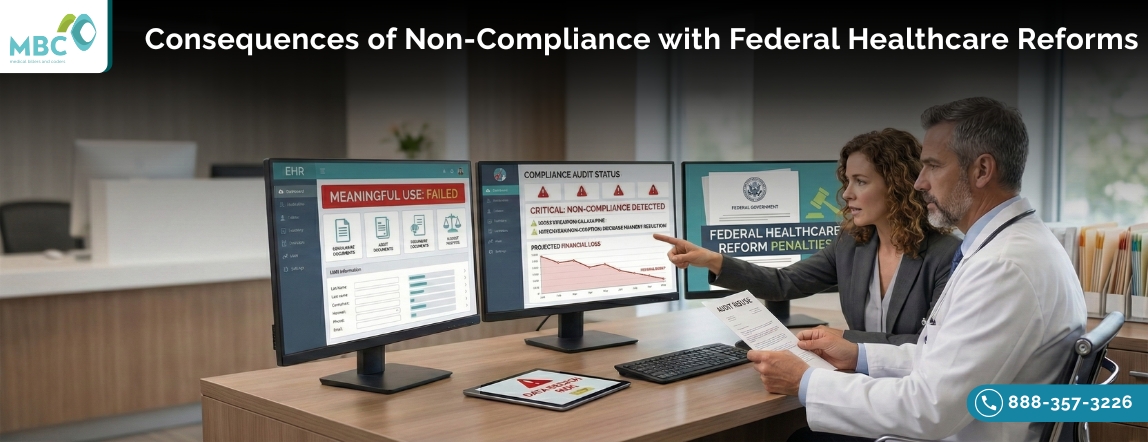
As if the imminent repercussions of the Debt ceiling and Sustainable Growth Rate Problem are not enough, physicians across the United States are in for an additional dose of disciplining by the Federal Health body, in terms of penalties – both civil as well as criminal penalties – for either negligent or willful defiance of reforms and their deadlines. Although physicians are justified in airing their reaction and treating it as too harsh, the move is seen as an additional shield for the imminent Federal healthcare reforms aimed at transforming the nation’s healthcare qualitatively.
Devising a multi-pronged penalty regimen, the Federal Government has identified mandatory programs that physicians must adhere to to avoid stringent penalties that could adversely impact their credibility in the medical fraternity.
HIPAA Violations and Enforcement
One of the areas where physicians are at risk of civil and criminal penalties is failure to comply with the HIPAA reporting mandate. Depending on the severity of negligence, the penalty can range from a minimum of $100 to $1.5 million and from 1 year to 10 years of imprisonment. Furthermore, the upcoming Version 5010 HIPAA Compliance – which is considered more complex than its earlier Version 4010 – could leave physicians highly vulnerable.
Non-adoption of Electronic Healthcare Reporting Compliance
Another area where physicians are liable to be penalized is failure to comply with Electronic Healthcare Reporting compliance as mandated by the Health Information Technology for Clinical Health, or HITECH Act. In parallel with incentives for EHR adoption, it can also penalize Medicare and Medicaid physicians who do not adopt EHRs or use them appropriately. The penalty regimen will start in 2015, penalizing Medicare physicians who do not meet meaningful criteria: 1 percent of Medicare-allowed charges in 2015, 2 percent in 2016, and 3 percent in 2017. Such impositions can hit solo and small physician practices hard, which may lack the resources to adopt health IT.
Imminent Repercussions of the Debt Ceiling and the Sustainable Growth Rate Problem
Putting more weight into the heavy baggage are the repercussions of imminent recommendation of Affordable Care Act – which has mandated implementation of Accountable Care Organization for incentive based payments for Medicare physicians; imminent fix to perennial Sustainable Growth Rate (SGR) problem – which forecasts either an across the board 2 percent cut to Medicare physicians, or writing off of cumulative (already around a negative 22 percent) against Medicare physician payments, which would virtually render them cashless; and last but not the least, the impact of Debt ceiling, which can limit healthcare funding substantially resulting in an adverse situation for physicians.
Physicians, left with no choice but to comply with the Federal healthcare reforms, will inevitably seek medical billing companies that can implement compliance programs as part of their comprehensive medical billing management.
Medical billers and coders, which has been an industry leader for over a decade, is ideally positioned to manage compliance programs on its clients’ behalf, with literally hundreds of AAPC-certified medical billers nationwide across all specialties who are tech-savvy, experienced, and constantly upgrading their professional knowledge and skills.
Along with these services, Medical billers and coders offer comprehensive consultancy for operational, strategic, and financial solutions to help you focus on your core competencies.
FAQs
Physicians may face civil fines, criminal penalties, reduced Medicare reimbursements, loss of credibility, and in severe cases, imprisonment for negligent or willful non-compliance with mandated federal healthcare programs.
HIPAA violations can result in penalties ranging from $100 to $1.5 million, along with possible imprisonment from 1 to 10 years, depending on the level of negligence or intent. Compliance with HIPAA Version 5010 further increases complexity and risk.
Physicians who fail to adopt or meaningfully use EHRs face Medicare payment reductions starting at 1% and increasing to 3%, which can significantly impact revenue—especially for solo and small practices.
These factors may lead to reduced healthcare funding, across-the-board Medicare payment cuts, or cumulative reimbursement reductions, creating severe financial strain for physicians.
Medical billing companies assist by managing compliance programs, ensuring accurate reporting, adopting required technologies, mitigating penalty risks, and providing strategic and financial guidance so physicians can focus on patient care.

Catering to more than 40 specialties, Medical Billers and Coders (MBC) is proficient in handling services that range from revenue cycle management to ICD-10 testing solutions. The main goal of our organization is to assist physicians looking for billers and coders, at the same time help billing specialists looking for jobs, reach the right place.