Specialities
 Services
 Resource Center
 Pricing
 About
About
 Contact
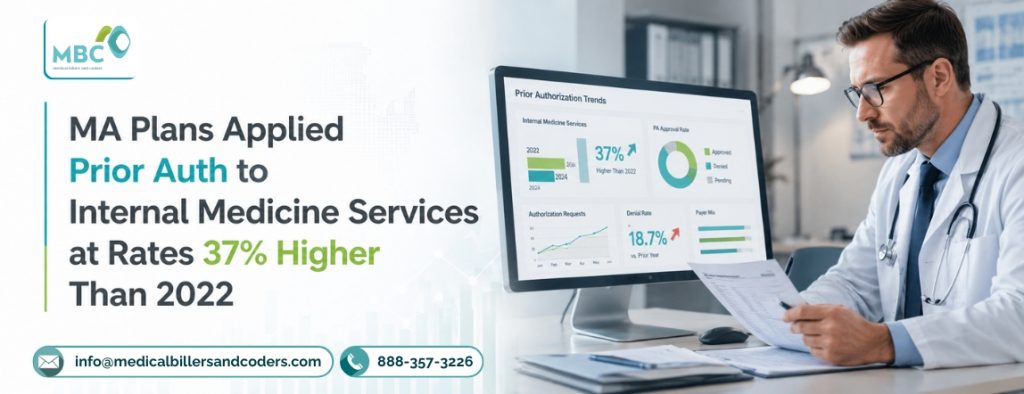
Yes — Medicare Advantage plans applied prior authorization requirements to internal medicine services at rates 37% higher than 2022, driven by expanded PA requirement lists, AI-assisted claim adjudication, and tighter chronic care and diagnostic service scrutiny that has fundamentally altered revenue predictability for high-volume primary care practices. For internal medicine groups operating on thin per-encounter margins, this is a structural threat to net realized revenue, requiring denial management built around MA plan behavior rather than generic payer workflows.
For a broader payer-behavior context, see Prior Auth Denial Trends 2026 and Payer-Specific Denial Patterns: How UHC and BCBS Are Denying Claims in 2026.
Why MA Plans Expanded Prior Authorization on Internal Medicine Services
Internal medicine sits at the center of the Medicare Advantage cost-containment strategy because internal medicine physicians order the downstream services — imaging, specialist referrals, diagnostic testing, chronic care management — that drive most MA plan spend. Restricting authorization at the internal medicine encounter level lets MA plans control utilization before it reaches more expensive specialty care.
Three structural shifts explain the 37% increase since 2022. First, MA plans expanded PA requirement lists annually without proportional notice — services requiring no authorization in 2022 now require it, and checklists not updated for 2025–2026 payer changes generate preventable denials on services practices have ordered for years. Second, AI-assisted adjudication systems now process requests in hours rather than days, but with denial rates significantly higher than those of human-reviewed decisions, shifting the burden from approval speed to appeal volume. Third, MA plans have compressed appeal and peer-to-peer review windows, leaving practices less time to contest denials before they convert to permanent write-offs.
For internal medicine-specific 2025–2026 billing pressures, see 6 Internal Medicine Billing Trends for 2025.
Where the Prior Authorization Pressure Concentrates
Chronic Care Management Documentation Triggers
CCM billing (CPT 99490, 99439, 99487) is under heightened MA scrutiny because internal medicine physicians manage multi-condition populations that generate the highest CCM volume. MA plans increasingly require documentation exceeding CMS time-threshold guidance — a denial root cause unrelated to whether care was delivered, and entirely about whether paperwork matches a stricter internal MA criteria set.
Diagnostic and Preventive Service Authorization
Internal medicine practices order high volumes of imaging, lab panels, and specialist referrals for routine chronic disease management. MA plans have placed pre-authorization on services previously authorization-free, with tighter response deadlines, and claims are denied outright when authorization isn’t secured in time, regardless of medical necessity. See Pre-Authorization in Medical Billing for the underlying process mechanics.
E/M Visit-Level Authorization Mismatches
High-complexity E/M visits, the core revenue driver for internal medicine, are increasingly subject to authorization data mismatch denials — where the authorization on file does not precisely match the billed service level. These require a corrected authorization request rather than a standard appeal; practices filing through the wrong process exhaust their appeal window without resolution.
The Three Prior Authorization Failure Patterns Driving Revenue Loss
Pattern 1 — Outdated PA Requirement Checklists: Staff order services without authorization because the PA list was not updated for the current MA rules. Not appealable on clinical grounds since authorization was never obtained. Revenue lost: $150 to $420 per denied encounter.
Pattern 2 — Compressed Appeal Window Misses: Denials are reviewed weekly or biweekly, while MA plans shorten appeal windows to as few as 14 days. By the time the denial reaches the queue, the window has closed. Recovery rate after expiration: near zero.
Pattern 3 — Authorization Mismatch Misrouted to Standard Appeal: Mismatch denials filed as standard appeals instead of the payer’s correction process. The claim is denied a second time on procedural grounds, exhausting both available remedies.
The Revenue Gap: Most Internal Medicine Practices Are Not Measuring
For a multi-provider group running 250 to 400 MA-covered encounters monthly, the prior authorization gap produces: outdated checklists (8% incidence) generating $36,000 to $134,400 in unrecoverable revenue; compressed appeal window misses adding $24,000 to $76,000; and mismatch claims misrouted to standard appeal contributing $18,000 to $54,000.
The aggregate gap per provider: $78,000 to $264,400 per 12 months — a figure that doesn’t register as a single denial category on a standard practice management report. It surfaces as declining MA-payer collections despite stable or growing patient panel size.
For how eligibility and authorization failures compound at the front end, see Eligibility Verification Automation: Why Physicians Are Adopting Digital Solutions.
How MBC Protects Internal Medicine Revenue from MA Prior Auth Pressure
MBC’s Internal Medicine Billing Services team maintains real-time prior authorization tracking by payer, updated continuously rather than annually, eliminating the outdated checklist failure pattern at its source. Our Denial Management infrastructure triages every prior authorization denial within 24 hours, immediately calculates the appeal window, and routes mismatch denials through the payer-specific correction process rather than the standard appeal path.
Our dedicated account manager benchmarks your MA denial rate against payer-specific norms, identifies which CCM and diagnostic categories generate the most friction, and structures Revenue Integrity reporting to separate authorization-driven denials from clinical and coding denials. For historical MA denials past the appeal window, our Old AR Recovery unit evaluates which claims remain viable under each payer’s grievance process while MBC’s forward billing team closes the structural gap.
With MBC’s 97% clean claim rate and a proven 30% A/R reduction within 90 days, internal medicine practices regain predictable MA-payer revenue instead of absorbing it as an unmeasured cost of doing business with Medicare Advantage plans.
Conclusion
The 37% increase in MA prior authorization rates on internal medicine services since 2022 reflects a structural shift in how Medicare Advantage plans control utilization at the point of primary care. Practices that respond with outdated checklists and weekly denial review cycles will continue to lose six figures per provider annually. Practices that build authorization tracking, appeal-window discipline, and payer-specific correction workflows into daily operations protect revenue that would otherwise be quietly redirected before a claim is ever denied.
Request Your Free Revenue Diagnostic and let MBC’s internal medicine billing specialists identify exactly where MA prior authorization gaps are costing your practice — before another billing cycle closes without recovering it. Contact us at info@medicalbillersandcoders.com or call 888-357-3226.
Medical Billing Services | medicalbillersandcoders.com | 888-357-3226
Frequently Asked Questions
MA plans expanded prior authorization on internal medicine encounters because internal medicine physicians order the downstream imaging, referral, and chronic care services that drive most MA plan spend, making encounter-level authorization an effective utilization control point.
Chronic Care Management (CPT 99490, 99439, 99487), diagnostic imaging and lab referrals, and high-complexity E/M visits face the highest authorization-related denial risk due to documentation thresholds exceeding CMS guidance and tightened response windows.
AI-assisted MA adjudication systems process requests faster than human reviewers but apply internal medical necessity criteria without individual physician advisor review on initial determination, resulting in denial rates higher than traditional human-reviewed decisions.
Once the appeal or peer-to-peer review window closes — now as short as 14 days for some MA plans — the denial typically becomes a permanent write-off with near-zero recovery rate, regardless of the claim’s clinical merit.
Authorization data mismatch denials require a corrected authorization request through the payer’s specific correction process rather than a standard claim appeal — filing through the wrong process exhausts the appeal window without resolving the denial.

A Subject Matter Expert in healthcare billing operations with nearly 10 years of experience, sharing insights on claims processing, coding support, and revenue cycle optimization. Dedicated to educating healthcare professionals on compliance, accuracy, and strategies to improve billing performance.