Specialities
 Services
 Resource Center
 Pricing
 About
About
 Contact
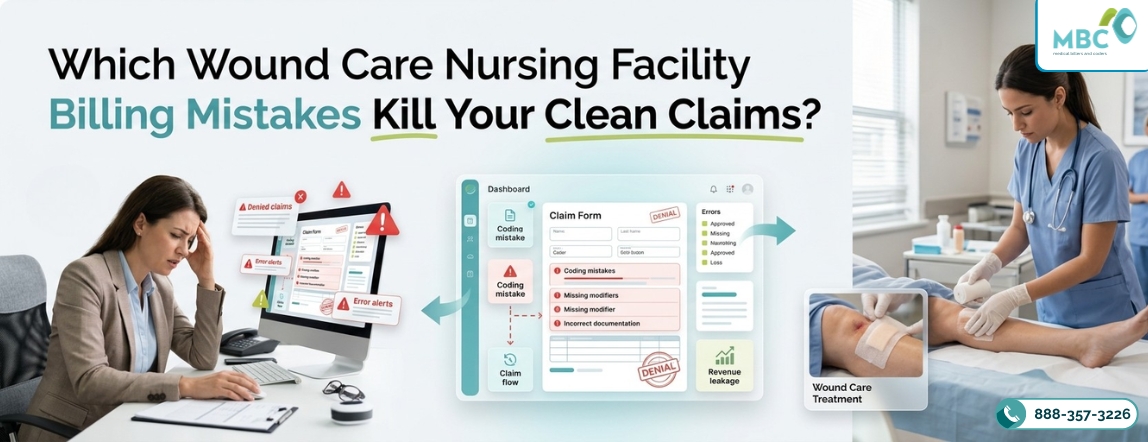
Wound care nursing facility billing loses clean claim status the moment one of six specific, entirely preventable mistakes enters the workflow — and unlike other specialties, most of these errors don’t just generate a denial, they generate an audit flag that follows the facility for 36 months.
Here’s what makes this particularly painful for revenue cycle directors: the mistakes aren’t obscure. They’re hiding in daily workflows that nobody has stopped to question. A POS code auto-populated from a template. A debridement pair that nobody flagged as an NCCI violation.
A diabetic wound coded with a single ICD-10 instead of two. Each one individually costs hundreds of dollars. Across a multi-site SNF operation running thousands of wound care claims annually, they compound into six-figure write-offs that never appear on a denial dashboard because they were never caught in the first place.
Let’s go through each one — specifically.
Mistake #1: The POS Code That Triggers Automatic Denial
The single most consistent clean claim killer in wound care nursing facility billing is submitting POS 11 (physician office) while the patient is in a POS 31 (Skilled Nursing Facility) or POS 32 (Nursing Facility) setting.
RAC contractors run POS pattern analysis before any human reviews a claim. The mismatch is caught automatically, the denial issues instantly, and the facility lands on a watch list for future claims — all without a single medical record being opened.
What makes it worse: POS 11 blocks certain CPT codes from paying in any setting. CPT 11043 (muscle and fascia debridement) and 11044 (bone debridement) are facility-only codes. Submit either with POS 11 and you generate both a denial and a structural upcoding flag.
If your EHR auto-populates POS 11 by default and your physicians routinely document muscle or bone involvement, you have a systematic exposure generating denials every single week.
The fix: Verify Part A vs. Part B coverage status at every patient encounter before the claim is built — not after it’s submitted.
Mistake #2: Billing 97597 and 11042 on the Same Wound
This is the NCCI bundling violation that catches facilities by surprise because it seems logical to bill both — one for selective surface debridement, one for surgical subcutaneous debridement.
But CMS’s National Correct Coding Initiative Chapter 4 is unambiguous: 97597 and 11042 cannot be billed on the same wound on the same date, period. The NCCI indicator is 0 — no modifier can override it. You chose the technique; bill the code that matches.
The denial code is CO-97 (bundled/included in another service), and it accounts for roughly 40% of all wound care claim rejections.
What’s worse: repeated CO-97 patterns on the same provider trigger MAC Targeted Probe and Educate reviews — escalating an administrative billing error into a clinical documentation investigation.
The same rule applies to compression codes. CPT 29580 (Unna boot) and 29581 (multilayer compression) bundle with debridement when performed on the same limb on the same day under NCCI Chapter 4G.
The only bypass is Modifier XS — and only when both services genuinely occur on different anatomical sites with separate documentation for each.
| Common NCCI Violation | Modifier Bypass Available? | Correct Approach |
| 97597 + 11042 (same wound, same day) | No — Indicator 0 | Bill one code based on documented technique |
| 29580 + 11042 (same limb, same day) | XS — different limb only | Document separate sites; apply XS |
| 97597 + 97602 (same session) | No — 97602 is Status B | 97602 is non-payable for physicians in office/SNF Part B |
| 11043 or 11044 + POS 11 | No — facility-only codes | Correct POS before submission |
| E/M + debridement (same day) | Modifier 25 on E/M | E/M must be separately identifiable and documented |
Mistake #3: Single ICD-10 Coding on Diabetic Foot Ulcers
Medicare requires dual ICD-10 sequencing for diabetic foot ulcers — and sequence matters as much as code selection. The etiology code (E11.621 for Type 2 diabetes with foot ulcer) must appear first. The manifestation code from the L97 series — specifying site, laterality, and depth — must follow.
Submit E11.621 alone and the claim faces a 40% denial rate from MAC automated edits. The logic is straightforward: the diabetes code tells payers why the wound exists; the L97 code tells them what the wound looks like and where it is.
Without both, there is no medical necessity argument the claim can make. ICD-10 codes that lack laterality or depth specificity face the same automated denial — unspecified codes are treated as insufficient medical necessity documentation regardless of how detailed the clinical note is.
This is the kind of mistake that falls through the cracks in wound care nursing facility billing when coders use standard medical billing logic rather than wound care-specific coding protocols.
Facilities relying on generalist medical billing services that haven’t built wound-specific ICD-10 scrubbing into their pre-submission workflow are generating this denial pattern on every diabetic wound encounter.
Mistake #4: Hitting the 12/360 Frequency Limit Without an ABN
Medicare limits debridement procedures (CPT 97597 through 11047) to 12 sessions per rolling 360-day period. The 13th claim denies automatically. That much most facilities know. What they don’t know — until it’s too late — is that without a signed Advance Beneficiary Notice (ABN) on file, this denial is permanent and non-recoverable. You cannot appeal it. You cannot bill the patient. The revenue is gone.
The right workflow: when any patient approaches session 10 or 11, generate the ABN using CMS Form CMS-R-131 before the next treatment date. Append Modifier KX to claims where documented medical necessity justifies exceeding the threshold.
Append Modifier GA to confirm the ABN is on file. Without this infrastructure in place, every frequency-exceeded claim becomes a write-off that never shows up on a denial report — because it was never recoverable to begin with.
Multi-site nursing facility groups running high-acuity wound care census — Stage III/IV pressure ulcers, diabetic foot ulcers with bone involvement, non-healing surgical wounds — routinely hit frequency thresholds on long-stay residents.
Tracking this manually across a large census is operationally impossible. This is precisely where specialized wound care billing services with automated per-patient frequency monitoring pay for themselves in recovered revenue.
Mistake #5: Documentation That Doesn’t Support the CPT Code Billed
“Wound debrided” does not support CPT 11042. Full stop. RAC auditors and MAC reviewers are specifically trained to look for five documentation pillars in every wound care note — and if any of them are missing, the claim fails:
- Anatomical location with laterality (e.g., right medial malleolus — not just “foot wound”)
- Dimensions in centimeters — length × width × depth at every visit
- Tissue type by percentage — granulation, slough, eschar — not “wound bed appears healthy”
- Exudate characterization — type and amount (e.g., moderate serosanguinous)
- Medical necessity statement — a specific clinical justification for why skilled professional intervention was required on that date
For CPT 11044 (bone debridement), the note must document bone removal, not just bone exposure. “Bone visible at wound base” does not support 11044 — it supports 11042 at most. OIG reviewers flag this specific mismatch as upcoding, which escalates the denial into a potential fraud referral rather than a simple coding correction.
Cloned notes — where wound assessment language repeats verbatim across visits — are the fastest path from a RAC audit to a UPIC investigation in 2026. Every assessment must reflect measurable wound progression, regression, or a clinical explanation for plateau.
Mistake #6: Missing or Misapplied Modifiers
Modifier errors are clean claim killers that are entirely invisible until the EOB arrives. The most common in nursing facility wound care billing: missing RT/LT laterality modifiers on any extremity-based procedure, which triggers CO-16 denials — one of the most preventable errors in this specialty.
Modifier 25 missing when an E/M and debridement are billed on the same date. Modifier 59 applied when Modifier XS is the correct, more specific alternative for separate anatomical sites.
Each of these has a different downstream consequence. CO-16 (missing information) is appealable with the correct modifier. CO-97 (bundling) requires demonstrating separate anatomical sites. But if the clinical note doesn’t support the modifier claim, the appeal fails regardless of the billing argument.
Facilities that act as a true revenue integrity partner to their clinical teams build modifier logic into pre-submission claim scrubbing — catching the laterality gap, the missing Modifier 25, and the XS vs. 59 mismatch before the claim ever reaches the MAC.
Correcting all six of these mistakes systematically — through workflow redesign, wound-specific NCCI scrubbing, automated ABN tracking, and dual ICD-10 validation — is what separates a 78% first-pass clean claim rate from the 95%+ benchmark that high-performing rcm services deliver on wound care specialties.
Are these six mistakes running silently through your nursing facility’s wound care claims right now?
MBC’s wound care revenue team performs a no-commitment claim-level diagnostic — identifying NCCI violations, POS mismatches, frequency exposure, and documentation gaps before they become denials, write-offs, or audit triggers.
Request Your Wound Care Claim Audit
FAQs
Yes — but only when performed on different wounds at different anatomical sites on the same day. They can never be billed together on the same wound. When billed for different sites, use Modifier XS to indicate a separate anatomical structure and ensure both locations are individually documented with measurements and tissue descriptions.
The 13th claim denies automatically with no appeal path and no ability to bill the patient. The revenue is a permanent write-off. An ABN (CMS Form CMS-R-131) must be signed before the session that exceeds the threshold, with Modifier KX on the claim to signal documented medical necessity and Modifier GA to confirm the ABN is on file.
Because Medicare reads ICD-10 codes in order to determine both medical necessity and clinical relationship. The etiology code (E11.621) must appear before the manifestation code (L97 series) — reversing the sequence or submitting only one code generates automated denials. The L97 code also must include laterality and depth specificity, or the claim fails MAC LCD Group 1 coverage criteria.
The note must explicitly document bone removal — the tissue type removed, the instrument used (e.g., rongeur), and the surface area of bone debrided. “Bone exposed at wound base” without documentation of actual bone tissue removed supports 11042 at most. Billing 11044 based solely on bone exposure is flagged by OIG reviewers as upcoding regardless of the clinical scenario.
Modifier 59 is a broad “distinct procedural service” modifier; XS is a more specific HCPCS modifier indicating a “separate structure” or anatomical site. CMS guidance recommends using the most specific modifier available — XS is preferred over 59 when services occur at genuinely different anatomical sites, as it reduces audit scrutiny and is less prone to blanket denial under MAC review.

A Senior Sales Manager with 18 years of experience in wound care billing services, healthcare sales, and provider relationship management. Passionate about increasing awareness of effective wound care solutions while helping healthcare organizations improve revenue performance, operational efficiency, and patient outcomes.