Specialities
 Services
 Resource Center
 Pricing
 About
About
 Contact
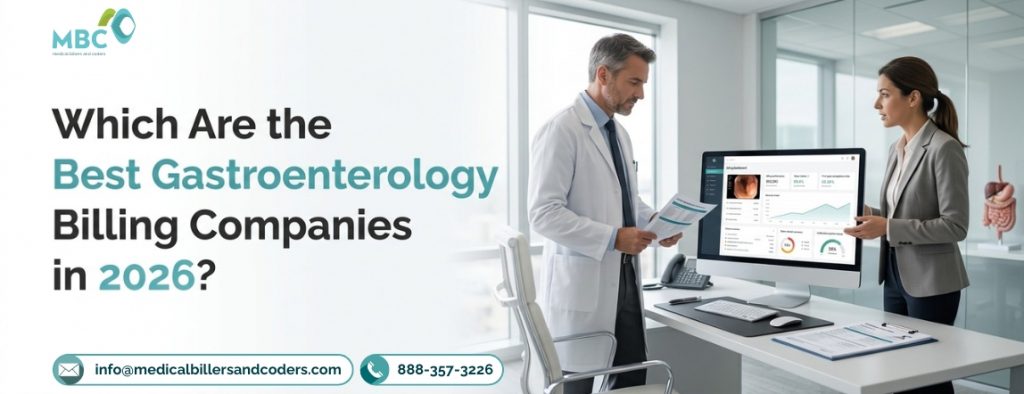
The best gastroenterology billing companies in 2026 share a specific set of traits: deep familiarity with colonoscopy modifier logic, MAC jurisdiction-specific LCD tracking, systematic denial management, and a documented approach to old AR recovery rather than bulk claim resubmission.
Instead of a fixed ranked list, since the right fit depends on a practice’s location, provider count, and claim volume, the best gastroenterology billing companies in 2026 are the ones that can demonstrate this depth clearly, procedure by procedure. That’s the direct answer. The rest of this piece breaks down exactly what separates a genuinely specialty-aligned GI billing partner from a generalist vendor claiming gastroenterology expertise.
What Do the Best Gastroenterology Billing Companies Actually Do Differently?
Gastroenterology billing carries coding density that a general medical billing services provider often isn’t built to handle well. Colonoscopy coding requires precise modifier application (33, PT, KX) to distinguish screening from diagnostic procedures, a distinction that directly affects reimbursement and patient cost-sharing.
Add upper endoscopy codes, capsule endoscopy billing, and infusion billing for IBD biologics, and it becomes clear why the best gastroenterology billing companies staff coders who work exclusively in GI’s specific coding structure rather than applying broad RCM services logic across every specialty they handle.
Why Location Still Matters When Comparing Gastroenterology Billing Companies
Medicare claims are processed regionally through Medicare Administrative Contractors, and LCD requirements for GI procedures differ by jurisdiction. A gastroenterology billing company that performs well nationally still needs to demonstrate local payer fluency, since colonoscopy screening intervals, capsule endoscopy medical necessity criteria, and infusion prior authorization rules vary depending on the MAC jurisdiction and state Medicaid plans involved.
| Evaluation Factor | Generalist Vendor | Best Gastroenterology Billing Companies |
|---|---|---|
| Colonoscopy modifier logic | Applied inconsistently | Standardized, verified per claim |
| Jurisdiction-specific LCD tracking | Rarely referenced directly | Built into documentation workflow |
| Biologic infusion prior auth | Manual, often missed | Systematized and monitored |
| Denial reporting depth | Group-level AR only | Provider-level, payer-level detail |
Key Criteria for Identifying the Best Gastroenterology Billing Companies
Modifier Accuracy Across GI Procedures
Screening-to-diagnostic colonoscopy conversions, same-day procedure bundling, and capsule endoscopy documentation all require precise handling. A gastroenterology billing company should be able to explain this modifier logic clearly, without hedging.
Denial Management Built Around GI-Specific Patterns
Denial management in gastroenterology isn’t generic claim scrubbing. It requires recognizing recurring issues tied to specific procedures, such as incomplete infusion prior authorization or unverified same-day bundling, and correcting the underlying workflow before the next claim is affected.
Old AR Recovery as Ongoing Practice, Not a One-Time Project
Old AR recovery, revisiting claims aged 90-plus days to identify why they stalled, frequently surfaces the same root causes behind current denials. The best gastroenterology billing companies treat old AR recovery and new claim accuracy as connected work.
Provider-Level Revenue Cycle Reporting
Group-level AR figures hide more than they reveal. Strong gastroenterology billing services show exactly which physician, at which location, with which payer, is underperforming, so issues surface in weeks rather than quarters.
Where GI Practices Commonly Lose Revenue
A few denial patterns show up consistently across gastroenterology practices, regardless of size or location:
Screening-to-diagnostic conversion errors. When a screening colonoscopy converts to diagnostic due to polyp removal, incorrect modifier application is one of the most frequent and costly denial triggers.
Capsule endoscopy medical necessity gaps. Claims submitted without documentation matching payer-specific criteria are a common source of denials given these studies’ higher reimbursement value.
Same-day procedure bundling errors. Multiple GI procedures performed in one session require correct bundling to avoid CCI edit denials.
Infusion billing under-documentation. IBD biologic infusions billed without complete prior authorization and dosage documentation routinely get downcoded or denied.
| Common Denial Trigger | Procedure/Code Involved | Typical Fix |
|---|---|---|
| Screening/diagnostic modifier error | Colonoscopy (33, PT, KX) | Apply correct modifier based on procedure outcome |
| Incomplete capsule endoscopy documentation | Capsule endoscopy codes | Match documentation to medical necessity criteria |
| Same-day bundling error | Multiple GI codes, same session | Verify CCI edits before submission |
| Missing infusion prior authorization | IBD biologic infusion codes | Confirm authorization and dosage documentation upfront |
Why More Practices Choose Outsourced GI Billing in 2026
The decision to move toward outsourced GI billing usually comes down to bandwidth and specialty depth. In-house teams juggling multiple responsibilities rarely have time to track jurisdiction-specific LCD updates or run root-cause denial analysis alongside daily operations. The best gastroenterology billing companies bring that depth as a standard part of the engagement, not an added service.
Partnering with experienced medical billing services can also mean the difference between a one-time appeal and a permanent fix to the underlying workflow. For practices evaluating whether outsourced GI billing makes sense, comparing the cost of outsourced billing against in-house overhead is usually the first step.
Ready to Compare Gastroenterology Billing Companies?
Choosing among the best gastroenterology billing companies in 2026 means asking direct questions: can they cite jurisdiction-specific LCDs by name? Do they provide provider-level denial reporting? How do they approach old AR recovery alongside new claims? A vendor that answers clearly and specifically is far more likely to run true gastroenterology-specific workflows.
Reach out to Medical Billers and Coders at 888-357-3226 or email info@medicalbillersandcoders.com to get a gastroenterology revenue diagnostic started this week. Our gastroenterology billing services, backed by broader RCM services, are built to catch these gaps before they cost you another denial cycle.
Reference – CMS — Local Coverage Determinations (LCD) Overview
FAQs
Deep colonoscopy and infusion coding expertise, jurisdiction-specific LCD tracking, and provider-level denial management, rather than a one-size-fits-all national template.
Yes, MAC jurisdictions differ regionally in their LCD requirements, so local payer fluency remains important even for otherwise strong national vendors.
Incorrect modifier application on screening-to-diagnostic colonoscopy conversions is one of the most frequent and costly denial triggers.
Reviewing aged claims often reveals the same root causes behind current denials, so a strong partner treats old AR recovery and new claims as one connected process.
Often yes, once staffing, training, and denial-related revenue loss from generalist in-house teams are factored into the comparison.

A Subject Matter Expert in healthcare billing operations with nearly 10 years of experience, sharing insights on claims processing, coding support, and revenue cycle optimization. Dedicated to educating healthcare professionals on compliance, accuracy, and strategies to improve billing performance.