Specialities
 Services
 Resource Center
 Pricing
 About
About
 Contact
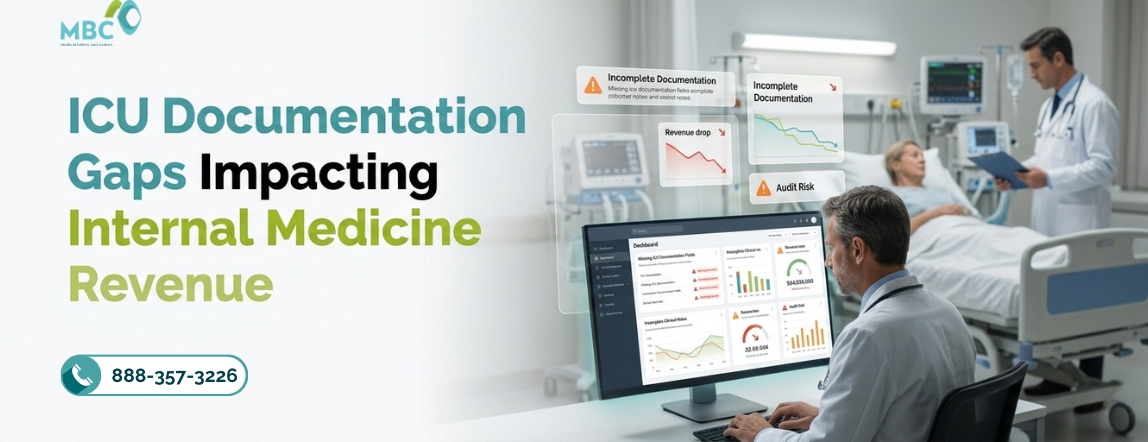
Yes—ICU documentation gaps are impacting Internal Medicine revenue by $320,000–$760,000 per 12 months when critical care time isn’t documented (losing $420–$680 per qualifying encounter), prolonged service codes go unbilled (missing $112 per extended visit), and transfer-of-care E/M levels downcode from insufficient history documentation, destroying 22–38% of intensive management revenue on properly performed services.
Critical care (99291/99292) requires 30+ minutes—but without documented start/stop times, payers downgrade to regular E/M codes losing $380–$580 per encounter.
The 60-Second ICU Revenue Test
Pull last week’s ICU encounters. Count how many include documented start/stop times for critical care.
Table 1: What Missing Time Documentation Costs Internal Medicine Revenue
| Time Documentation Status | What Gets Coded | What Should Code | Loss Per Encounter |
| No start/stop times | 99233 ($180) | 99291 ($560) | $380 |
| Generic “prolonged time” | 99233 ($180) | 99291 ($560) | $380 |
| Partial time (no total) | 99233 ($180) | 99291+99292 ($780) | $600 |
If 30%+ of ICU encounters lack time documentation, gaps are destroying Internal Medicine revenue systematically.
Three ICU Documentation Gaps Destroying Internal Medicine Revenue
Gap 1: Critical Care Time Not Documented ($273,600 Loss)
The $560 per encounter gap:
Hospitalist spends 52 minutes managing septic shock patient: reviewing cultures, adjusting vasopressors, interpreting ABGs, coordinating with nephrology, discussing goals with family.
Encounter note: “Patient critically ill with septic shock. Managed ventilator settings, adjusted pressors.”
What gets coded: 99233 (subsequent hospital care) = $180
What qualifies: 99291 (30–74 minutes critical care) = $560
Loss: $380 per encounter
Why Internal Medicine Billing Services miss this:
Note lacks required time documentation showing 30+ minutes spent.
The critical care time template:
“Critical care start time: 14:22. Critical care end time: 15:14. Total critical care time: 52 minutes. Managed patient with septic shock requiring high-intensity decision-making: reviewed microbiology results (gram-negative bacteremia), adjusted norepinephrine infusion based on MAP targets, interpreted serial ABGs showing metabolic acidosis, coordinated emergent dialysis with nephrology for acute kidney injury, discussed code status and prognosis with family. Critical care activities consumed 52 minutes (excluding separately billable procedures). Billing: 99291 (30–74 minutes critical care).”
Key critical care elements:
Start time and end time (or total minutes)
High-acuity condition (organ system failure)
High-intensity decision-making documented
Excludes separately billable procedures from time
Monthly volume:
ICU encounters qualifying for critical care (30+ minutes): 80
Time documentation present: 32 (40%)
Time documentation missing: 48 (60%)
Average loss per missing documentation: $380
Monthly loss: $18,240
Loss per 12 months: $218,880
Medical Billing Services implement critical care time-tracking protocols preventing systematic downcoding to 99233.
Recovery: $219,000 per 12 months protecting Internal Medicine revenue.
Gap 2: Prolonged Service Codes Not Captured ($67,200 Loss)
The $112 per encounter opportunity:
Hospitalist spends 95 minutes on complex discharge planning for multi-morbid patient requiring skilled nursing placement, medication reconciliation, durable medical equipment coordination, and family education.
Encounter note: “Extensive discharge planning completed.”
What gets coded: 99238 (discharge day management) = $180
What qualifies: 99238 + 99417 (prolonged service) = $292
Loss: $112 per encounter
Prolonged service requirements:
Total time 15+ minutes beyond base code time
Document total encounter time
Statement linking time to prolonged service code
The prolonged service template:
“Total discharge day management time: 95 minutes. Base 99238 includes 60 minutes; additional 35 minutes qualifies for 99417 (prolonged service 15+ minutes). Extended time required for: complex medication reconciliation (18 medications), skilled nursing facility placement coordination, DME arrangements (oxygen, walker), and comprehensive family education regarding CHF management. Billing: 99238 + 99417.“
Monthly volume:
Discharge encounters exceeding 75 minutes: 50
Prolonged service documented: 12 (24%)
Prolonged service opportunity missed: 38 (76%)
Average loss: $112
Monthly loss: $4,256
Loss per 12 months: $51,072
Internal Medicine Billing Services implement prolonged service time documentation capturing previously unbilled extended encounters.
Recovery: $51,000 per 12 months in Internal Medicine revenue.
Gap 3: Transfer-of-Care E/M Level Downcoding ($86,400 Loss)
The $140 downgrade:
Hospitalist admits ICU patient transferred from outside hospital. Reviews 48-page transfer packet, outside imaging, prior cardiology notes, family history from transferring physician.
Encounter note: “Patient transferred from outside facility. Reviewed records. Continued current management.”
What gets coded: 99221 (initial hospital care, straightforward) = $180
What was performed: 99223 (initial hospital care, high complexity) = $320
Loss: $140 per encounter
Why downcoding occurs:
Note doesn’t document extent of outside record review qualifying as “extensive data.”
The transfer documentation fix:
“Initial hospital care for patient transferred from [Hospital Name]. Reviewed extensive outside records: 48-page transfer packet including 3 days of ICU flow sheets, outside CT angiography (reviewed images independently), cardiology consultation note, serial troponin trends, family history obtained from transferring hospitalist Dr. [Name]. Data reviewed qualifies as high complexity due to independent interpretation of external imaging and synthesis of multiple outside specialty evaluations. Formulated new management plan based on integrated record review. Medical decision-making: high complexity. Billing: 99223.”
Monthly volume:
ICU transfer admissions: 30
High complexity documentation: 12 (40%)
Downcode to 99221 due to incomplete documentation: 18 (60%)
Average downcode loss: $140
Monthly loss: $2,520
Loss per 12 months: $30,240
Medical Billing Services implement transfer-of-care documentation templates ensuring data review elements support highest appropriate E/M level.
Recovery: $30,240 per 12 months protecting Internal Medicine revenue.
How Internal Medicine Billing Services Eliminate ICU Documentation Gaps
Specialized Internal Medicine Billing Services recognize ICU documentation gaps impacting Internal Medicine revenue stem from missing critical care time documentation, unbilled prolonged service codes, and transfer-of-care E/M downcoding.
Medical Billing Services implement critical care time-tracking templates (recovering $219,000), prolonged service protocols (recovering $51,000), and transfer documentation standards (recovering $30,000).
Combined ICU gap elimination recovers $300,240 per 12 months in lost Internal Medicine revenue.
MBC’s Revenue Integrity Partner Approach
MBC’s Revenue Diagnostic evaluates your billing through ICU encounter audits identifying missing time documentation, unbilled prolonged service opportunities, and transfer-of-care downcoding patterns.
MBC helps Yield your EBITDA by maximizing reimbursement through systematic ICU documentation improvement. As your Revenue Integrity Partner, we implement hospitalist-specific templates, automated time-tracking reminders, and transfer-of-care documentation standards.
MBC’s fee structure includes ICU documentation training, provider coaching, and quarterly coding audits at https://www.medicalbillersandcoders.com/pricing.
Request Your Free Revenue Diagnostic for ICU gap analysis quantifying exact Internal Medicine revenue recovery opportunity.
Contact Medical Billers and Coders to eliminate ICU documentation gaps impacting Internal Medicine revenue—because $300,240 per 12 months in preventable losses destroys hospitalist profitability.
Frequently Asked Questions
Are ICU documentation gaps really impacting Internal Medicine revenue by six figures?
Yes—missing critical care time documentation creates $219,000 in downcoding losses (60% of qualifying encounters unbilled), prolonged service codes go uncaptured losing $51,000, and transfer-of-care E/M downcoding costs $30,000, totaling $300,240 per 12 months impacting Internal Medicine revenue requiring Internal Medicine Billing Services systematic time-tracking protocols.
What time documentation prevents critical care downcoding?
Notes must include: “Critical care start time: 14:22, end time: 15:14, total time: 52 minutes” plus documentation of high-acuity condition (organ failure) and high-intensity decision-making—without start/stop times, payers downcode 99291 ($560) to 99233 ($180) destroying $380 per encounter impacting Internal Medicine revenue requiring Medical Billing Services templates.
When do prolonged service codes (99417) apply in Internal Medicine?
When total encounter time exceeds base code time by 15+ minutes—discharge management taking 95 minutes qualifies for 99238 ($180) plus 99417 ($112) because 95 minutes exceeds base 60 minutes by 35 minutes, but requires documented total time and “additional 35 minutes qualifies for 99417” statement capturing $51,000 per 12 months through Internal Medicine Billing Services protocols.
How do transfer-of-care encounters justify 99223 (high complexity)?
Document extent of outside record review: “Reviewed 48-page transfer packet, independently interpreted outside CT imaging, synthesized cardiology consultation and serial labs”—this “extensive data review with independent interpretation” supports 99223 ($320) vs. 99221 ($180), recovering $140 per transfer protecting Internal Medicine revenue through Medical Billing Services transfer templates.
How can Internal Medicine Billing Services eliminate ICU documentation gaps?
Implement critical care time-tracking templates with start/stop times ($219,000 recovery), prolonged service documentation protocols for extended encounters ($51,000 recovery), and transfer-of-care templates documenting outside record review extent ($30,000 recovery)—total $300,240 Internal Medicine revenue protection through Internal Medicine Billing Services at https://www.medicalbillersandcoders.com/pricing.
References
- Centers for Medicare & Medicaid Services. (2024). Critical care services documentation and time requirements. https://www.cms.gov/outreach-and-education/medicare-learning-network-mln/mlnproducts/downloads/eval-mgmt-serv-guide-icn006764.pdf
- American Medical Association. (2024). Prolonged service codes and time-based E/M billing requirements. https://www.ama-assn.org/practice-management/cpt

Catering to more than 40 specialties, Medical Billers and Coders (MBC) is proficient in handling services that range from revenue cycle management to ICD-10 testing solutions. The main goal of our organization is to assist physicians looking for billers and coders, at the same time help billing specialists looking for jobs, reach the right place.