Specialities
 Services
 Resource Center
 Pricing
 About
About
 Contact
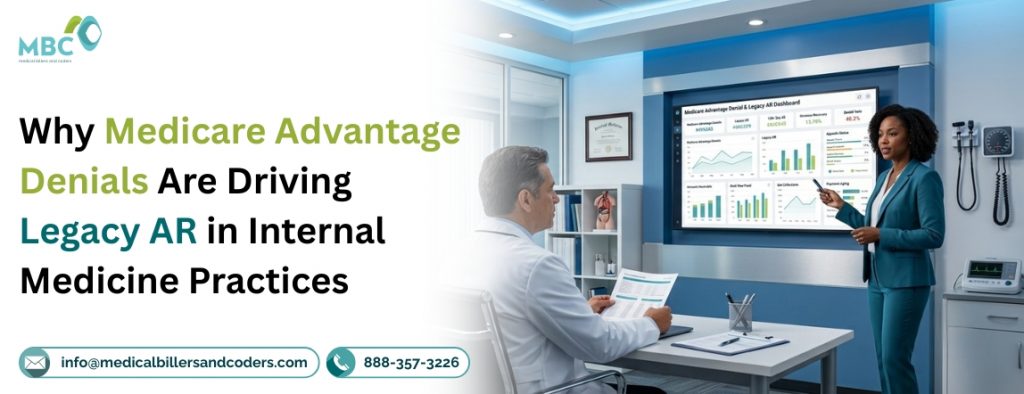
Medicare Advantage denials are the single largest driver of legacy AR in internal medicine because MA plans deny roughly 17% of submitted claims, more than double traditional Medicare’s 8%, and apply prior authorization to internal medicine services at rates 37% higher than in 2022. For a $4 million group, that gap represents roughly $680,000 in claims that fail on first submission, moving closer to an unrecoverable appeal deadline with every unworked week.
What Is Legacy AR in Internal Medicine Practices?
Legacy AR is any claim balance sitting past 90, 120, or 180 days without resolution, accumulating fastest inside chronic disease management, annual wellness, and multi-diagnosis visit claims.
Generalist Internal Medicine Billing Services often miss this, since practices bill across dozens of MA plan variants per state, each with distinct authorization thresholds. That variation quietly turns a clean claim into legacy AR.
Since vendor performance on MA-specific denials varies widely, it is worth benchmarking prospective partners against our roundup of the best internal medicine billing companies for 2026 before choosing who manages your AR recovery.
What’s Actually Driving the Denials
Medicare Advantage plans aren’t administered like traditional Medicare. Each MA payer sets its own prior authorization list, medical necessity standard, and appeal deadline, which is why a single claim denial in internal medicine can require a different resolution path than the same denial reason on a different MA plan.
The friction isn’t distributed evenly across payers. KFF’s most recent national analysis found MA insurers denied 7.7% of prior authorization requests on average, but Centene’s denial rate ran more than double that at 13.6%, while Humana and Anthem generated the highest volume of requests. Payer-blind Denial Management breaks down fastest on internal medicine panels with a high MA concentration.
The Triple Threat to Internal Medicine Margins:
- Prior Authorization Gaps in Chronic Care Services: MA plans frequently require authorization for CCM, TCM, and diagnostic services that traditional Medicare pays without prior authorization, and missed authorizations result in hard denials with no appeal path.
- Medical Necessity Downcoding on High-Complexity Visits: MA payers apply internal severity algorithms to E/M levels, denying or downcoding claims that traditional Medicare would pay at the billed level.
- Compressed Timely Filing and Appeal Windows: Many MA plans enforce shorter appeal deadlines than CMS does, and manual AR tracking often misses them before the claim becomes unrecoverable.
Why MA-Driven AR Ages Faster Than Traditional Medicare AR
Traditional Medicare denials follow predictable, published rules, easy to appeal on a standard cycle. Medicare Advantage denials follow dozens of rulebooks.
That inconsistency is why generic Medical Billing Services underperform on MA-heavy panels; appeal logic has to be rebuilt payer by payer, not applied as one template. Strong Revenue Cycle Management (RCM) connects recovery work to prevention, since claims that are never denied can still age silently in internal medicine AR due to underpayments, while rising MA prior authorization volume expands the denial side. Primary care sees similar pressure from the same MA dynamics.
How to Find Out How Much of Your AR Is Actually MA-Driven
Before appealing anything, confirm the scope. Pull your AR aging report and filter every balance over 90 days by payer type, isolating MA plans from traditional Medicare and commercial claims.
Within that MA bucket, sort by denial reason code rather than dollar amount. A batch driven by authorization codes needs a different fix than one driven by medical necessity or filing codes, and treating them as a single queue causes recovery teams to work the wrong claims first.
Then compare the percentage of your total 90-plus-day AR sitting inside MA against your MA patient panel percentage. If MA represents 30% of your patients but 55% of your aged AR, that gap confirms a plan-specific process failure, not general billing inefficiency, and it tells you where to fix the process first.
Reading the Denial Code Before You Appeal
Most internal medicine MA denials cluster around three standardized Claim Adjustment Reason Codes (CARCs), and each one requires a different response, not a generic resubmission.
| CARC Code | What It Means | Immediate Action |
|---|---|---|
| CO-197 | Precertification, authorization, or notification absent | Confirm authorization was actually required, then submit a retro-authorization request or an authorization appeal with medical necessity documentation attached |
| CO-50 | Service not deemed medically necessary | Pull the specific MA plan’s medical policy for that CPT code and resubmit with documentation mapped directly to that policy’s stated criteria |
| CO-29 | Timely filing limit exceeded | Rarely appealable; recovery depends on a documented CMS or plan-specific exception, which is why catching the deadline before it passes matters more than appealing after |
HMO vs. PPO: Why the Appeal Strategy Changes by Plan Type
MA HMO plans route authorization typically through a primary care gatekeeper and require referral documentation before specialist or diagnostic services are covered, which means an internal medicine visit can create a risk of denial for services the practice never directly billed for.
MA PPO plans authorize more services at the point of care but apply tighter medical-necessity review to high-cost diagnostics and chronic care management codes. Practices carrying both plan types need two separate documentation checklists, not one blended process, or the HMO referral gaps and PPO necessity gaps both get missed.
| Factor | Traditional Medicare | Medicare Advantage |
|---|---|---|
| Prior authorization on E/M and CCM services | Rarely required | Frequently required, plan-specific |
| Medical necessity review | Published national/local coverage rules | Proprietary payer algorithms |
| Appeal deadline | Standardized federal timeline | Varies by plan, often shorter |
| AR aging risk in internal medicine | Moderate | High, compounding across plan variants |
Additional Denial Triggers Worth Tracking
| Denial Reason | Internal Medicine Impact | Resolution Path |
|---|---|---|
| E/M level not supported | Partial payment, downcoded reimbursement | Documentation-backed reconsideration with MDM detail |
| Referral missing (HMO plans) | Full denial on specialist-ordered services | Confirm gatekeeper referral was filed before the encounter |
| Credentialing/enrollment mismatch | Denial regardless of clinical accuracy | Proactive Credentialing and payer roster audits |
Key Takeaways
- Legacy AR in internal medicine is disproportionately generated by Medicare Advantage due to payer-specific authorization and appeal rules.
- Comparing your MA share of aged AR against your MA patient panel percentage reveals whether the problem is plan-specific or general inefficiency.
- CO-197, CO-50, and CO-29 each require a different fix, not one generic resubmission process.
- HMO and PPO MA plans require separate documentation checklists, not a single blended workflow.
- Credentialing accuracy is a preventable, frequently overlooked root cause of AR aging.
MBC Spotlight
MBC’s Internal Medicine Center of Excellence tracks MA authorization and appeal rules at the payer level, not the specialty level, which is why client practices see movement on aged claims instead of a static AR report. One MBC client recovered $112,000 in Medicare Advantage denials that had already been written off as uncollectible once payer-specific documentation was rebuilt into the appeal. MBC’s internal medicine engagements maintain a 97% clean claim rate and a 30% AR reduction within 90 days, backed by 25+ years of experience and 98% client retention.
Conclusion
Medicare Advantage denials are a structural reason legacy AR accumulates in internal medicine, not a billing inconvenience. Practices that treat MA appeal logic as payer-specific recover meaningfully more of what they’ve already earned.
If your practice is carrying aged MA balances that haven’t moved in months, it’s worth finding out exactly where the leakage is before writing it off. Request Your Free Revenue Diagnostic and get a payer-by-payer view of what’s recoverable.
Frequently Asked Questions
Legacy AR is any claim balance unresolved past 90 to 180 days, most often from unappealed Medicare Advantage denials.
MA plans apply their own prior authorization lists, medical-necessity algorithms, and appeal deadlines rather than a single federal rule set.
Recovery odds drop sharply after 120 days, often past most MA appeal windows, so early aging detection matters more than late-stage collection effort.
Verify plan-specific authorization before the visit rather than after; separate HMO referral checklists from PPO medical-necessity checklists; map documentation to each payer’s stated policy rather than a generic template; and audit credentialing status on a recurring rather than reactive basis.
Once aged claims span more than a handful of MA plan variants, in-house teams typically lack the payer-specific appeal bandwidth that specialized old AR recovery teams maintain full-time.
Medicare Advantage plans aren’t administered like traditional Medicare. Each MA payer sets its own prior authorization list, medical necessity standard, and appeal deadline, as outlined in the CMS Medicare Managed Care Manual . Traditional Medicare, by contrast, relies on published national and local coverage determinations available through CMS coverage determination guidance.

A Subject Matter Expert in healthcare billing operations with nearly 10 years of experience, sharing insights on claims processing, coding support, and revenue cycle optimization. Dedicated to educating healthcare professionals on compliance, accuracy, and strategies to improve billing performance.