Specialities
 Services
 Resource Center
 Pricing
 About
About
 Contact
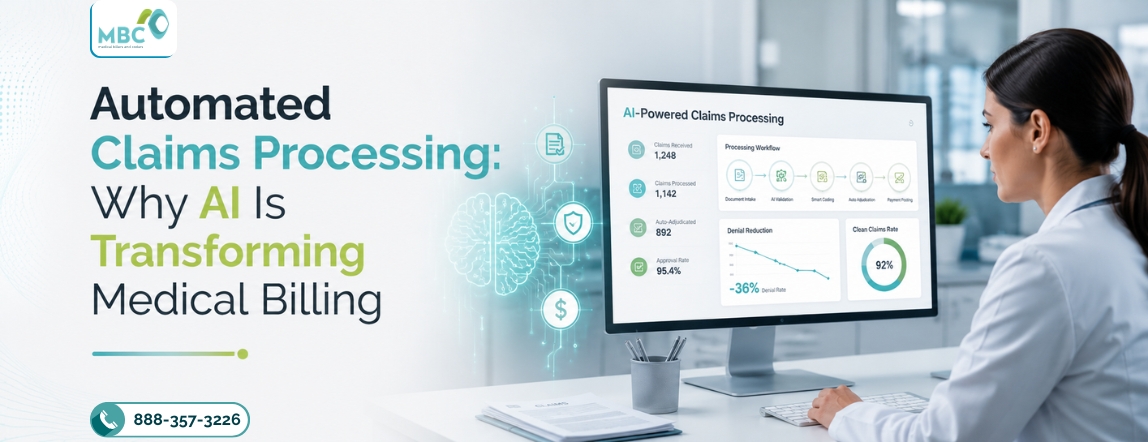
Automated Claims Processing is the answer to one of healthcare’s most persistent revenue problems: claims that leave your system clean but return as denials, write-offs, and wasted staff hours.
In 2026, AI-powered billing infrastructure has made it possible to catch errors before submission, not after — reducing denial rates by up to 42% and cutting Days in AR below 20 for high-performing facilities.
If your practice is still running a reactive billing model, this article explains exactly what you are losing and what the shift to automated systems actually looks like on the ground.
The Real Cost of Manual Billing in 2026
The numbers are not abstract. According to CMS, administrative complexity and billing inefficiencies cost the U.S. healthcare system an estimated $496 billion annually — roughly 25% of total healthcare spending (CMS National Health Expenditure Data, 2024). For individual practices, that translates to $0.08–$0.11 spent just to collect every single dollar billed.
What makes this worse is that traditional billing is built on a reactive loop. A claim goes out, a payer finds the error, and the denial comes back. Staff then spend 45–60 minutes per claim investigating, correcting, and resubmitting — if they resubmit at all. The American Medical Association estimates that nearly two-thirds of denied claims are never reworked (AMA Prior Authorization Survey, 2023). That revenue is simply gone.
With initial denial rates now approaching 12–15% across payer types, this is not a workflow problem anymore. It is a financial infrastructure problem.
How Automated Claims Processing Works in Practice
Automated Claims Processing uses Natural Language Processing (NLP) and machine learning to move billing from reactive to predictive. Instead of a coder manually reviewing records after the fact, AI reads physician notes, maps diagnoses to ICD-10 codes, and applies modifier logic — all before the claim touches a clearinghouse.
The core mechanism is real-time claim scrubbing. Every claim is analyzed against payer-specific rules, patient eligibility data, and historical denial patterns before submission. If a modifier is missing or a bundling rule is violated, the system flags it for human review. Only clean claims go out.
This is what distinguishes modern medical billing and coding services from legacy vendors: the ability to prevent denials rather than chase them. The results across implementations are consistent:
- Days in AR reduced from 35–45 days to 18–22 days
- Administrative labor costs down 30–40% through elimination of routine data entry
- First-pass claim acceptance rates above 97% for optimized workflows
For practices evaluating the financial case, MBC’s billing pricing structures are built around measurable performance outcomes, not flat per-claim fees.
Traditional Billing vs. AI-Powered Automated Claims Processing
| Metric | Traditional Billing | AI-Automated System |
| Error Detection | After payer denial | Pre-submission scrubbing |
| Processing Time | 30–45 days | 2–7 business days |
| Denial Rate | 12–15% and rising | Reduced by 18–42% |
| Staff Role | Data entry and rework | Exception management |
| Cost to Collect | $0.08–$0.11 per dollar | 30–40% labor reduction |
| Patient Collections | Inconsistent | AI-personalized payment plans |
Proactive Denial Management: The Shift That Changes Everything
The most significant operational change in 2026’s revenue cycle management is the move from denial recovery to denial prevention. Machine learning models trained on historical claim data can now score every claim for denial risk before it leaves the system — flagging payer-specific nuances, missing documentation, and modifier conflicts in real time.
Kaiser Permanente demonstrated what this looks like at scale: a 17% reduction in initial denial rates within six months of deploying AI-driven prediction tools. For a facility processing 800 claims per month at an average value of $1,200 per claim, a 17% improvement in first-pass acceptance recovers approximately $163,000 annually in previously lost resubmission cycles.
This is what separates a true revenue integrity partner from a billing vendor. The distinction is not technology — it is operational philosophy. Reactive billing optimizes for recovery. Proactive billing optimizes for prevention.
Specialty-Specific Impact: Where AI Makes the Biggest Difference
Generic platforms underperform in high-complexity specialties. Orthopedic and ASC billing involves implant cost capture, global period documentation, and complex bundling rules that standard scrubbing engines miss entirely. Ophthalmology claims require precise modifier sequencing across bilateral procedures. Wound care billing must navigate LCD policies that vary by MAC jurisdiction.
Claims Processing Best Practices in these environments require specialty-trained AI models — not general-purpose clearinghouses. Facilities that implement specialty-specific automation consistently outperform those using generic platforms by 8–14 percentage points on Net Collection Ratio.
The OIG’s Work Plan for 2026 continues to flag modifier misuse and unbundling as priority audit targets (OIG Work Plan, HHS gov). AI-driven medical billing services that are trained on specialty coding logic help practices stay ahead of compliance exposure — not just revenue targets.
Patient Collections and the Billing Experience
Modern Automated Claims Processing also changes how patients interact with billing. Real-time eligibility verification at the point of scheduling means patients receive accurate cost estimates before service — not surprise bills three weeks later. Geisinger Health System saw a 15–20% increase in self-pay collections after implementing AI-personalized payment plan outreach.
When patients understand what they owe and receive a clear, convenient payment path, bad debt decreases and satisfaction scores rise. This is the business case for automation that often goes undiscussed: it is not only an internal efficiency play. It directly affects patient retention.
Ready to Stop Chasing Denials?
If your Days in AR are above 25, your denial rate is above 8%, or your staff is spending more time on rework than on strategy — your billing infrastructure is costing you money every single day.
MBC’s Automated Claims Processing implementation has helped multi-specialty practices and surgical facilities recover an average of $180K–$420K annually in previously lost or delayed revenue. Our specialty-trained teams combine AI-powered scrubbing with credentialed human oversight across 25+ specialties.
Schedule a Revenue Leakage Audit — No Commitment Required
Call us: (888) 357-3226 Email: info@medicalbillersandcoders.com
FAQs
No. AI handles volume tasks like data entry and code suggestion. Your staff shifts to exception management and compliance strategy — higher-value work that requires human judgment.
It scrubs every claim against payer rules, eligibility data, and historical denial patterns before submission — catching errors that would otherwise trigger a rejection.
Yes, when implemented through a secure stack. Leading systems use zero-trust architecture, audit logging, and Business Associate Agreements (BAAs) that meet or exceed HHS requirements (HHS HIPAA Security Rule).
Most facilities see measurable improvement in first-pass acceptance rates within 30–60 days. Full ROI — including AR reduction and labor savings — typically realizes within 12–18 months.
Yes. Cloud-based AI platforms scale to practice size. MBC structures its medical billing services to match volume, so smaller practices access the same scrubbing infrastructure as multi-OR facilities.
AI improves Automated Claims Processing by identifying coding errors, modifier mismatches, and eligibility issues before claims are submitted. This proactive approach reduces denials, accelerates reimbursements, and helps practices maintain healthier cash flow with fewer manual interventions.
Yes. Automated Claims Processing supports Fastest Claim Processing by using AI-powered claim scrubbing, predictive denial detection, and real-time eligibility verification. These technologies shorten reimbursement cycles, improve first-pass acceptance rates, and reduce delays caused by manual claim corrections.

With almost 12 years of experience in healthcare revenue cycle management, this Revenue Cycle Specialist brings deep expertise in medical billing, claims optimization, and practice profitability. Shares industry-backed insights focused on improving collections, reducing denials, and driving operational excellence.