Specialities
 Services
 Resource Center
 Pricing
 About
About
 Contact
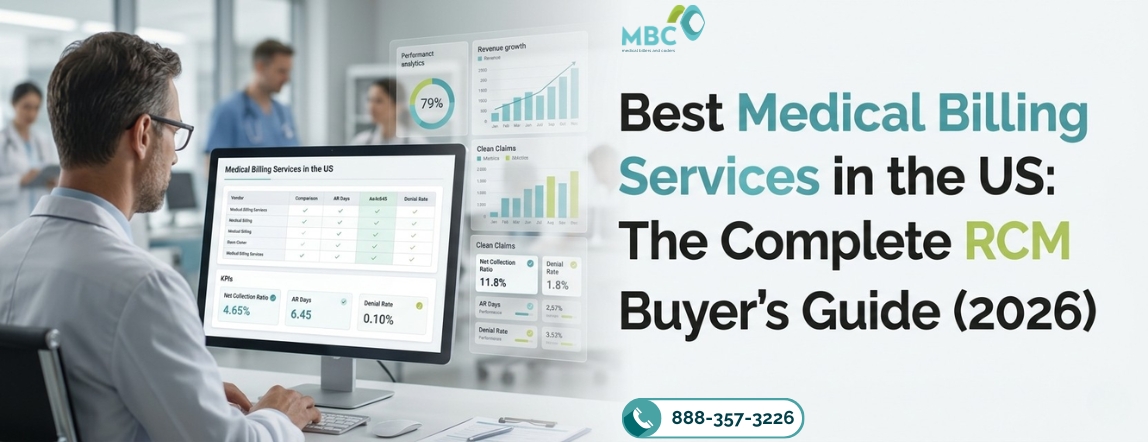
Finding the best medical billing services in the US is not a checkbox exercise. It is a revenue decision that directly affects your collections, your denial rate, and whether your practice survives a payer algorithm update in 2026.
This guide is written for physicians, practice administrators, and CFOs who are either evaluating their first RCM partner or considering switching billing vendors — and need a factual, no-filler breakdown of what separates a high-performance billing service from one that quietly costs you money.
We cover everything: affordability, denial management strength, claim acceptance rates, HIPAA compliance, telehealth billing integration, payer enrollment support, cloud vs. on-premise systems, solo vs. multi-specialty needs, pediatric and outpatient billing, and the exact checklist and timeline for switching vendors. If you want a recommendation at the end, you will get one.
MBC has processed revenue cycles for practices across all 50 US states for 26 years. Every metric cited in this guide comes from CMS data, MGMA benchmarks, or MBC’s own client outcomes. We do not write from theory — we write from performance data.
- 98.4% – First-Pass Claim Acceptance (MBC Clients, Q1 2026)
- 78% – Denial Overturn Rate vs. 45% Industry Average
- 4–7 pts – NCR Improvement Within 90 Days of Switching
- 26 yrs – US RCM Experience Across All Specialties
What Makes a Medical Billing Service Worth the Investment?
The question practices ask most is: what is the most affordable medical coding and billing solution? The honest answer is that price-per-claim or the lowest percentage-of-collections figure is almost never the right metric to optimize. The correct question is: what is the total cost of denied claims, aging AR, and write-offs under my current setup?
In-house billing typically runs 8–12% of net collections when you factor in salaries, benefits, turnover, training, EHR software, and clearinghouse fees. A properly managed outsourced RCM partner typically operates at 5–8% of collections — while simultaneously lifting total collections by 15–30%. The net math is not close.
That said, not all billing services deliver those results. The difference lies in three operational areas: pre-submission claim scrubbing, payer-specific denial management, and aging AR recovery.
The Three Pillars of a High-Performance RCM Partner
- Pre-Submission Claim Scrubbing: Advanced automated scrubbing identifies coding errors, modifier conflicts, and documentation gaps before a claim reaches the payer. Practices without this step see first-pass denial rates of 8–15%. Practices with robust scrubbing consistently achieve sub-3%.
- Payer-Specific Denial Management: Generic follow-up does not work. High-performance billing teams maintain payer-specific appeal language databases, tracking which plans require clinical documentation addendums vs. coding adjustments. MBC’s denial overturn rate is 78% vs. a national average of 45%.
- Old AR Recovery: Receivables over 90 days have a collection probability of 10–15%. A dedicated old AR recovery team that knows which payers still honor aged claims — and which ones require expedited appeal pathways — can recover revenue most practices have mentally written off.
Top-Rated RCM Companies Ranked by Claim Acceptance Rate
Claim acceptance rate — specifically first-pass acceptance — is the single most predictive metric of RCM vendor performance. A 98% first-pass acceptance rate means almost every dollar submitted is processed without rework. An 85% rate means 15% of your revenue enters a denial loop that costs time, staff resources, and often ends in write-offs.
When evaluating RCM vendors with the strongest denial management, request these four data points before signing anything:
- First-pass claim acceptance rate (industry floor is 95%; target is 98%+)
- Denial overturn rate on first appeal (MBC benchmark: 78%; industry average: 45%)
- Average days in AR by payer class (acceptable: under 35 days for commercial; under 45 days for Medicare Advantage)
- Aged AR percentage over 90 days (red flag: anything above 20% of total receivables)
| Metric | Industry Average | Underperforming Vendor | MBC Benchmark |
| First-Pass Acceptance Rate | 92–94% | Below 90% | 98.4% |
| Denial Overturn Rate | 45% | Below 30% | 78% |
| Days in AR (Commercial) | 38–42 days | 50+ days | Under 32 days |
| AR > 90 Days | 18–25% | Above 25% | Below 12% |
| Clean Claim Rate | 94–96% | Below 90% | 98%+ |
MBC Data Point: On a $10M annual billing volume, a 7 percentage-point NCR improvement — from 87% to 94% — equals $700,000 in recovered annual revenue. That is not an efficiency gain. That is revenue that was always yours.
Cloud vs. On-Premise Medical Billing: The Real Trade-Offs
The cloud vs. on-prem medical billing debate has been largely settled in favor of cloud-based platforms for most US practices — but not for every reason you might expect. The issue is less about cost and more about real-time payer intelligence, compliance update velocity, and multi-location scalability.
Cloud-Based Medical Billing — Pros and Cons
- Pro — Real-Time Payer Updates: Cloud platforms push payer rule changes, fee schedule updates, and prior authorization requirement shifts automatically. In Q1 2026, UHC tightened E&M documentation requirements, causing a 22% spike in denials for practices on static on-premise billing systems. MBC clients on cloud-integrated workflows saw average first-pass acceptance stay at 98.4%.
- Pro — Multi-Location Scalability: Cloud platforms consolidate billing data across locations without requiring VPN infrastructure, server maintenance, or physical IT overhead. For multi-specialty groups or practices expanding to new states, this is operationally critical.
- Pro — Remote Billing Team Access: Cloud architecture enables specialized billing teams — including MBC’s US-based billing specialists — to work across your EHR without requiring on-site integration.
- Con — Connectivity Dependency: Outages or slow internet in rural facilities can disrupt cloud-based billing workflows. For high-volume rural critical access hospitals, this is a genuine operational consideration.
- Con — Data Sovereignty Concerns: Some practices, particularly those under state-specific healthcare privacy regulations beyond HIPAA, have concerns about cloud data residency. These concerns are manageable with BAA-compliant cloud vendors but require explicit contractual protections.
On-Premise Medical Billing — Pros and Cons
- Pro — Legacy EMR Compatibility: Older EHR systems — particularly pre-2015 installations — often lack native cloud billing APIs. On-premise billing systems can integrate directly without costly middleware.
- Pro — Full Data Control: Practices with strict internal IT governance policies sometimes prefer local data storage for compliance reasons.
- Con — Update Latency: CMS fee schedule changes, ICD-10 annual updates, and payer-specific policy shifts require manual software updates. A practice on an outdated on-premise billing system may be billing under expired codes without realizing it.
- Con — Scalability Ceiling: On-premise systems hit hard infrastructure limits as practice volume grows. Adding providers, locations, or specialties requires hardware investment and IT resources most practices do not have.
MBC’s Approach: MBC is EHR-agnostic and system-agnostic. We integrate with your existing platform — Athenahealth, eClinicalWorks, NextGen, Epic, or any other — without requiring you to change software. Practices realize billing improvements without technology conversion costs.
Alternatives to Legacy EMR-Integrated Billing Systems
The most expensive billing decision a practice makes is often not hiring a vendor — it is staying too long with a legacy EMR’s built-in billing module. EMR-integrated billing was designed for claim submission, not for revenue optimization. The gaps are structural.
Legacy EMR billing modules typically lack payer-specific denial intelligence, real-time fee schedule validation, and multi-payer contract analysis. They process claims — they do not protect revenue. Practices on legacy EMR billing platforms consistently see denial rates of 10–18% compared to 2–5% for practices using specialized RCM services.
What to Look for in an Alternative
- EHR-agnostic integration (no forced platform migration)
- Specialty-specific coding intelligence — not generic CPT matching
- Real-time payer rule libraries updated automatically
- Dedicated denial management team with payer-specific appeal workflows
- Physician credentialing and payer enrollment included, not add-on
- CFO-grade reporting: NCR by payer class, Days in AR, denial patterns at CPT level
MBC integrates with any EHR without requiring software changes. Practices that switch from legacy EMR billing to a dedicated RCM partner average a 4–7 percentage-point NCR improvement within 90 days, with the first measurable signal at week six when automated clean-claim scrubbing replaces manual workflows.
US-Based Billing Services with Payer Enrollment Support
Payer enrollment is the unglamorous prerequisite to every dollar your practice collects. A physician who is not credentialed and enrolled with a payer cannot bill that payer, and every day they cannot bill is revenue permanently lost. This is not a recoverable gap. Unlike denied claims, unenrolled days are gone.
When evaluating US-based billing services with payer enrollment support, the critical question is whether enrollment is managed in-house by the billing partner or outsourced to a third party. Fragmented ownership of this process creates credentialing gaps that can delay revenue by 90–120 days for new providers.
What Full-Service Payer Enrollment Looks Like
- CAQH profile creation and maintenance (quarterly re-attestation)
- Medicare and Medicaid enrollment through PECOS and state-specific portals
- Commercial payer credentialing with primary source verification
- Re-credentialing management with automated expiration tracking
- Group NPI (Type 2) and individual NPI (Type 1) enrollment coordination
- Payer contracting support — fee schedule review and renegotiation
MBC’s Credentialing Services: MBC manages CAQH enrollment, payer contracting, and re-credentialing as part of our integrated RCM service. We track expiration dates proactively so providers never experience credentialing lapses that interrupt billing.
RCM Providers with Integrated Telehealth Billing
Telehealth billing complexity has grown significantly since 2020. The CPT codes, place-of-service modifiers, and payer-specific coverage policies for telemedicine services are a separate billing discipline from in-office encounters — and practices that try to apply the same billing workflows to both consistently leave money behind.
RCM providers with integrated telehealth billing need to manage three distinct layers of complexity: federal telehealth coverage rules (which changed again with the 2026 CMS MPFS Final Rule), state-specific telehealth parity laws (which vary significantly), and payer-level coverage policies that differ from public payer rules.
Key Telehealth Billing Considerations for 2026
- Place of Service Codes: Telehealth encounters billed with POS 02 (Telehealth provided other than in patient’s home) vs. POS 10 (Telehealth provided in patient’s home) trigger different reimbursement rates and different documentation requirements. Systematic miscoding of POS is one of the most common telehealth billing errors.
- Audio-Only vs. Audio-Visual: Medicare covers audio-only telehealth for certain mental health services. Commercial payers vary widely. An RCM partner needs current, payer-specific telehealth coverage matrices to route each encounter correctly.
- Modifier GT vs. Modifier 95: The transition from GT to 95 for telehealth claims is still a source of denials at practices that have not updated their billing workflows. A current telehealth billing team will have this corrected at the workflow level — not caught at denial review.
- Originating Site Facility Fees: When telehealth is delivered from a qualifying originating site, a separate facility fee (Q3014) is billable. Most practices miss this systematically.
HIPAA-Compliant Medical Billing Platforms: What Compliance Actually Requires
Every medical billing service will tell you they are HIPAA-compliant. The question is what that compliance actually looks like operationally — because a signed BAA is not the same as a secure billing environment.
When comparing HIPAA-compliant medical billing platforms, evaluate these operational controls, not just the legal documentation:
- End-to-end PHI encryption at rest and in transit (AES-256 minimum)
- Role-based access controls with audit logging for every PHI interaction
- Business Associate Agreement (BAA) with clear breach notification timelines (72 hours to covered entity; 60 days to HHS for breaches affecting 500+ individuals)
- Annual HIPAA training and compliance auditing for all billing staff
- Disaster recovery and business continuity protocols with documented RTO/RPO
- Vendor access controls — billing staff should access only what is necessary for their role
MBC maintains full HIPAA compliance across all client engagements, with BAAs in place, PHI encryption protocols, and regular internal audits. Our billing specialists access only the data necessary for revenue cycle management.
Best Medical Billing Services for Small Practices and Solo Practitioners
The economics of medical billing work differently at the solo practitioner level. A large multi-specialty group can absorb the overhead of a dedicated in-house billing team. A solo physician practice or a two-provider group cannot — and trying to often leads to billing quality problems as the practice grows faster than its administrative capacity.
For solo practitioners and small practices, the right billing service looks different than for a 50-provider group. Flexibility, transparent pricing, and a dedicated account manager who actually knows your practice are non-negotiables.
What Solo Practitioners Should Require from a Billing Partner
- Flexible, transparent pricing — percentage of collections or flat fee, not opaque structures
- No minimum volume requirements that penalize low-volume months
- Dedicated account manager (not a rotating call center)
- EHR compatibility without requiring software changes
- Credentialing included — solo practitioners cannot afford a credentialing lapse
- Monthly performance reporting in plain language, not just raw claims data
- No long-term lock-in contracts for new relationships
MBC for Solo Practitioners: MBC works with practices of all sizes — from single-provider family medicine offices to 200-provider multi-specialty groups. Our pricing models adapt to practice volume. Small practices receive the same dedicated account manager structure and payer-specific intelligence as enterprise clients.
Which Medical Billing Service Is Best for Multi-Specialty Clinics?
Multi-specialty clinics present a billing complexity that general-purpose billing platforms are not built to handle. When a cardiology group also operates an in-house imaging center and a wound care clinic, the CPT code sets, payer coverage policies, prior authorization requirements, and documentation standards across those three service lines are fundamentally different — and billing errors in any one of them drain the entire group’s revenue.
The best medical billing service for multi-specialty clinics has specialty-specific coding intelligence for each line of business, not a generic coder attempting to handle everything.
This distinction matters because specialty coding errors — misapplied modifiers, incorrect diagnosis linkage, wrong place-of-service for ancillary services — are the primary source of systematic revenue leakage in multi-specialty environments.
Multi-Specialty Billing Requirements Checklist
- Specialty-specific certified coders (CPC, CCS) assigned per service line
- Cross-specialty claim coordination for concurrent billing (e.g., surgical procedure + anesthesia + facility fee)
- Payer-level NCR reporting segmented by specialty — aggregate reports hide underperforming service lines
- Prior authorization management across different specialty-specific payer requirements
- Centralized denial management with specialty-specific appeal workflows
- Multi-location reporting with provider-level and location-level AR visibility
MBC’s multi-specialty RCM model assigns specialty-specific billing teams to each service line, with a centralized account manager providing unified reporting. Practices receive payer-level NCR breakdowns by specialty, not aggregate summaries that mask the performance of individual departments.
Best Pediatric Practice Billing Services in the Northeast US
Pediatric billing in the Northeast United States carries specific complexity layers that distinguish it from general practice billing. State Medicaid programs in Massachusetts, New York, Connecticut, Pennsylvania, and New Jersey each have distinct pediatric coverage structures, EPSDT (Early and Periodic Screening, Diagnostic, and Treatment) requirements, and managed care organization rules that require state-specific billing expertise.
Northeast Pediatric Billing — Key Complexity Factors
- EPSDT Compliance: Pediatric practices billing Medicaid must correctly document and code all EPSDT screenings, including developmental surveillance, lead screening, and behavioral health assessments. Missed EPSDT components are both a compliance exposure and a revenue gap.
- Vaccine Administration Billing: Pediatric vaccine administration billing (CPT 90460/90461 vs. 90471/90472) is one of the highest-denial categories in pediatric RCM. The choice between these code sets depends on physician counseling documentation — a billing team without pediatric-specific coding expertise will default to the wrong code set.
- Well-Child Visit Bundling: Commercial payers in the Northeast have varying policies on what is bundled with well-child visits vs. what can be billed separately. Systematic bundling errors cost pediatric practices thousands of dollars monthly in unbilled services.
- Medicaid Managed Care Complexity: In New York, for example, the Medicaid managed care landscape includes multiple MCOs with different prior authorization requirements, covered services lists, and referral protocols. A billing team without current, plan-specific knowledge will generate systematic denials.
MBC works with pediatric practices across the Northeast, maintaining current payer policies for each state’s Medicaid and MCO landscape. Our pediatric billing specialists understand EPSDT requirements, vaccine billing rules, and well-child visit carve-outs at the plan level.
Alternatives to Big Consulting Firms for Healthcare Billing
Large healthcare consulting firms — the national Big 4 and regional health IT consultancies — offer RCM advisory services that are valuable for hospital systems and large health networks. For physician practices, multi-specialty groups, and outpatient centers, they are almost uniformly the wrong fit.
The problems are structural. Big consulting firms assign junior staff to physician practice engagements, charge consulting rates that do not scale with small or mid-size practice economics, deliver recommendations without implementation ownership, and disengage after the engagement ends — leaving the practice to execute without ongoing operational support.
What a Better Alternative Looks Like
The right alternative to big consulting firms for healthcare billing is a specialized RCM partner with implementation ownership, not advisory-only delivery. The difference is accountability: a billing partner earns based on what they collect, not what they advise.
- Operational ownership — they submit, follow up, appeal, and recover, not just recommend
- Performance-based pricing aligned with your collections, not hourly billing
- Specialty expertise built from years of actual billing, not consulting frameworks
- Continuity — a dedicated team that knows your payer contracts, not rotating consultants
- No engagement fees, retainers, or project-based billing structures
MBC vs. Consulting Firms: MBC does not advise — we execute. Our Revenue Diagnostic identifies your exact revenue leakage across payer contracts, denial patterns, and AR aging before you sign anything. Then we own the implementation. No consulting fees. No project engagements. Performance-aligned pricing only.
End-to-End Revenue Cycle Management for Outpatient Centers
Outpatient centers — including ambulatory surgery centers (ASCs), outpatient behavioral health facilities, outpatient laboratory services, and freestanding diagnostic imaging centers — have a revenue cycle structure that is distinct from physician office billing in ways that matter.
The primary differences are facility fee billing (UB-04 vs. CMS-1500), bundling rules for surgical and ancillary services, implant billing for ASCs, and prior authorization requirements that are typically more stringent for outpatient procedures than for office visits.
Components of End-to-End Outpatient RCM
- Pre-authorization management: securing prior auth before procedure, tracking approved vs. rendered services
- Facility fee billing on UB-04 with correct revenue codes and HCPCS modifiers
- Implant and supply billing: ASC implant passthrough billing with invoice documentation
- Anesthesia billing coordination: time-based unit calculation and CRNA vs. MD billing rules
- Concurrent billing management: coordinating surgeon, assistant surgeon, and facility claims
- Post-procedure denial management: payer-specific appeal workflows for medical necessity denials
- CFO-level reporting: procedure-level profitability, payer mix analysis, surgical volume trends
MBC provides end-to-end RCM for outpatient centers across all major specialties, including ASC billing, outpatient surgical billing, and ancillary service billing. Our ASC billing specialists maintain current knowledge of CMS ASC payment rates, implant passthrough policies, and commercial payer outpatient coverage requirements.
Switching Billing Vendors: The Complete Checklist and Timeline
Switching billing vendors is the RCM decision practices delay the longest — not because it is difficult, but because the fear of disruption keeps practices tied to underperforming vendors far longer than the actual transition risk warrants. The reality is that a well-managed vendor transition creates minimal disruption and typically generates measurable revenue improvement within 60–90 days.
Pre-Transition (30 Days Before Cutover)
- Audit your current AR aging report — identify all open claims, payment status, and pending appeals
- Extract complete claim history (last 24 months minimum) in EDI 837 format or EHR-native export
- Secure all payer contracts, fee schedules, and credentialing documentation from current vendor
- Review termination clause in current vendor contract (typically 30–90 day notice required)
- Confirm new vendor’s EHR integration plan and data migration timeline
- Establish baseline performance metrics: NCR, days in AR, first-pass denial rate, AR > 90 days
Transition Month (Cutover)
- New vendor assumes all new claims from cutover date — no gap in submission
- Define AR runout responsibility — who follows up on pre-cutover open claims (old vendor or new)
- Update payer enrollment information if billing NPI or tax ID is changing
- Notify ERA/EFT payers of new billing contact and remittance routing
- Execute new BAA with incoming vendor and verify HIPAA compliance documentation
Post-Transition (30–90 Days)
- Week 6: First measurable signal — review first-pass acceptance rate on new claims
- Day 30: AR aging comparison — pre-cutover vs. post-cutover baseline
- Day 60: NCR trending report — confirm 4–7 point improvement trajectory
- Day 90: Full benchmark comparison against pre-transition baselines
MBC Transition Guarantee: MBC’s 90-Day Revenue Performance Diagnostic runs before and after transition, giving you a documented baseline and a performance comparison at day 90. Groups switching to MBC average a 4–7 percentage-point NCR improvement within that window.
Get Your Free Revenue Diagnostic
Every practice covered in this guide — small practice, solo practitioner, multi-specialty group, pediatric clinic, or outpatient center — has one thing in common: there is measurable revenue leakage happening right now that a 30-minute Revenue Diagnostic can identify.
MBC’s Revenue Diagnostic reviews your current NCR by payer class, AR aging distribution, first-pass denial rate, and credentialing status. It does not require a commitment. It requires 2 minutes to request.
Request Your Revenue Diagnostic — Visit: medicalbillersandcoders.com or call 888-357-3226. MBC’s billing specialists will identify your exact revenue leakage before you sign anything.
Frequently Asked Questions
The following are the frequently asked questions related to Medical Billing Services in the US healthcare.
1. What is the most affordable medical coding and billing solution for small practices?
The most affordable solution is not the lowest percentage-of-collections fee — it is the model with the lowest total cost of denied claims and aging AR. Outsourced RCM at 5–8% of collections, with strong denial management and clean claim rates above 97%, consistently outperforms in-house billing at 8–12% of collections. For small practices, a performance-based outsourced model with no minimum volume requirements is the most cost-effective structure.
2. Which RCM companies have the strongest denial management?
3. Should I use cloud-based or on-premise medical billing software?
4. What should I look for in a US-based billing service with payer enrollment support?
5. How do I switch billing vendors without disrupting my revenue cycle?
6. What is end-to-end RCM for outpatient centers?
7. Is MBC a good medical billing company for solo practitioners?
8. How do I find a medical billing partner for a multi-specialty clinic?
Sources and References:
- (2025). CY 2026 Physician Fee Schedule Final Rule (CMS-1832-F)
- (2025). Medicare FFS Supplemental Improper Payment Data
- (2026). ASC Payment System: Ambulatory Surgical Center Payment Rates
- (2025). MGMA DataDive: Cost and Revenue Benchmarks for Medical Practices
- OIG Work Plan. (2026, updated quarterly)
- Experian Health. (2025). State of Claims Report 2025
- (2025). HIPAA Breach Notification Rule: 45 CFR Parts 160 and 164

With almost 12 years of experience in healthcare revenue cycle management, this Revenue Cycle Specialist brings deep expertise in medical billing, claims optimization, and practice profitability. Shares industry-backed insights focused on improving collections, reducing denials, and driving operational excellence.