Specialities
 Services
 Resource Center
 Pricing
 About
About
 Contact
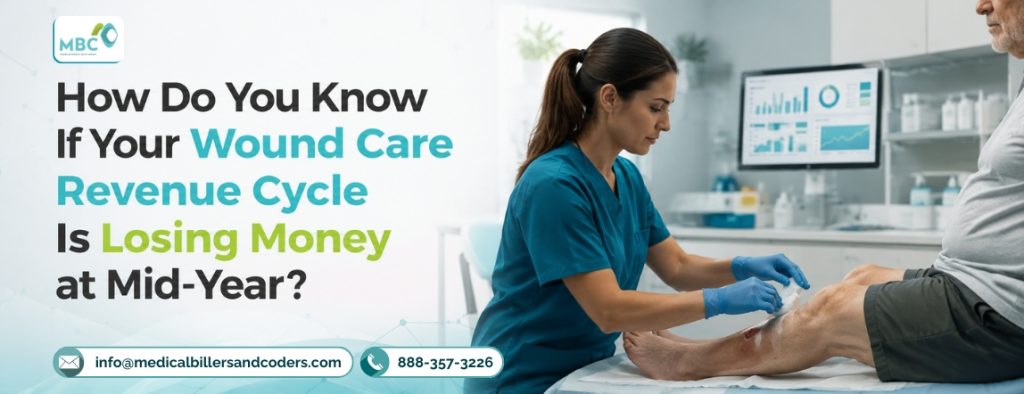
If patient volume is steady but collections feel flat, your wound care revenue cycle is likely losing money right now — and mid-year is exactly when most practices find out. The gap between what your clinicians bill and what actually gets collected rarely comes from a single broken process.
It builds quietly: one denied CTP claim here, an unbilled debridement unit there, a documentation gap that triggers a take-back months later. By June, that quiet erosion can reach $80,000 to $150,000 in preventable revenue loss for a busy wound care center.
This mid-year check is not about generating more volume. It is about protecting what you have already earned.
The Three Biggest Leaks in Wound Care Revenue Cycle in 2026
1. Skin Substitute Billing After the CMS Flat-Rate Shift
Effective January 1, 2026, CMS fundamentally changed how cellular and tissue-based products (CTPs) are reimbursed. Under the CY 2026 Physician Fee Schedule Final Rule, CMS moved most CTPs from individualized ASP+6% pricing to a flat rate of $127.14 per square centimeter — regardless of brand, FDA pathway, or acquisition cost. (Source: CMS CY 2026 PFS Final Rule, CMS-1832-F)
This is the most significant wound care billing change in over a decade. Practices that built their revenue models on high-margin skin substitutes — some previously reimbursed at $300 to $400 per sq cm — now face the same flat payment as products costing $20 per sq cm to acquire. If your formulary has not been reviewed since January, you are likely taking margin hits on every application.
CMS also deleted legacy HCPCS codes C5271 through C5278 effective 2026. Claims submitted with outdated codes face automatic rejection. Meanwhile, only 18 skin substitute products are on the explicit “Covered” list under current Local Coverage Determinations (LCDs), while 158 are classified as non-covered and 154 remain at MAC discretion.
2. Debridement Undercoding and Unit Errors
Debridement codes (CPT 11042 through 11047) are among the highest-denial codes in the wound care specialty. The most common errors: billing a single unit when wound size supports multiple, selecting the wrong tissue depth, and failing to document the necrotic tissue type and total surface area in measurable terms. CPT 97597 and 97598 — used for active wound management — are frequently miscoded or billed without adequate documentation tying them to medical necessity.
A routine dressing change is not separately reimbursable under Medicare when bundled into an active wound care service. Practices that continue billing dressing change CPT codes as standalone services on debridement visits are generating denials and compliance exposure simultaneously.
3. Documentation Gaps That Flag MAC Audits
Under 2026 LCDs for diabetic foot ulcers (DFUs) and venous leg ulcers (VLUs), Medicare requires documented evidence of a 30-day standard-of-care trial showing less than 50% wound improvement before a skin substitute application qualifies for coverage. Vascular assessments — including Ankle-Brachial Index of at least 0.60 for DFUs — must appear in the chart, along with documentation from the physician managing the underlying condition.
If these fields are missing or incomplete, the claim does not just get denied — it gets flagged. The OIG’s Fraud Defense Operations Center prevented nearly $185 million in improper wound care payments in 2025 alone, and skin substitute billing is under active scrutiny.
Mid-Year Revenue Cycle Health Check: Warning Signs vs. Performance Benchmarks
| Revenue Metric | Warning Sign | Healthy Benchmark |
| Clean Claim Rate | Below 92% | 95% or higher |
| Days in AR | Over 45 days | 28 to 35 days |
| CTP Denial Rate | Above 15% | Under 8% |
| Debridement Unit Accuracy | Frequent downcoding by payer | Billed units match documented wound area |
| Net Collection Ratio | Below 88% | 93 to 97% |
| Write-Off Rate | Over 5% of gross charges | Under 2% |
How to Run a Mid-Year Wound Care Billing Audit in 5 Steps
You do not need to wait for a payer audit to find the leaks. A targeted internal review — ideally run with your medical billing and coding services partner — can identify the highest-risk areas within 30 days.
- Pull denial data by CPT code for January through June 2026. Segment by debridement codes, CTP application codes, and evaluation codes separately.
- Cross-reference your active skin substitute formulary against the 2026 CMS covered product list. Any non-covered products being applied should trigger immediate documentation review.
- Review your HCPCS coding for CTPs and verify that legacy codes (C5271 through C5278) have been fully replaced in your billing system.
- Audit a sample of 25 debridement claims for wound measurement documentation. If tissue depth and total area are not explicitly recorded, expect denials on re-audit.
- Compare your Net Collection Ratio quarter-over-quarter. A decline of more than 3 percentage points without a volume decrease signals a billing workflow problem, not a patient mix issue.
Where Most Wound Care Practices Miss Revenue After Mid-Year
One pattern repeats itself across wound care centers at this point in the year: the practice believes it is billing correctly because claims are going out clean. But clean submission rate and clean claim rate are not the same metric. A claim that passes the clearinghouse and still gets denied by the MAC is recorded as a denial — not a clean claim failure — which means the revenue loss shows up in AR aging, not in scrubbing reports.
High-volume wound care practices averaging 300 or more patient encounters per month can accumulate $60,000 to $120,000 in preventable denial losses in a single quarter. The majority trace back to three root causes: incorrect CTP HCPCS codes post-2026 rule change, debridement unit miscounts, and missing pre-application documentation for skin substitutes.
Specialty-specific wound care billing services track these patterns across a larger data set than any single practice can see internally. A revenue integrity partner with wound care depth will identify payer-specific variance — for example, when a specific MAC is downgrading debridement codes or flagging CTP claims at a higher rate than the national average — before that trend costs your practice six figures.
Is Your Wound Care Revenue Cycle Leaking Into the Second Half of 2026?
MBC’s wound care billing specialists have reviewed hundreds of mid-year revenue audits across wound care clinics, hospital outpatient wound centers, and multi-provider practices. We identify where your wound care revenue cycle is losing money — and deliver a clear recovery plan, not a generic report.
Our rcm services are built around specialty-specific billing protocols, MAC-jurisdiction compliance, and real-time denial tracking — not one-size-fits-all workflows. If your Net Collection Ratio has slipped, your CTP denials have increased since January, or your Days in AR have stretched past 40, this is the right time to act.
Schedule your Mid-Year Revenue Integrity Review today.
Call us: 888-357-3226 | Email: info@medicalbillersandcoders.com
Explore our wound care billing service options and pricing to find the right fit for your practice.
FAQs
CMS shifted most skin substitute (CTP) reimbursement from ASP+6% to a flat rate of $127.14 per square centimeter effective January 1, 2026. Practices that have not restructured their formulary or updated HCPCS codes are absorbing margin losses on every application.
Run a mid-year denial report segmented by CPT code. If your CTP denial rate exceeds 8%, your debridement units are being routinely downgraded, or your Net Collection Ratio has dropped more than 3 points since Q1, your wound care revenue cycle has active leaks.
Yes. These debridement CPT codes remain standard and unchanged. The emphasis in 2026 is on documentation: wound measurements, tissue type, and total surface area must be explicitly recorded to avoid denial or downgrade by the MAC.
Medicare requires evidence of a 30-day standard-of-care trial showing less than 50% healing progress, a vascular assessment (Ankle-Brachial Index of at least 0.60 for diabetic foot ulcers), and documentation of the physician managing the underlying condition. Missing any of these triggers denial.
Yes. MBC operates a specialty-focused wound care billing team with direct knowledge of current LCDs, 2026 CTP coding rules, MAC-jurisdiction-specific requirements, and debridement documentation standards. Our medical billing services are designed for practices that need specialty depth, not general billing support.

With almost 12 years of experience in healthcare revenue cycle management, this Revenue Cycle Specialist brings deep expertise in medical billing, claims optimization, and practice profitability. Shares industry-backed insights focused on improving collections, reducing denials, and driving operational excellence.