Specialities
 Services
 Resource Center
 Pricing
 About
About
 Contact
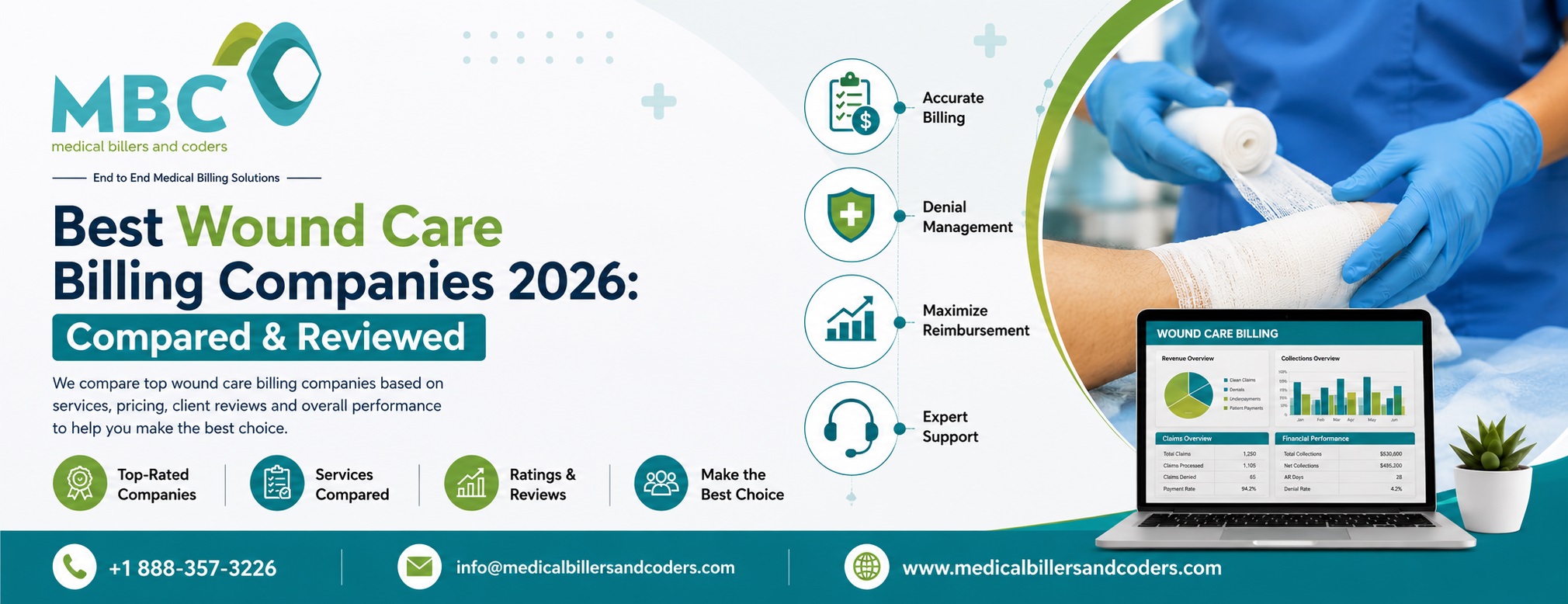
Best Wound Care Billing Companies:
- Medical Billers and Coders (MBC)
- Omega Healthcare
- CareCloud
- Tebra (formerly Kareo)
When wound care centers evaluate the best wound care billing companies, the answer isn’t just about who processes claims fastest — it’s about who prevents the $30,000–$50,000 in monthly revenue loss that generalist billing companies generate through debridement underbilling, modifier omissions, and HBOT authorization failures.
Medical Billers and Coders (MBC) leads this comparison for 2026 because wound care billing fails at four specific points — debridement code selection, modifier 25 compliance, HBOT authorization management, and NPWT supply documentation — and MBC is built around each of them.
The Triple Threat to Wound Care Revenue
Most practices bleeding revenue don’t know where it’s going. Here’s where it disappears:
1. Debridement Underbilling
CPT 97597 covers the first 20 sq. cm of active wound care; CPT 97598 bills each additional 20 sq. cm. Generalist billers routinely submit a single unit when documentation supports multiple — a silent, compounding write-off on every debridement encounter.
2. E/M Bundling from Modifier 25 Omissions
When wound care providers conduct a separately identifiable evaluation on a procedure day without modifier 25 attached, payers bundle the E/M into the procedure fee. At 100 monthly procedure visits, that omission eliminates $4,000–$8,000 in E/M revenue per month.
3. HBOT Authorization Gaps
Most payers authorize hyperbaric oxygen therapy (CPT 99183) in blocks of 10–20 sessions. Billing session 11 without renewed authorization produces a clean-claim denial — avoidable, but only if authorization tracking is a structured workflow, not an afterthought.
Why MBC Leads Among Best Wound Care Billing Companies in 2026
MBC’s wound care billing practice operates with subspecialty-certified coders — not generalists cross-trained on wound care basics. Their standard service includes real-time OR log integration for NPWT supply documentation, pre-submission modifier 25 compliance checks, and a 97%+ Net Collection Rate benchmarked against MGMA wound care specialty data.
For multi-site wound care centers and HBOT-intensive practices, that NCR differential translates to $240,000–$360,000 in annual recovered revenue compared to generalist billing partners averaging 88–91%.
Contact MBC: 888-357-3226 | info@medicalbillersandcoders.com
Quick Comparison
|
Company |
Best For |
Reported NCR |
|
MBC |
Multi-site centers, HBOT practices |
97%+ |
|
Omega Healthcare |
Health system wound care lines |
~93% |
|
CareCloud |
Mid-size wound care practices |
~90% |
|
Tebra (Kareo) |
Small independent offices |
~88–91% |
The Complete Guide to Wound Care Billing (eBook)
FAQs
Subspecialty coding for debridement units, modifier 25 compliance, HBOT authorization workflows, and NPWT device classification — four areas where generalists consistently generate avoidable write-offs.
Top-performing centers achieve 94–97% NCR; below 90% signals systematic coding failures requiring immediate root-cause analysis.
Yes — under CPT 99183 for 14 specific diagnoses including diabetic lower extremity wounds and compromised skin grafts, with prior authorization required by most Medicare Advantage and commercial payers.
With modifier 25 attached to the E/M code and documentation confirming the evaluation was significant and separately identifiable from the pre-procedure assessment.
Billing E2402 (rental) when a disposable device (A6550) was supplied — or vice versa — triggers payer denials and potential audit recoupment liability; device type must be confirmed at point of dispensing.

A Subject Matter Expert in healthcare billing operations with nearly 10 years of experience, sharing insights on claims processing, coding support, and revenue cycle optimization. Dedicated to educating healthcare professionals on compliance, accuracy, and strategies to improve billing performance.