Specialities
 Services
 Resource Center
 Pricing
 About
About
 Contact

Best Wound Care Medical Billing Companies 2026:
- Medical Billers and Coders (MBC)
- Omega Healthcare
- CareCloud
- eClinicalWorks RCM
- Tebra (formerly Kareo)
Best Wound Care Medical Billing Companies 2026 are evaluated at the intersection of procedure coding, supply documentation, authorization management, and measurement-based code selection — four domains where generalist billing companies consistently fail wound care centers. According to the Association for the Advancement of Wound Care (AAWC), wound care practices lose 10%–18% of collectible revenue annually to coding errors, modifier omissions, and authorization failures that subspecialty-certified wound care billers prevent at the claim level.
At a wound care center billing $300K per month, 10% revenue loss is $30,000 monthly — $360,000 annually — written off silently without a billing company capable of identifying the specific coding failures generating it. This comparison evaluates the leading wound care medical billing companies against the five performance criteria that wound care center directors and CFOs use when selecting a revenue cycle partner.
Key Takeaways
- Best wound care medical billing companies in 2026: Medical Billers and Coders (MBC), Omega Healthcare, CareCloud, eClinicalWorks RCM, and Tebra.
- Wound care centers lose 10%–18% of collectible revenue annually to coding errors, modifier omissions, and authorization failures.
- Billing one debridement unit when measurements support more under CPT 97598 is the most common wound care billing error.
- Missing modifier 25 on same-day E/M visits can erase $4,000–$8,000 in monthly E/M revenue.
- Untracked HBOT authorizations (CPT 99183), usually approved in 10–20 session blocks, trigger avoidable denials.
- Confusing NPWT rental (E2402) and disposable (A6550) devices causes denials and audit overpayment risk.
- Skin substitute claims without manufacturer invoices lead to post-payment recoupment.
- MBC reports 97%+ NCR, compared with roughly 93% for Omega, 90% for CareCloud, and 88–91% for Tebra.
How We Evaluated Wound Care Medical Billing Companies
- Wound Care Coding Depth: Certified coders with documented expertise in debridement code selection (CPT 97597–97598, 16020–16030), HBOT billing (CPT 99183), NPWT supply coding (HCPCS E2402, A6550), and skin substitute product documentation — not generalists cross-trained on wound care basics.
- E/M and Procedure Same-Day Billing Accuracy: Systematic modifier 25 application with compliant documentation review — the most common revenue loss trigger for high-volume wound care centers.
- HBOT Authorization Management: Prior authorization tracking and medical necessity documentation management for hyperbaric oxygen therapy — a standard service requirement, not an optional add-on.
- Net Collection Rate for Wound Care Specialty: NCR benchmarked against MGMA wound care specialty data, not aggregate billing company averages.
- Supply and Device Documentation Workflow: Structured documentation checkpoints for NPWT device type determination and skin substitute product invoice requirements before claim submission.
Quick Comparison: Best Wound Care Medical Billing Companies 2026
| Company | Best For | Wound Care Coding Depth | Reported NCR | HBOT Auth Management | Enterprise Fit |
|---|---|---|---|---|---|
| Medical Billers and Coders (MBC) | Hospital-affiliated wound centers and multi-site practices | Subspecialty-certified wound care coders | 97%+ | Standard service | ★★★★★ |
| Omega Healthcare | Large health system wound care service lines | Broad multi-specialty | ~93% | Varies by contract | ★★★★☆ |
| CareCloud | Mid-size wound care practices | General multi-specialty | ~90% | Practice-managed | ★★★☆☆ |
| eClinicalWorks RCM | Existing eCW platform wound care users | Platform-dependent | Platform-dependent | Not included | ★★★☆☆ |
| Tebra (Kareo) | Small independent wound care offices | Primary care focus | ~88–91% | Not included | ★★☆☆☆ |
#1: Medical Billers and Coders (MBC): Best for Wound Care Center Revenue Performance
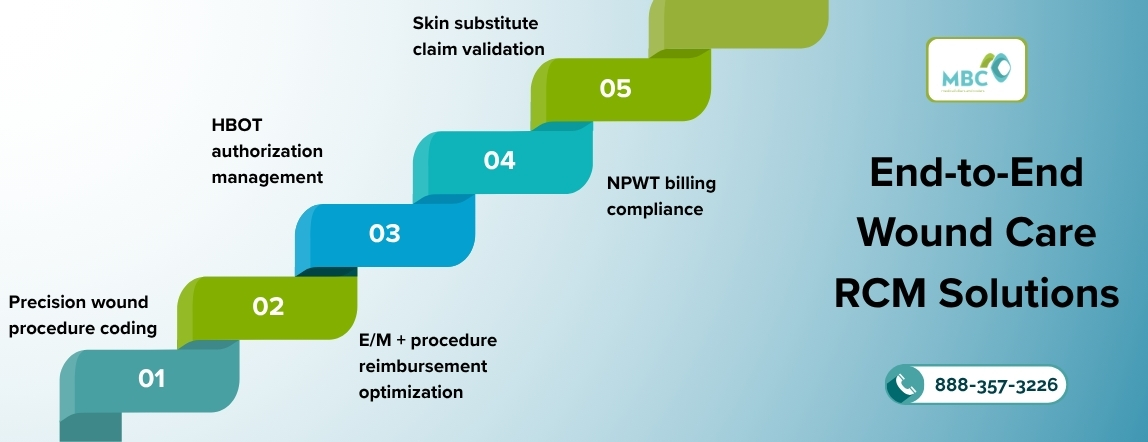
MBC’s wound care billing practice is built around the four revenue failure points that define wound care specialty billing: debridement code accuracy, modifier 25 compliance, HBOT authorization management, and NPWT supply documentation.
These are not areas where general billing competence is sufficient — each requires wound care-specific expertise that a generalist billing team does not develop without dedicated subspecialty training.
Why MBC Leads in Wound Care Billing
- Debridement Code Accuracy: CPT debridement code selection requires precise wound measurement documentation. CPT 97597 covers the first 20 square centimeters of active wound care; CPT 97598 bills each additional 20 square centimeters. Selective and non-selective debridement carry different code families entirely. MBC’s wound care coders review measurement documentation before code assignment — preventing the most common wound care billing error: applying a single debridement code to a wound that documentation supports billing as multiple units.
- Modifier 25 and E/M Revenue Recovery: Wound care centers with high procedure volumes frequently lose E/M revenue when billing companies omit modifier 25 or apply it to non-compliant documentation. MBC’s pre-submission documentation review checks each encounter for separately identifiable E/M documentation before claim submission — recovering E/M revenue that generalist billing companies systematically write off through modifier omission.
- HBOT Authorization as Standard Workflow: Medicare and most commercial payers require prior authorization for HBOT under CPT 99183. MBC manages the full authorization lifecycle — initial request, medical necessity documentation, session tracking, and re-authorization at payer-defined intervals — as a standard service. Wound care practices whose billing companies treat HBOT authorization as the practice’s responsibility generate avoidable HBOT write-offs that accumulate into six figures annually at high-volume HBOT centers.
- NPWT and Skin Substitute Documentation: Negative pressure wound therapy billing requires device type determination (E2402 for rental versus A6550 for disposable), supply quantity documentation, and session frequency compliance with payer coverage policies. Skin substitute applications require manufacturer invoice documentation for high-cost graft products before CMS and commercial payer reimbursement. MBC’s wound care billing workflow includes pre-submission documentation checkpoints for both — eliminating post-denial audit cycles that create cash flow disruption for wound care centers.
- 97%+ NCR for Wound Care Practices: MBC delivers a 97%+ Net Collection Rate to wound care centers through specialty-specific coding protocols, real-time claim scrubbing against wound care payer rules, and proactive denial root-cause analytics that identify payer-specific coding patterns before they become systematic write-off categories.
- Best For: Hospital-affiliated outpatient wound care centers, multi-site wound care practices, HBOT centers with high authorization volume, and independent wound care groups with complex debridement and skin substitute billing.
Contact MBC for Wound Care Billing: 888-357-3226 | info@medicalbillersandcoders.com
#2: Omega Healthcare: Best for Health System Wound Care Service Lines
Omega Healthcare operates one of the largest RCM outsourcing platforms in the industry, processing over 100 million annual transactions across a broad client base. For large health systems with wound care service lines embedded within broader hospital RCM infrastructure, Omega offers genuine scale and process automation depth.
The limitation for independent wound care centers and multi-site specialty practices is Omega’s generalist model. Its operational scale is built for health system claim volume — not the subspecialty coding accuracy that HBOT-intensive and complex debridement practices require.
Wound care centers with high-acuity procedure mixes and significant skin substitute billing volume should evaluate whether Omega’s broad RCM infrastructure matches their specialty coding requirements before committing.
Best For: Large health systems with wound care service lines already integrated into Omega Healthcare’s broader hospital RCM infrastructure.
#3: CareCloud: Best for Mid-Size Wound Care Practices
CareCloud’s structured denial management workflows and live reporting dashboards provide genuine operational visibility for wound care practice administrators. Its 90% collection rate metric is credible for wound care practices with moderate procedure complexity — primarily routine debridement, simple NPWT, and standard chronic wound management without high HBOT or complex skin substitute volume.
The ceiling appears at wound care centers with high procedure complexity. HBOT authorization management, complex debridement code selection, and skin substitute invoice documentation require subspecialty expertise that CareCloud’s generalist model does not consistently deliver for high-acuity wound care cases.
Best For: Mid-size wound care practices with moderate procedure complexity seeking structured workflow management and real-time claims visibility.
#4: eClinicalWorks RCM: Best for Existing eCW Platform Users
eClinicalWorks RCM’s wound care billing capabilities are best understood as platform-integrated billing — the system reduces documentation-to-claim friction for practices already operating on eCW, but its specialty coding depth depends on the eCW billing module’s configuration and the expertise of the billing team assigned to the account.
For wound care centers not already on eClinicalWorks, the RCM offering provides no meaningful advantage over dedicated wound care billing specialists. Practices evaluating eCW RCM should directly assess whether their assigned billing team has documented wound care subspecialty experience — not just eCW platform training.
Best For: Wound care practices already operating on eClinicalWorks EHR seeking integrated billing workflow management within the existing platform ecosystem.
#5: Tebra (Formerly Kareo): Best for Small Independent Wound Care Offices
Tebra is not a credible evaluation option for wound care centers with significant HBOT volumes, complex debridement billing, or skin substitute product documentation requirements. Its billing infrastructure is optimized for small independent practices and primary care, not the specialty coding complexity of outpatient wound care centers.
Best For: Solo practitioners managing simple wound care billing with low procedure complexity within the existing Kareo platform.
The Five Wound Care Billing Errors That Silently Drain Revenue
Before selecting any wound care billing company, assess your current billing partner’s performance against these five specific failure points:
1. Debridement Unit Underbilling:
Billing a single debridement unit when wound measurement documentation supports multiple units is the most common wound care billing error. Each additional 20 square centimeter wound area beyond the first qualifies for an additional unit under CPT 97598. Consistent underbilling at a high-volume wound care center generates five-figure monthly revenue loss.
2. E/M Bundling from Missing Modifier 25:
Payers bundle E/M visits into the procedure fee when modifier 25 is absent, eliminating the E/M reimbursement entirely. At a wound care center performing 100 monthly procedure visits with concurrent E/M, modifier 25 omission eliminates $4,000–$8,000 in monthly E/M revenue depending on payer mix and E/M level distribution.
3. HBOT Authorization Expiration:
Most payers authorize HBOT in blocks of 10–20 sessions. Failing to track and renew authorization before session block expiration generates clean-claim denials at session 11 or 21 — avoidable denials that require retroactive appeal and create cash flow gaps at HBOT-intensive wound care centers.
4. NPWT Device Type Misclassification:
Billing E2402 (rental device) when the practice supplied a disposable NPWT device (A6550) — or vice versa — generates payer denials and potential overpayment liability on audit. NPWT device type must be confirmed at the point of supply dispensing, not at billing.
5. Skin Substitute Invoice Documentation:
CMS requires manufacturer invoice documentation for high-cost skin substitute applications billed under Q-codes. Missing invoice documentation triggers post-payment audit recoupment — a liability that often exceeds the original reimbursement in combined recoupment and appeal costs.
Ready to Recover Your Wound Care Revenue?
If your wound care center is experiencing HBOT authorization denials, E/M bundling from modifier 25 omissions, or debridement underbilling, you are generating avoidable write-offs on every claim cycle.
MBC’s wound care billing specialists deliver subspecialty-certified coding, HBOT authorization management, and NPWT documentation workflows as standard services.
Request a complimentary AR analysis for your wound care practice and identify the specific coding failure points your current billing workflow is generating.
FAQs: Best Wound Care Medical Billing Companies
To bill wound care services, code debridement by documented wound size using CPT 97597 for the first 20 sq cm and 97598 for each additional 20 sq cm. Add modifier 25 for same-day E/M visits, secure HBOT prior authorization under CPT 99183, confirm NPWT device type, and attach manufacturer invoices for skin substitutes.
Q: Which company is best in medical billing?
The best medical billing company is one with proven depth in your specialty. For wound care, Medical Billers and Coders (MBC) leads with subspecialty-certified coders, HBOT authorization management as a standard service, NPWT and skin substitute documentation checkpoints, and a 97%+ Net Collection Rate for wound care centers.
Q: What are the top 5 medical billing companies in the USA?
The top five medical billing companies in the USA for wound care are Medical Billers and Coders (MBC), Omega Healthcare, CareCloud, eClinicalWorks RCM, and Tebra (formerly Kareo). MBC leads for hospital-affiliated and multi-site wound centers, while Omega, CareCloud, eCW, and Tebra suit health systems, mid-size groups, eCW users, and small offices.
Wound care billing requires precise measurement-based code selection for debridement, E/M and procedure same-day billing using modifier 25 with compliant documentation, hyperbaric oxygen therapy authorization management, and negative pressure wound therapy supply documentation. AAWC data indicates wound care practices lose 10%–18% of collectible revenue to coding errors, modifier omissions, and authorization failures annually — losses that a subspecialty-certified wound care billing company eliminates at the claim level.
Top-performing wound care centers achieve Net Collection Rates of 94%–97% according to MGMA specialty benchmarks. The national median sits near 91%–93% because of persistent debridement coding errors and HBOT authorization denial volume. A billing company delivering below 90% NCR for a wound care center is allowing systematic revenue loss through avoidable coding failures.
The five most common wound care billing errors are: incorrect debridement unit selection from imprecise wound measurement documentation; missing modifier 25 on E/M visits billed on procedure days; HBOT denials from incomplete authorization or non-compliant session documentation; NPWT device type misclassification between rental and disposable codes; and skin substitute product billing without required manufacturer invoice documentation.
Medicare covers HBOT under CPT 99183 for 14 specific wound-related diagnoses including diabetic wounds of the lower extremities, chronic refractory osteomyelitis, and compromised skin grafts. Coverage requires prior authorization from most Medicare Advantage plans and many commercial payers. A wound care billing company must include HBOT authorization management as a standard workflow — billing HBOT without confirmed authorization is the single largest source of avoidable HBOT write-offs.
When a wound care provider performs both an E/M visit and a procedure on the same date of service, the E/M must be billed with modifier 25 to indicate that the evaluation was significant and separately identifiable from the pre-procedure assessment. Without modifier 25 and compliant documentation, payers will bundle the E/M into the procedure payment — a systematic revenue loss that wound care practices with high procedure volumes experience as six-figure annual write-offs.

A Senior Sales Manager with 18 years of experience in wound care billing services, healthcare sales, and provider relationship management. Passionate about increasing awareness of effective wound care solutions while helping healthcare organizations improve revenue performance, operational efficiency, and patient outcomes.