Specialities
 Services
 Resource Center
 Pricing
 About
About
 Contact
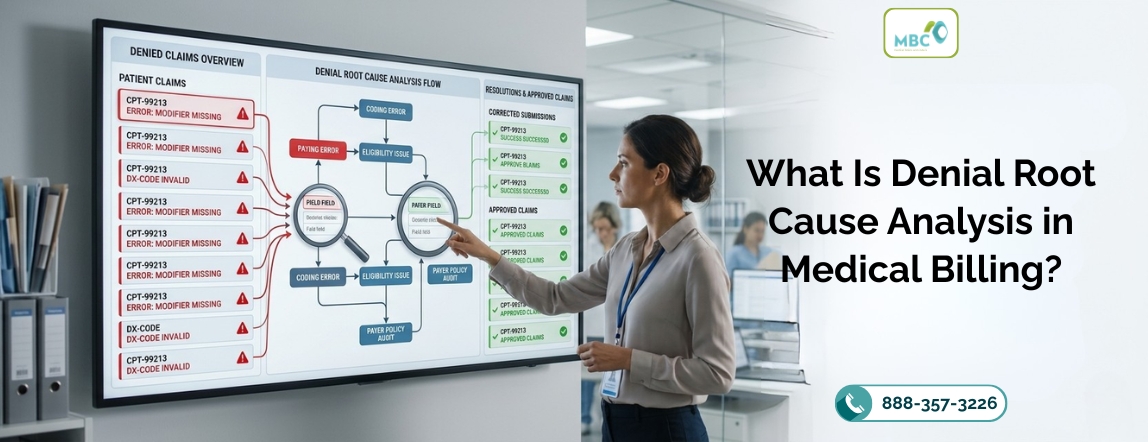
Denial Root Cause Analysis is a structured, data-driven discipline that traces every denied claim back to the specific process failure that created it — so your team fixes the system, not just the symptom. For healthcare organizations that want to stop bleeding revenue, this is no longer optional. Here is the problem most revenue cycle leaders already feel: denial rates across U.S. hospitals have climbed to nearly 12% of all submitted claims.
The Centers for Medicare & Medicaid Services (CMS) 2023 Improper Payment Report confirmed that improper payments — largely driven by insufficient documentation and coding errors — reached $31.4 billion in the Medicare Fee-for-Service program alone.
Across the industry, approximately $262 billion in medical claims are initially denied each year, costing providers $25 to $118 per claim in rework costs alone. That is a margin crisis hiding inside your remittance data.
Why ‘Working’ Denials Is Not the Same as Solving Them
Most billing teams work denials. Few teams actually eliminate them. There is a critical difference. Working a denial means you appealed it, recovered some payment, and moved on. Denial Root Cause Analysis means you identified the operational failure behind that denial and built a guardrail to prevent it from happening to the next 500 similar claims.
The Agency for Healthcare Research and Quality (AHRQ) — which established the foundational RCA framework used across patient safety and now adapted for revenue operations — defines root cause analysis as the process of identifying “systemic errors” rather than individual blame. That framing matters: your denials are almost never caused by one biller’s mistake. They are caused by broken workflows upstream.
For providers relying on generic medical billing services, this distinction rarely gets made. For organizations partnering with a revenue integrity partner operating a true RCA infrastructure, it is the difference between a 12% denial rate and a 3% one.
The Five Root Cause Categories That Drive 90%+ of Your Denials
Effective Denial Root Cause Analysis does not categorize denials by the payer’s remark code. It categorizes them by the internal process failure. Here is what MBC’s denial data across multi-site health systems consistently surfaces:
- Coding Errors (26%): Insufficient diagnosis specificity, bundling violations, missing modifiers
- Registration & Eligibility (24%): Wrong payer on file, inactive coverage, demographic mismatches
- Authorization Failures (19%): Missing prior auth, expired authorizations, quantity limits exceeded
- Billing Errors (18%): Duplicate claims, timely filing violations, invalid NPI submissions
- Documentation Gaps (13%): Missing clinical notes, insufficient specificity, absent signatures
The OIG Work Plan routinely flags authorization failures and documentation gaps as priority audit targets — meaning these are not just revenue leaks, they are compliance risks. A proper denial management program must address both simultaneously.
AI-Powered Decision Trees: How Modern RCA Actually Works
A mid-size health system processing 500,000 claims annually may face 40,000+ denials. At 15 minutes of manual review per denial, a team of five analysts can realistically review only a fraction of that volume before the appeal window closes.
That is why the shift from manual to AI-powered Denial Root Cause Analysis has become a defining separator between high-performing rcm services and commodity billing operations.
Here is a concrete example of how AI decision trees add precision: A denial code CO-16 (“lacks information”) could mean a dozen different things depending on the Remittance Advice Remark Code (RARC) paired with it. If the RARC is MA-130, clinical records are being requested (Documentation Gap). If it is M-76, a modifier is missing (Coding Error).
A rules-based lookup table misses this context. An AI-powered Denial Root Cause Analysis engine reads both codes, cross-references the claim type and payer contract, and routes the denial to the right specialist — all in under 500 milliseconds. The classification accuracy rate runs between 85% and 92%, versus the wide variance seen across manual analyst teams.
Manual RCA vs. AI-Powered RCA: A Direct Capability Comparison
| Dimension | Manual RCA | AI-Powered RCA (MBC) |
| Speed | 8–15 min per denial | Under 500 milliseconds |
| Accuracy | Varies by analyst — inconsistent across billers | 85%–92% standardized classification rate |
| Scale | Limited to small daily batches | Scalable to millions of claims monthly |
| Insights | Single-factor, linear lookups | Multi-dimensional pattern detection across payers |
| Outcome | Reactive appeal on a claim-by-claim basis | Proactive Prevention Rules Engine — stops denials before submission |
| AR Impact | Minimal — Days in AR remain elevated | Average 22% reduction in Days in AR within 90 days |
From Root Cause Insights to a Prevention Rules Engine
The ultimate deliverable of Denial Root Cause Analysis is not a report. It is a live Prevention Rules Engine — a set of automated pre-submission edits that flag claims before they ever leave your system.
For example: If RCA reveals that a specific commercial payer is consistently denying surgical claims missing Modifier -59, the rules engine auto-flags every claim with that CPT range going to that payer for modifier review before transmission.
Clean claim rates — already at 98%+ for high-acuity surgical cases under MBC management — are a direct result of this proactive loop, not a result of faster appeals.
Organizations that implement this level of revenue integrity solutions infrastructure consistently see:
- 40%–60% reduction in preventable denials within the first six months
- 50%–70% faster resolution cycle on remaining denials
- 22% average reduction in Days in AR within 90 days of activation
- 3x–5x ROI in year one on the infrastructure investment
The CMS No Surprises Act (effective January 2022) has added another layer of complexity, particularly for out-of-network authorization and billing. Practices without an active Denial Root Cause Analysis process are absorbing NSA-related denials without understanding the pattern — and paying $25–$118 per claim in rework for failures that could be eliminated upstream.
What This Means for Your Revenue Cycle Management Strategy
The fundamental shift in revenue cycle management over the last five years has been from transactional billing to revenue performance engineering. Payer contracts have tightened. Prior authorization requirements have expanded — per the AHA’s 2024 Prior Authorization Survey, 94% of physicians report that PA burdens delay necessary patient care.
Documentation requirements have multiplied. In this environment, reactive denial work is an operational tax that compound annually.
Organizations partnering with specialized medical billing and coding services — ones operating a true Denial Root Cause Analysis infrastructure — protect margins in ways internal teams simply cannot scale to. The difference is not effort; it is system design.
STOP LOSING REVENUE TO PREVENTABLE DENIALS
MBC’s Denial Root Cause Analysis diagnostic identifies your top 5 denial drivers and quantifies the annual revenue at risk — before you commit to anything.
Request Your Complimentary Denial Pattern Audit Today
Phone:888-357-3226 | Email: info@medicalbillersandcoders.com
FAQs
CARCs (Claim Adjustment Reason Codes) provide the primary denial reason. RARCs (Remittance Advice Remark Codes) provide the specific context needed to fix it. True Denial Root Cause Analysis requires both codes to accurately identify the operational failure — using just the CARC leads to misrouting and repeat denials.
Most organizations see measurable improvement in denial volume and resolution speed within the first 60–90 days of activating a Prevention Rules Engine. Full ROI — typically 3x–5x — materializes within the first 12 months, based on MBC’s implementation data across multi-site health systems.
No. Smaller practices often carry the highest per-claim rework cost — averaging $25 per claim for solo and small group practices. Even a foundational RCA process targeting the top two denial drivers can materially protect thin operating margins. The process scales to fit the organization.
The ‘5 Whys’ is a structured questioning method: ask ‘Why?’ five times to peel past surface-level symptoms to the actual system failure. Example: Why was the claim denied? (No auth). Why? (Auth not requested). Why? (Patient added to schedule late). Why? (No same-day auth protocol exists). Why? (Workflow gap in scheduling system). The fix is a protocol — not a retrained biller.
Yes — and for most multi-site practices and health systems, an outsourced revenue integrity partner is the only operationally viable option. Internal teams rarely have the claim volume visibility, payer contract analytics, or AI tooling required to run a true enterprise-grade RCA program. MBC provides this as a core component of its RCM services model.
References:

With almost 12 years of experience in healthcare revenue cycle management, this Revenue Cycle Specialist brings deep expertise in medical billing, claims optimization, and practice profitability. Shares industry-backed insights focused on improving collections, reducing denials, and driving operational excellence.