Specialities
 Services
 Resource Center
 Pricing
 About
About
 Contact
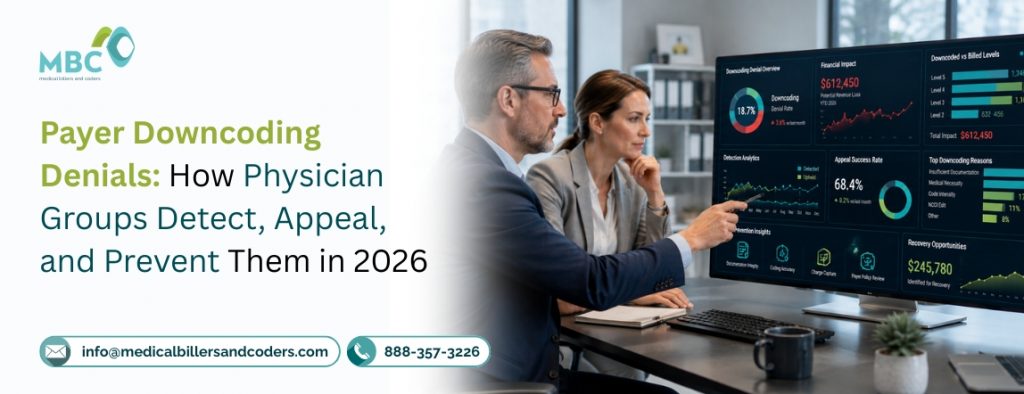
Here is the fact most practices discover eighteen months too late: the majority of payer downcoding never appears as a denial at all.
When UnitedHealthcare, Cigna, Anthem, or a BCBS plan downcodes a claim, one of two things happens. Either the claim is denied with CARC CO-150 — “payer deems the information submitted does not support this level of service” — and lands on your denial dashboard, or the payer quietly adjusts your 99215 to a 99213, pays the lower amount, and posts it as a clean, paid claim. The first version is a payer downcoding denial. The second is silent revenue loss that no denial report will ever surface.
If you are a CFO, practice administrator, or physician group owner searching this term, you are almost certainly dealing with both — and the second one is costing you more. According to MBC’s 2026 RCM services analysis, systematic downcoding costs the average multi-specialty practice $40,000–$180,000 annually in suppressed reimbursement, and roughly 68% of downcoded claims are recoverable when appealed with corrected, MDM-aligned documentation.
This guide covers how to detect both forms in your own remittance data, why most in-house appeals fail, and what a structured recovery workflow looks like.
What Payer Downcoding Denials Actually Are — and Why 2026 Is Different
Downcoding is a payer unilaterally reducing the level of a submitted code — most commonly office and outpatient E/M codes 99204/99205 and 99214/99215 — to a lower level before payment. The practice dates back years; UnitedHealthcare formally shifted from denying under-documented E/M claims to adjusting and paying them at a lower level back in 2019. What has changed is scale and method.
Three forces are converging in 2026:
1. AI-driven adjudication.
Major commercial payers now run automated algorithms that compare your billed E/M level against documentation language and against your physicians’ billing pattern relative to specialty peers.
A 2024 Senate report cited by the AMA found automated tools can deny claims at rates up to 16 times higher than traditional review. UnitedHealthcare uses the Optum EDC Analyzer for claim review; Elevance-affiliated plans use Cotiviti for automated claim editing. No individual clinician reviews the encounters being adjusted.
2. Peer-pattern targeting.
If your physicians bill 99214 at a rate meaningfully above specialty peers, the algorithm flags the entire tax ID — regardless of whether the documentation supports every visit.
High-acuity groups in orthopedics, cardiology, and multi-specialty settings carry the highest exposure precisely because their case mix legitimately skews toward level 4 and 5.
3. Regulatory pushback creating appeal leverage.
Arkansas and Virginia both adopted downcoding laws in 2025, New York’s anti-downcoding bill (S4833) is in committee, and the AAOS published a formal Downcoding Action Guide in late 2025 challenging the legality of adjustment policies that never disclose how determinations are made.
For practices, this matters practically: the regulatory record now documents that payer downcoding algorithms operate without adequate clinical review — which strengthens the foundation of a well-built appeal.
How to Detect Payer Downcoding Denials in Your Own Data This Week
You cannot appeal what you cannot see. Two reports surface the problem:
1. The CO-150 concentration report.
Pull 12 months of denials filtered to CARC CO-150 and related remark codes, grouped by payer and by rendering provider. A concentration of CO-150 on level 4 and 5 E/M codes from one or two commercial payers is not random documentation failure — it is an algorithm flagging your group’s billing pattern.
2. The submitted-vs-paid code variance report.
This is the one most in-house teams never run. Compare the CPT code submitted on each claim against the CPT code the payer actually paid, by payer. When a commercial payer consistently pays one level below what you submitted — with no denial issued — silent downcoding is active. It will not show in your denial rate. It shows up as a net collection rate drifting downward quarter over quarter with no visible cause.
Run both reports before you change anything else. The variance report alone typically quantifies the annual exposure within an afternoon, and it converts an abstract suspicion into a board-ready number.
Why Most Downcoding Appeals Fail — and What Winning Ones Contain
Since the 2021 AMA E/M overhaul, code level is determined by Medical Decision Making or total time — history and exam no longer score.
Payer algorithms exploit a specific documentation gap: the clinical work supports the billed level, but the note does not explicitly capture the MDM elements, especially the “data reviewed and analyzed” component. When documentation only marginally maps to the submitted level, the appeal fails — and the payer’s decision stands.
Winning appeals share four traits:
- Explicit MDM mapping. The appeal walks the payer through the AMA 2021 criteria — number and complexity of problems addressed, data reviewed, risk of complications — and shows where each element appears in the record. A physician managing three chronic conditions with medication adjustments in one visit meets high-complexity criteria; the appeal must say so in the payer’s own scoring language.
- Payer-specific structure. Each plan has distinct appeal requirements, timelines, and escalation paths. Generic appeal letters that ignore plan-specific criteria are the single largest reason recoverable dollars stay unrecovered.
- Regulatory framing where applicable. OIG findings from 2025 confirming that major plans used automated tools to downcode without adequate clinical review give appeals a documented regulatory foundation — factual, cited, never adversarial.
- Batch escalation, not one-off letters. Downcoding is systematic, so the response must be too. Practices with structured appeal workflows recover 61–74% of suppressed revenue within 90 days, per MBC’s 2026 analysis. Practices appealing claim-by-claim as staff time allows rarely recover a fraction of that.
Preventing Payer Downcoding Denials Before They Happen
Recovery is reactive. The durable answer is documentation and coding discipline that gives the algorithm nothing to flag:
- Structured notes aligned to MDM scoring. When chart language explicitly maps to the 2021 MDM elements or states total time on the date of service, automated review passes the claim. Practices that restructure documentation this way typically see downcoding rates drop within 60–90 days.
- Pre-submission E/M scrubbing. Every level 4 and 5 claim should be validated against its documentation before it leaves the building — with provider queries when the note does not support the level, so the code is corrected upward or the documentation completed, not silently under-coded.
- Do not under-code defensively. The AMA has warned that adjustment policies pressure physicians into under-coding to avoid scrutiny. Under-coding trades a recoverable loss for a permanent one — and creates its own compliance exposure. Primary care groups should generally see 99214 on roughly 35–50% of established visits; complex specialties higher. Billing well below benchmark means you are paying the payer’s algorithm a tax it never even asked for.
- Monthly payer-level variance monitoring. Downcoding patterns shift as payers update policies each quarter. The variance report from the detection section should become a standing monthly control, not a one-time audit.
Who Performs This Work
Detecting, appealing, and preventing payer downcoding denials at scale is a different discipline from routine claims submission. It requires payer-specific policy intelligence, AAPC-certified coding review against AMA 2021 MDM criteria, and an appeals operation that runs in batches with deadline management — sustained every month, across every commercial payer in your mix.
Medical Billers and Coders (MBC) has spent 25+ years doing exactly this for physician groups across all states and 32+ specialties. Our 400+ AAPC-certified coders pre-scrub E/M claims against documentation before submission, monitor submitted-vs-paid variance by payer for every client, and run structured downcoding appeals — the operating model behind our clients’ 97.4% clean claim rate, 95% net collection rate, and denial rates held under 5%.
If your CO-150 volume is climbing, or your net collections are drifting down with no denials to explain it, the exposure is already quantifiable — and most of it is recoverable.
Recover Your Downcoded Revenue — Call 888-357-3226 or email info@medicalbillersandcoders.com for a payer downcoding exposure analysis of your last 12 months of remittance data.
FAQs: Payer Downcoding Denials
No. A downcoding denial (typically CARC CO-150) rejects the claim for level-of-service documentation and appears on your denial dashboard. Far more common is silent downcoding, where the payer adjusts the code downward and pays the claim — it never registers as a denial and only surfaces through a submitted-vs-paid variance report.
Based on MBC’s 2026 RCM services data, UnitedHealthcare, Anthem/BCBS plans, Cigna, and Humana run the most active automated E/M review programs across commercial and Medicare Advantage lines, with level 4 and 5 office visits (99214, 99215, 99204, 99205) as the primary target.
Payers have broad latitude, but the landscape is shifting. Arkansas and Virginia enacted downcoding laws in 2025, New York legislation is pending, and OIG findings from 2025 documented that major plans used automated tools without adequate clinical review — all of which strengthens the appeal position of practices whose documentation meets AMA 2021 MDM criteria.
Approximately 68% of downcoded claims are overturned on appeal when supported by documentation explicitly mapped to AMA 2021 MDM elements and submitted through a plan-specific appeal workflow, per MBC’s 2026 analysis. Structured workflows recover 61–74% of suppressed revenue within 90 days.
Run a submitted-code-vs-paid-code variance report by payer. If one or more commercial payers consistently pay one E/M level below what you submitted on claims that show as “paid,” silent downcoding is active — and your denial rate will never reveal it.

With almost 12 years of experience in healthcare revenue cycle management, this Revenue Cycle Specialist brings deep expertise in medical billing, claims optimization, and practice profitability. Shares industry-backed insights focused on improving collections, reducing denials, and driving operational excellence.