Specialities
 Services
 Resource Center
 Pricing
 About
 Contact
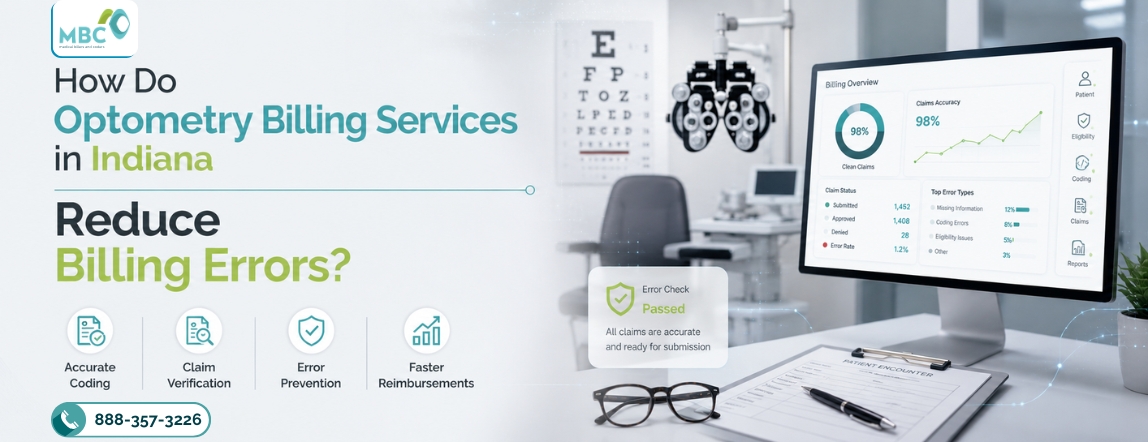
Optometry Billing Services in Indiana are at the center of a growing operational challenge facing eye care practices across the state. As payer policies grow more complex and reimbursement rules become increasingly specialty-specific, even minor errors in claim submission can cascade into denials, delayed payments, and revenue loss that compounds month over month.
For Indiana optometrists — managing everything from routine eye exams to complex medical eye care — the difference between a thriving practice and a cash-flow crisis often comes down to billing precision.
This blog breaks down exactly how specialized Optometry Billing Services in Indiana eliminate the root causes of billing errors, protect reimbursement integrity, and position practices for sustainable revenue performance.
The Real Cost of Billing Errors in Indiana Optometry Practices
Billing errors are not a minor administrative inconvenience. For Indiana eye care providers, they represent a direct drain on Net Collection Ratio, an inflation of Days in AR, and an accumulation of write-offs that never needed to happen. The most common error categories include:
- Incorrect use of CPT codes for medical vs. routine eye exams (92004 vs. 92002 vs. 99213)
- Modifier misuse — particularly modifiers 25, 59, and GY for Medicare-covered vs. non-covered services
- Failure to distinguish between vision plan billing and medical insurance billing for the same encounter
- Missing or insufficient documentation for chronic condition management (e.g., glaucoma, diabetic retinopathy)
- Coordination of benefits errors when patients carry both medical insurance and vision coverage
Each of these errors triggers either an outright denial or a payment reduction. Optometry Billing Services in Indiana are specifically structured to intercept these failure points before claims reach the payer.
How Specialized Optometry Billing Services Prevent Errors at the Source
1. Dual-Track Billing Protocols: Medical vs. Vision Insurance
One of the most persistent sources of billing errors in Indiana optometry practices is the failure to route claims correctly between medical insurers (Medicare, Medicaid, commercial health plans) and vision benefit plans (VSP, EyeMed, Spectera). Optometry Billing Services in Indiana maintain separate billing workflows for each track, ensuring:
- Exam type is coded to the correct payer category based on diagnosis (ICD-10-CM codes H40.xx for glaucoma, E11.3xx for diabetic eye disease flag medical billing)
- Refraction charges (CPT 92015) are billed only to vision plans or as non-covered services to medical payers with appropriate ABN documentation
- Bilateral procedure modifiers (RT/LT or -50) are applied correctly by payer-specific rules
This dual-track discipline alone eliminates a significant category of rejections that plague practices managing billing in-house without specialty-specific infrastructure.
2. Real-Time Eligibility Verification and Benefits Mapping
Billing errors frequently begin before the patient is even seen. Incomplete eligibility verification leads to incorrect payer billing, coordination of benefits failures, and claim rejections on the back end. Professional Optometry Billing Services run real-time eligibility checks that confirm:
- Active coverage and effective dates across both medical and vision plans
- Service-specific deductibles, copays, and plan limitations
- Vision frequency limitations (e.g., exam every 12 months vs. 24 months)
- Prior authorization requirements for specialty contact lens fittings or low vision services
By mapping benefits accurately before the encounter, billing teams eliminate the guesswork that creates downstream rejections and patient billing disputes.
3. Claim Scrubbing and Edit Protocols Before Submission
Every claim submitted through professional medical billing services goes through a multi-layer scrubbing process before it reaches the payer. For Optometry Billing Services in Indiana, this scrubbing protocol includes:
- CPT-ICD-10 medical necessity pairing validation (ensuring diagnosis codes support the services billed)
- Modifier logic checks against payer-specific LCD (Local Coverage Determination) policies
- Bundling edits to prevent incorrect submission of separately billable vs. included services
- Place of service code validation (11 for office, 22 for outpatient hospital-based optometry)
Clean claim rates above 97% are achievable — and expected — when this infrastructure is operational. Without it, first-pass rejection rates in optometry commonly run 12–18%, generating rework cycles that consume staff time and delay cash flow.
Indiana-Specific Payer Landscape: Why Local Expertise Matters
Indiana’s payer mix introduces complexity that generic RCM services are not equipped to manage. Optometry Billing Services in Indiana bring working knowledge of:
- Indiana Medicaid (HHW — Healthy Indiana Plan) vision and medical eye care coverage distinctions
- Anthem BCBS Indiana’s ophthalmology-adjacent billing edits that affect optometrists billing medical eye care
- Medicare Administrative Contractor (MAC) CGS Administrators’ LCD policies governing low vision, contact lens fitting, and glaucoma screening claims
- Managed care organization (MCO) credentialing and prior authorization timelines under Indiana Medicaid managed care
This local payer intelligence is not available in generic national billing platforms. It is built through direct claims experience, payer contract analysis, and ongoing policy monitoring — capabilities that define professional RCM services in this specialty.
Denial Management: Recovering Revenue Before It Becomes a Write-Off
Even with clean-claim protocols in place, a portion of claims will be denied. The distinction between high-performing and underperforming practices is not whether denials occur — it is how fast and how completely those denials are worked.
Optometry Billing Services in Indiana operate structured denial management workflows that:
- Categorize denials by root cause (eligibility, authorization, coding, timely filing) within 24–48 hours of receipt
- Prioritize appeals by dollar value and payer-specific overturn rates
- Generate corrected claims with updated documentation or modifiers within the payer’s appeal window
- Track denial trends by CPT code, provider, and payer to identify systemic errors upstream
Practices leveraging professional Optometry Billing Services in Indiana report average denial overturn rates of 70–85% and measurable reductions in Days in AR within the first 90 days of engagement.
Compliance Safeguards: Protecting Practices from Audit Risk
Indiana optometry practices face audit exposure from Medicare CERT reviews, Medicaid RAC audits, and commercial payer post-payment audits. The most commonly flagged areas include:
- Upcoding comprehensive exams (92004/92014) without documentation meeting the threshold
- Medical eye care claims without physician-level documentation supporting medical necessity
- Contact lens fitting fees billed with incomplete fitting assessment documentation
Professional Optometry Billing Services build compliance guardrails directly into the billing workflow — flagging documentation gaps before submission, not after an audit demand arrives. This proactive approach is what separates specialty billing infrastructure from transactional claim submission.
If your current revenue cycle isn’t delivering clean claim rates above 97% or your Days in AR are trending above 35, it may be time to evaluate your billing infrastructure against a transparent performance benchmark.
If your current revenue cycle isn’t delivering clean claim rates above 97% or your Days in AR are trending above 35, it may be time to evaluate your billing infrastructure against a transparent performance benchmark. Review MBC’s optometry billing service tiers and pricing to understand the investment-to-recovery ratio before making a decision.
Choosing the Right Optometry Billing Services in Indiana
Not all billing vendors are built for optometry’s dual-payer complexity. When evaluating Optometry Billing Services, practices should verify:
- Demonstrated experience with both vision plan networks (VSP, EyeMed) and medical payer billing
- Certified coding staff with ophthalmic coding credentials (COC or equivalent)
- Indiana Medicaid and HHP/HHW managed care billing experience
- Real-time reporting dashboards showing CPT-level performance, denial rates, and collection ratios
- Transparent SLAs: claim submission timelines, denial response windows, and escalation protocols
MBC’s Optometry Billing Services are built on 25+ years of specialty RCM experience, with dedicated coding teams fluent in Indiana’s payer environment and the dual-track billing discipline that eye care practices require. Contact us at 888-357-3226 or info@medicalbillersandcoders.com to schedule a revenue performance analysis.
FAQs: Optometry Billing Services in Indiana
1. What is the most common billing error in Indiana optometry practices?
The most frequent error is misclassifying a medical eye exam under a vision plan or vice versa. Incorrect CPT and ICD-10-CM pairing — particularly for chronic conditions like glaucoma and diabetic eye disease — generates the majority of preventable denials in Indiana optometry.
Yes. Professional Optometry Billing Services in Indiana maintain separate billing tracks for vision benefit plans (VSP, EyeMed, Spectera) and medical insurers (Medicare, Medicaid, commercial PPOs), ensuring claims are routed, coded, and documented correctly for each payer category.
Specialized RCM services monitor Indiana Medicaid managed care organization (MCO) bulletins, HHW coverage updates, and MAC LCD policy changes on an ongoing basis. This continuous policy intelligence is applied directly to claim submission protocols and modifier usage.
High-performing Optometry Billing Services consistently achieve first-pass clean claim rates of 97% or higher for medical eye care billing. Practices currently below 90% are likely absorbing significant rework costs and AR drag that a structured billing service would eliminate.
Most Indiana optometry practices engaging professional medical billing services see measurable AR reduction within 60–90 days. Denial overturn workflows and front-end eligibility corrections are the primary accelerators, with Days in AR improvements of 20–35% common within the first quarter of engagement.
How Do Optometry Billing Services in Indiana Reduce Billing Errors?
Phone: 888-357-3226Email: sales@medicalbillersandcoders.com

Catering to more than 40 specialties, Medical Billers and Coders (MBC) is proficient in handling services that range from revenue cycle management to ICD-10 testing solutions. The main goal of our organization is to assist physicians looking for billers and coders, at the same time help billing specialists looking for jobs, reach the right place.