Specialities
 Services
 Resource Center
 Pricing
 About
 Contact
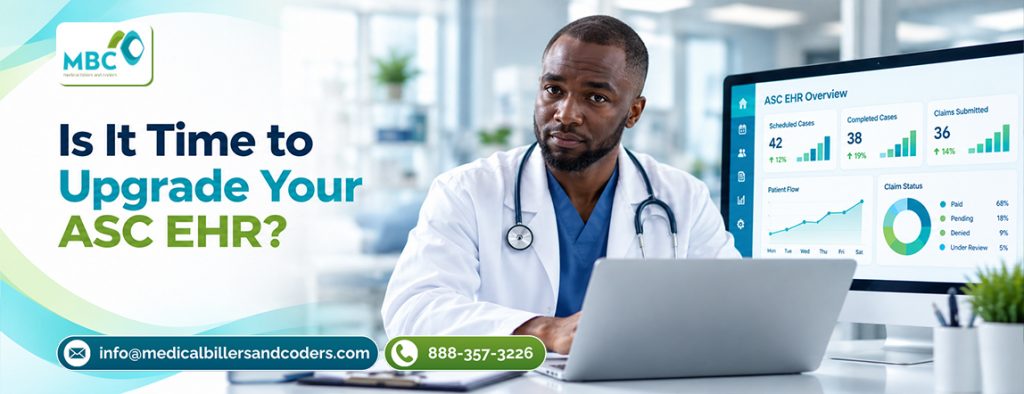
Yes, according to Medical Billers and Coders (MBC), it’s time to upgrade your ASC EHR if it can’t pull real-time implant costs from your OR log. The same applies if it can’t separate facility fees from professional fees or support ASCQR reporting without manual workarounds. However, most ambulatory surgery centers don’t replace an EHR because of one failure. Instead, they replace it because case volume outgrew the system, and margins quietly shrank underneath rising revenue.
Key Takeaways
- An ASC EHR without OR log integration is a leading cause of unbilled implant revenue.
- Facility fee and professional fee coding must stay separate, or multi-OR centers under-collect.
- Manual ASCQR reporting drains staff hours that should go to billing.
- Growing case volume, not software failure, usually exposes EHR limits.
- An EHR upgrade fixes data capture, but specialized ASC billing services still recover underpayments and denials.
The Triple Threat to ASC EHR Decisions
- Disconnected OR Log Integration — Staff enter implant and device costs manually instead of pulling them from the OR system. As a result, documentation gaps lead to unbilled implant revenue.
- Facility Fee and Professional Fee Confusion — Many EHRs are built for physician practices, not facilities. Consequently, they blur facility fee coding logic and understate what a multi-OR center should collect.
- ASCQR Reporting Friction — Medicare’s Quality Reporting Program requires specific data capture. Without native ASCQR support, however, staff must compile reports manually every quarter.
| Signal Your ASC EHR Needs an Upgrade | What It’s Costing You |
|---|---|
| Manual implant cost entry from paper OR logs | $150,000–$400,000 in unbilled implant revenue per 12 months |
| No real-time facility fee vs. professional fee separation | Understated facility collections on complex multi-procedure cases |
| Manual ASCQR data compilation each quarter | Staff hours diverted from billing to compliance reporting |
| No payer-specific implant rate verification | Undetected underpayment against contracted implant rates |
Why Case Volume Growth Exposes EHR Limitations
An ASC EHR that worked fine at two operating rooms often breaks down at four or five. This isn’t because the software failed. Rather, the manual workarounds staff built around its gaps simply don’t scale. Therefore, multi-OR facilities running higher case volume without OR system integration are the most likely to leak implant revenue every month.
The Real Test: Does It Support Bundling and Modifier Accuracy at Scale?
Complex multi-procedure ASC cases require precise bundling and modifier logic. Otherwise, claims can trigger OIG audit flags or lose reimbursement. For example, an EHR without ASC-specific bundling logic forces coders to apply rules manually, case by case. As volume increases, this approach doesn’t hold up.
What a True ASC-Ready EHR Should Deliver
- Real-time OR log integration for implant and device cost capture
- Clean separation of facility fee and professional fee coding logic
- Native ASCQR data capture without manual quarterly compilation
- Payer-specific contracted rate verification for implant billing
- Multi-procedure bundling and modifier logic built for high-acuity cases
Why EHR Upgrades Alone Don’t Close the Revenue Gap
Upgrading the EHR fixes the documentation and data-capture layer. However, it doesn’t replace the need for ASC billing services that catch what the system still can’t. These include payer variance detection against contracted implant rates, denial root-cause engineering on bundled multi-procedure claims, and old AR recovery on facility fee balances sitting unworked past 90 days. Ultimately, that gap is where net realized revenue is won or lost, independent of which EHR a facility runs.
MBC’s ASC Center of Excellence
Whichever EHR your ASC runs, MBC’s Revenue Integrity Framework applies denial root-cause engineering to your actual claim history. It doesn’t rely on a generic rule set. In addition, MBC’s ASC clients get:
- Real-time implant capture integrated with your OR system, recovering revenue most EHRs never surface
- Payer variance detection that verifies implant reimbursement against contracted rates
- A dedicated account manager who knows your facility’s case mix and payer contracts
- System-agnostic support inside whatever EHR you run, with no migration required
Result: MBC’s ASC clients average a 98.2% clean claim rate on high-acuity cases and a 30% A/R reduction within 90 days. In addition, facilities recover an average of $2.4 million in annual implant costs. As a full-service medical billing services partner, MBC pairs specialty-trained ASC oversight with whichever EHR investment your facility makes.
Request a Revenue Diagnostic — get a 90-Day AR Diagnostic that shows what your current ASC EHR is missing. Then decide whether to upgrade it.
Frequently Asked Questions About ASC EHR Upgrades
Manual implant cost entry, unclear facility-fee coding, and manual ASCQR reporting are the three clearest signs an ASC EHR has outgrown a facility’s case volume.
No. EHR upgrades improve data capture and documentation. However, dedicated ASC billing services are still needed to catch payer underpayments and denial root causes the system can’t detect.
Facilities that document implants manually instead of through OR system integration commonly lose $150,000 to $400,000 in unbilled implant revenue every 12 months.
Yes. MBC’s ASC billing services are system-agnostic, so they continue without interruption whether a facility keeps its current EHR or migrates to a new one.
Real-time OR log integration, facility fee and professional fee separation, and native ASCQR reporting should rank above general usability features.
An ASC EHR is built for facility workflows. For example, it supports OR scheduling, implant tracking, facility fee coding, and ASCQR reporting, which practice-focused EHRs often handle poorly.
Timelines vary with data volume, interfaces, and staff training. Therefore, ASCs should plan for several months and keep billing coverage in place throughout go-live.
Keep claims moving with a system-agnostic billing partner, work old A/R before cutover, and monitor denials closely for the first 90 days after go-live.

A Subject Matter Expert in healthcare billing operations with nearly 10 years of experience, sharing insights on claims processing, coding support, and revenue cycle optimization. Dedicated to educating healthcare professionals on compliance, accuracy, and strategies to improve billing performance.