Specialities
 Services
 Resource Center
 Pricing
 About
About
 Contact
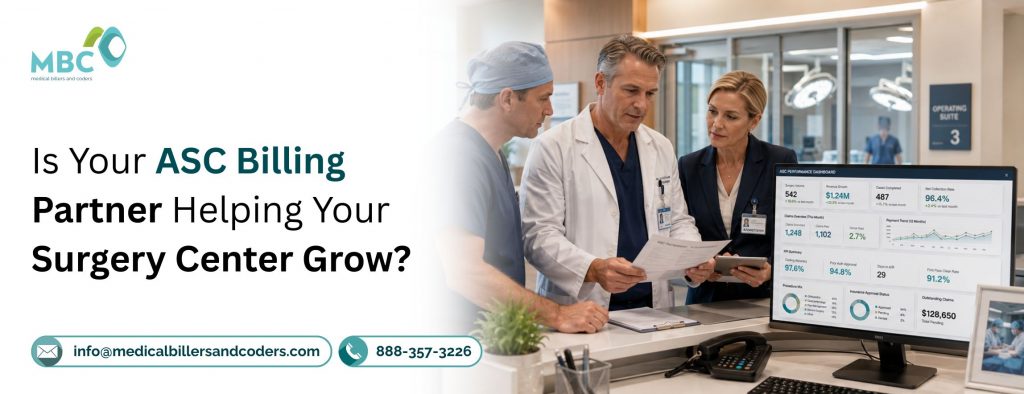
No — your ASC billing partner is not helping your surgery center grow if it is processing claims without protecting implant revenue, managing prior authorization windows reactively, or reporting facility performance through a collections summary that conceals which procedure categories are underperforming and which payer contracts are systematically underpaying.
An ASC billing partner that processes claims is a transaction vendor. An ASC billing partner that protects net realized revenue on high-acuity surgical cases, recovers implant cost leakage in real time, and delivers CFO-grade payer variance reporting monthly is a growth infrastructure — the operational foundation that allows a multi-OR surgery center to scale case volume without scaling revenue cycle failure.
The difference between the two is not price per claim. It is whether the billing partner can answer five performance questions that define whether your ASC is collecting what it is owed or absorbing what payers choose to pay.
The Triple Threat to ASC Margins in 2026:
- Implant revenue leakage — unbilled or underbilled implant costs generating $180,000 average annual loss per busy ASC without real-time OR log integration
- Prior authorization expiration on high-revenue surgical cases — unauthorized-service denials on orthopedic, spine, and ophthalmology procedures with compressed appeal windows
- Payer variance on facility fee claims — contracted rate underpayments accepted silently on complex multi-procedure cases that no denial report surfaces
Five Questions That Reveal Whether Your ASC Billing Partner Is a Growth Infrastructure or a Transaction Vendor
Question 1 — How Does Your Billing Partner Capture Implant Revenue?
Implant cost recovery is the highest-stakes billing function in ASC revenue cycle management — and the one most consistently mishandled by generalist billing vendors without ASC-specific operational infrastructure. Orthopedic hardware, spine implants, ophthalmologic lenses, and cardiac devices each carry per-implant invoice costs that must be captured from the OR log, verified against payer-specific implant cost passthrough or separately reimbursable thresholds, and billed correctly against the applicable HCPCS code before the claim is submitted.
The correct answer: real-time OR log integration capturing implant use at case completion, automated invoice reconciliation against payer-specific implant reimbursement thresholds, and a billing workflow that submits implant claims concurrent with the facility fee claim — not as a separate follow-up process that misses the timely filing window.
A multi-OR ASC performing 150 orthopedic and spine cases monthly with a 12% implant capture failure rate loses $259,200 to $648,000 per 12 months in unbilled implant costs — a charge capture failure that a billing partner with real-time OR log integration prevents at the source.
Question 2 — How Does Your Billing Partner Manage Prior Authorization on High-Revenue Surgical Cases?
Orthopedic reconstruction, spine procedures, ophthalmologic surgery, and multi-level pain management cases carry the highest per-case facility fee revenue in the ASC setting — and the highest prior authorization denial rates. A billing partner without real-time PA requirement tracking generates unauthorized-service denials representing $3,200 to $18,000 per denied case in facility fee revenue — with appeal windows as compressed as 14 to 30 days from denial date on Medicare Advantage plans.
The correct answer: PA requirement tracking updated continuously by payer and procedure code — not quarterly — with proactive authorization follow-up before the case date and a 24-hour denial triage protocol classifying every PA denial by failure mechanism. Authorization expiration denials require a corrected authorization request, not a clinical appeal; mismatch denials require a specific correction process, not a standard resubmission. A billing partner filing all PA denials through the same appeal path exhausts the remedy window on 30% to 40% of correctable denials before resolution.
For how prior authorization denial patterns are affecting ASC revenue in 2026, see Prior Auth Denial Trends 2026 and Payer-Specific Denial Patterns: How UHC and BCBS Are Denying Claims in 2026.
Question 3 — How Does Your Billing Partner Detect Payer Variance on Facility Fee Claims?
ASC facility fee claims — billed under revenue code 0490 for general surgery, 0360 for orthopedics, and procedure-specific codes for ophthalmology and pain management — are subject to payer-specific contracted rates that differ materially from the CMS ASC fee schedule. Commercial payers and Medicare Advantage plans have documented patterns of applying internal payment edits that reduce facility fee payments below contracted allowables on complex multi-procedure cases — without generating a denial.
The correct answer: a payer variance detection protocol comparing contracted facility fee rates against actual payments by revenue code, CPT code, and payer on every remittance cycle — flagging variances before the filing window closes. A multi-OR ASC processing 200 surgical cases monthly with a 5% payer variance incidence rate and an average facility fee underpayment of $420 per case absorbs $504,000 per 12 months in silent underpayments that trigger no corrective action unless payer variance detection is running on every remittance.
Question 4 — How Does Your Billing Partner Report ASC Performance to Your CFO?
An ASC billing partner helping a surgery center grow reports performance in the metrics that drive growth decisions: Net Collection Rate by procedure category and by payer, Days in AR by case type, implant capture rate by OR, prior authorization denial rate by procedure code, and payer variance rate by contracted payer — not a monthly collections summary that tells the CFO how much arrived without telling them how much should have arrived or why the difference exists.
The correct answer: a monthly CFO-grade dashboard populated with ASC-specific KPIs benchmarked against payer-specific and procedure-specific performance norms — with every metric below benchmark flagged with the specific denial root-cause driving it and a corrective action with a 30-day resolution timeline. A billing partner delivering a collections summary is reporting history. A billing partner delivering a KPI dashboard is providing growth intelligence. For the full RCM reporting framework behind ASC financial performance, see Revenue Cycle Management in Healthcare.
Question 5 — Is Old AR Recovery Included in Your Billing Partner’s Standard Service?
ASC claims in the 90-to-180-day AR bucket — particularly implant passthrough claims, multi-procedure facility fee claims denied on bundling edits, and PA expiration denials — carry specific recovery paths that close permanently when the applicable payer filing or grievance window expires. A billing partner treating 90-day AR as a write-off threshold rather than a recovery audit trigger permanently forfeits 20% to 35% of recoverable ASC AR on every billing cycle.
The correct answer: Old AR Recovery built into the standard billing contract — with quarterly AR audits classifying 90-plus day claims by failure mechanism, recovery worked within the applicable payer window, and results reported by denial category against a net realized revenue benchmark. For how 90-day AR misclassification affects ASC revenue, see Medical Billing Company Red Flags.
What a Growth-Oriented ASC Billing Partner Actually Delivers
A billing partner helping your ASC grow does not wait for denials to trigger corrective action. It captures implant revenue at case completion, manages prior authorization before the case date, detects payer variance on every remittance, delivers CFO-grade KPI reporting monthly, and recovers 90-day AR before filing windows close — as standard operating infrastructure, not as premium service tiers or project-based engagements.
The financial difference between a transaction billing vendor and a growth infrastructure ASC billing partner: $180,000 to $2,400,000 per 12 months in recovered implant revenue, protected facility fee revenue, and recovered AR — depending on case volume, procedure mix, and payer contract composition. At a 4-OR ASC performing 300 surgical cases monthly, this revenue gap is the difference between a stable collections line and a compounding growth platform.
How MBC’s ASC Billing Partner Infrastructure Drives Surgery Center Growth
MBC’s ASC Billing Services team operates as a growth infrastructure partner — not a claims processing vendor. Our real-time OR log integration captures implant revenue at case completion, eliminating the charge capture failure pattern generating $259,200 to $648,000 per 12 months in unbilled implant costs at high-volume orthopedic and spine ASCs. Our prior authorization management workflow maintains real-time PA requirement tracking by payer and procedure code, with proactive authorization follow-up before case dates and 24-hour denial triage routing every PA denial to the correct recovery path before the appeal window compresses.
Our payer variance detection protocol compares contracted facility fee rates against actual payments by revenue code and payer on every remittance cycle — recovering silent underpayments before filing windows close. Our dedicated account manager delivers a monthly CFO-grade dashboard populated with all five performance KPIs above, benchmarked against ASC-specific payer norms, and reviewed with your administrator before the next billing cycle opens. Our Old AR Recovery unit runs quarterly ASC AR audits — classifying 90-plus day implant, facility fee, and PA denial claims by failure mechanism and working the recoverable portion within applicable payer windows before permanent closure.
With MBC’s 97% clean claim rate and proven 30% A/R reduction within 90 days, surgery centers transitioning to MBC’s ASC billing partner infrastructure recover an average of $420,000 to $1,800,000 per 12 months in revenue their previous billing vendor was systematically missing across implant capture, payer variance, and 90-day AR recovery categories.
Practices completing MBC’s Complimentary 90-Day AR Diagnostic receive an ASC-specific revenue gap analysis covering all five performance questions above — populated with actual OR and claims data, benchmarked against payer-specific ASC performance norms, and reviewed with a dedicated account manager before the next case volume cycle closes.
Request Your Free Revenue Diagnostic — contact us at info@medicalbillersandcoders.com or call 888-357-3226.
Medical Billing Services | medicalbillersandcoders.com | 888-357-3226
Frequently Asked Questions
Q1. What is the difference between an ASC billing partner and a standard medical billing company?
An ASC billing partner is a billing company with operational infrastructure specifically built for ambulatory surgery center revenue cycle requirements — real-time OR log integration for implant cost capture, ASC-specific facility fee coding under revenue code and HCPCS frameworks, prior authorization management for high-revenue surgical procedure categories, and payer variance detection on facility fee claims. A standard medical billing company applies general outpatient billing logic to ASC claims — producing systematic implant capture failures, PA denial misrouting, and facility fee underpayments that a standard denial report never surfaces.
Q2. How much implant revenue does a typical ASC lose annually without real-time OR log integration?
Industry benchmarking consistently identifies $180,000 to $648,000 per 12 months in unbilled or underbilled implant costs at multi-OR ASCs without real-time OR log integration, depending on case volume, procedure mix, and payer contract composition. At a 4-OR ASC performing 150 orthopedic and spine cases monthly, a 12% implant capture failure rate generates $259,200 to $648,000 in annual implant revenue leakage — a charge capture failure, not a collections failure, that requires OR log integration at the source rather than retrospective billing audits.
Q3. Why do prior authorization denials on high-revenue ASC cases carry higher revenue risk than standard outpatient denials?
High-revenue ASC cases — orthopedic reconstruction, spine procedures, ophthalmologic surgery — carry facility fee revenue of $3,200 to $18,000 per case. A prior authorization denial on a single high-revenue case represents more facility fee revenue than 20 to 40 standard outpatient encounters. Combined with Medicare Advantage appeal windows compressed to 14 to 30 days from the denial date, PA denials on ASC cases that are not triaged within 24 hours of receipt and routed to the correct recovery path generate permanent write-offs at a revenue scale that standard outpatient denial management workflows are not designed to address.
Q4. How does payer variance on ASC facility fee claims differ from a standard claim denial?
Payer variance on ASC facility fee claims is a payment adjustment — the payer issues payment at a rate below the contracted allowable without generating a denial — making it invisible on denial reports and unaddressable through standard appeal processes. Recovery requires a contracted-rate dispute process or a formal underpayment grievance filed within the applicable payer window, which differs from the standard appeal process and requires payer-specific contracted rate data to document. A billing partner without payer variance detection running on every remittance cycle accepts these adjustments as final payments.
Q5. What ASC-specific KPIs should a surgery center administrator review monthly to assess billing partner performance?
The five ASC-specific KPIs that assess ASC billing partner performance are: Net Collection Rate by procedure category and payer (benchmark 94%+ overall); implant capture rate by OR (benchmark 95%+ of all implants used); prior authorization denial rate by procedure code (benchmark below 8% on any individual high-revenue procedure category); payer variance rate by contracted payer (benchmark zero variance between contracted and actual facility fee payments); and 90-plus day AR as percentage of total AR (benchmark below 15%). Any KPI below benchmark with no documented corrective action and resolution timeline from the billing partner is a growth constraint, not a market condition.

A Subject Matter Expert in healthcare billing operations with nearly 10 years of experience, sharing insights on claims processing, coding support, and revenue cycle optimization. Dedicated to educating healthcare professionals on compliance, accuracy, and strategies to improve billing performance.