Specialities
 Services
 Resource Center
 Pricing
 About
About
 Contact
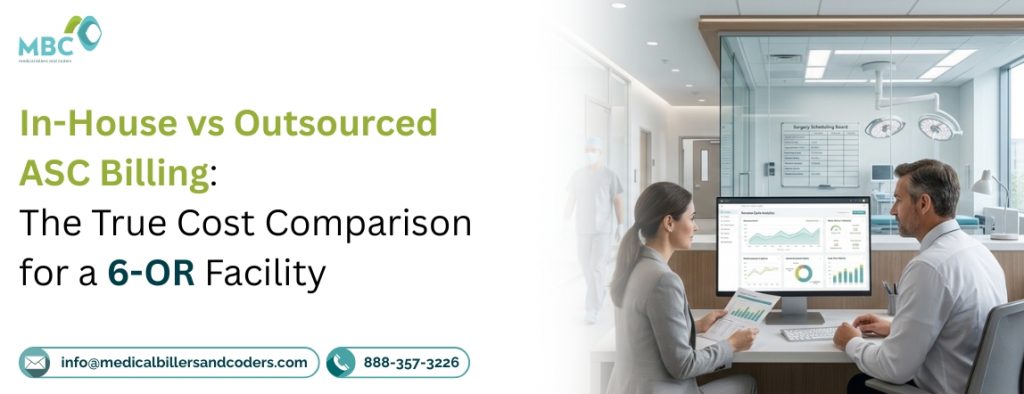
For a 6-OR ASC, outsourced billing typically costs less on a fully loaded basis than an in-house team once staffing, benefits, and turnover risk are counted, though the breakeven point depends on collection volume and case complexity.
Key Takeaways
- The sticker-price comparison, salary versus fee percentage, misses most of the real cost difference.
- A 6-OR facility typically needs three to five in-house billing FTEs, each carrying payroll tax, benefits, and turnover risk beyond base salary.
- Outsourced ASC billing scales with collections, so cost grows only when revenue grows, while in-house staffing stays fixed regardless of volume.
- Implant cost recovery and OIG-compliant bundling require ASC coding depth most in-house teams at this scale can’t maintain without ongoing training.
- The real question is which model captures more of the revenue the facility is already entitled to, not which costs less on paper.
What “Cost” Actually Means for a 6-OR Facility
Most cost comparisons stop at the first number: an in-house biller’s salary against an outsourced partner’s percentage of collections. That comparison misses most of what determines total cost of ownership at a 6-OR scale.
An in-house team handling six operating rooms needs enough staff to cover coding, denial follow-up, implant documentation, and authorization work, typically three to five FTEs across coding, billing, and AR roles. Each FTE carries payroll tax and benefits on top of base salary, plus training costs to keep pace with ASC-specific HCPCS codes, bundling rules, and Medicare’s ASC Quality Reporting requirements. None of that shows up in a simple salary-versus-fee comparison, but it shows up on the balance sheet.
In-House vs. Outsourced Cost Components for a 6-OR ASC
| Cost Component | In-House Billing Team | Outsourced ASC Billing |
|---|---|---|
| Staffing | 3–5 FTEs for coding, billing, and AR follow-up | Included in the collections-based fee |
| Payroll tax and benefits | Layered on top of every salary | Not applicable |
| Turnover and vacancy risk | Backfill gaps directly slow claim submission | Coverage continuity built into the partner’s staffing model |
| Software, clearinghouse, and coding updates | Ongoing licensing and update costs | Included in the partner’s infrastructure |
| Denial management capacity | Limited by in-house team’s bandwidth | Dedicated denial root-cause workflows |
| Implant cost recovery | Requires specialized, ongoing training investment | Built into ASC-specific coding protocols |
| Cost scaling | Fixed regardless of collection volume | Scales directly with collections |
The Hidden Costs In-House Teams Often Miss
Turnover is the most underestimated cost in an in-house ASC billing operation. When a coder with ASC-specific expertise leaves, claims slow immediately, and the facility absorbs a backlog or pays overtime while recruiting a replacement, a gap rarely modeled into an in-house cost estimate but one that shows up directly in Days in AR.
Implant revenue is the second blind spot. High-acuity, multi-procedure ASC cases carry significant implant costs, and capturing that revenue correctly requires coders who understand OR log integration, contracted implant rates, and payer-specific documentation. A generalist team, stretched across coding, billing, and AR duties, frequently undercaptures this revenue without anyone noticing until an audit surfaces the gap.
Common Cost Blind Spots and Recommended Fixes
| Blind Spot | Recommended Fix |
|---|---|
| Turnover backlog slowing claim submission for months at a time | Confirm the billing model has built-in staffing continuity, whether in-house cross-training or outsourced bench depth |
| Implant costs going uncaptured due to generalist coding | Require coders with specific implant cost recovery and OR log integration expertise |
| Software and compliance update costs treated as a rounding error | Include clearinghouse, EHR, and coding update costs explicitly in any in-house cost model |
| Denial management treated as a part-time task | Evaluate whether denial follow-up has dedicated capacity or competes with daily billing volume |
| Cost comparison based on salary vs. fee percentage alone | Model total cost of ownership including benefits, turnover, technology, and undercaptured revenue |
Where Outsourcing Changes the Calculus at 6-OR Scale
At lower surgical volumes, an in-house team’s fixed cost can be the more economical choice. At 6-OR scale, the calculus shifts, since collections-based pricing scales with revenue rather than staying fixed, and the coding depth needed to capture implant revenue and prevent OIG-flagged bundling errors becomes harder to maintain in-house as complexity grows. This is where Revenue Cycle Management built around ASC Billing Services earns its cost, not by being cheaper on paper, but by capturing revenue an in-house team at this scale is structurally more likely to miss. See our related guide on choosing the right RCM model for multi-site practices. If you’re ready to compare providers, see our review of the best ASC billing companies for 2026.
MBC Spotlight: Cost of Ownership Built for Multi-OR Facilities
MBC’s ASC Center of Excellence is built around the exact cost pressures a 6-OR facility carries: dedicated implant cost recovery, real-time denial management, and staffing continuity that doesn’t create a claims backlog every time a coder leaves. Every client works with a dedicated account manager on a system-agnostic platform, backed by a 97% clean claim rate and a 30% A/R reduction within 90 days through the Complimentary 90-Day AR Diagnostic, built on 25+ years of experience and 98% client retention. See our broader guide to outsourced medical billing services for more. Not sure if your current partner is keeping up? Read Is Your ASC Billing Partner Helping Your Surgery Center Grow? for the warning signs.
Conclusion
The in-house versus outsourced decision for a 6-OR ASC comes down to which model captures more of the revenue the facility is already entitled to, while carrying less risk from turnover, compliance gaps, and undercaptured implant costs.
Request Your Free Revenue Diagnostic to see how your facility’s current billing cost structure compares against an outsourced ASC model.
Frequently Asked Questions
Beyond base salaries for three to five FTEs across coding, billing, and AR follow-up, the real cost includes payroll tax, benefits, software fees, ongoing compliance training, and the harder-to-quantify cost of turnover and backfill gaps.
Outsourced ASC billing is typically priced as a percentage of collections, so the fee scales with facility revenue rather than staying fixed the way in-house salaries do, regardless of volume swings.
There’s no single threshold, but multi-OR facilities running high-acuity cases typically see the calculus shift toward outsourcing as implant revenue complexity and denial management demands outpace what a fixed in-house team can absorb.
The highest hidden costs are turnover-driven claims backlogs, undercaptured implant revenue from generalist coding, and the ongoing training needed to keep pace with ASC-specific HCPCS codes and bundling rules.
A complete comparison should include staffing, benefits and payroll tax, software fees, training costs, turnover risk, and the revenue impact of denial management capacity and implant cost recovery accuracy, not just the headline salary or fee percentage.

A Subject Matter Expert in healthcare billing operations with nearly 10 years of experience, sharing insights on claims processing, coding support, and revenue cycle optimization. Dedicated to educating healthcare professionals on compliance, accuracy, and strategies to improve billing performance.