Specialities
 Services
 Resource Center
 Pricing
 About
About
 Contact
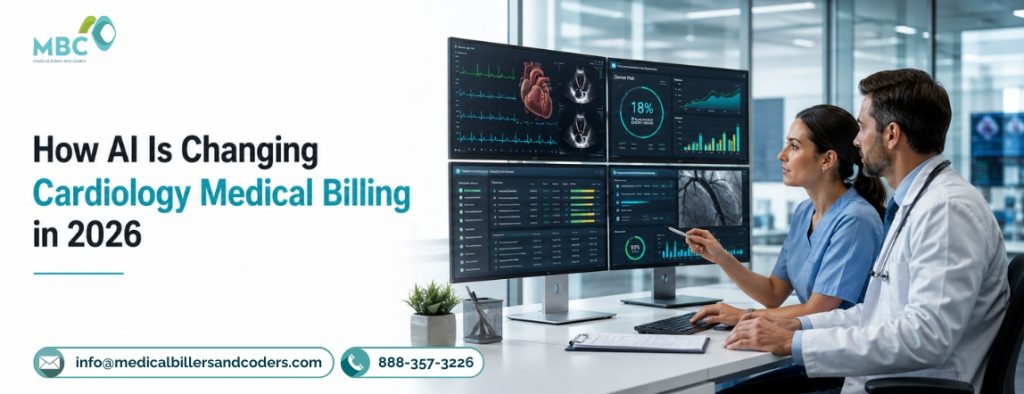
Quick answer: AI is changing Cardiology Billing in 2026 by automating charge capture, flagging coding errors before submission, predicting denials in advance, and speeding up old AR Recovery. Practices pairing AI with experienced coders are seeing cleaner claims and faster payments than those relying on manual workflows alone.
Cardiology billing has always been one of the more unforgiving corners of revenue cycle management. Bundled procedure codes, device claims, and strict medical necessity rules mean even well-run practices lose revenue to denials and delayed reimbursement. In 2026, AI in Cardiology Billing is closing many of these gaps — from automated charge capture to predictive denial scoring.
Why Cardiology Billing Is Hard to Automate
Cardiology sits at the intersection of high-cost procedures and heavy documentation scrutiny. A single cath lab visit can involve dozens of CPT codes and modifiers, and that’s before accounting for echocardiograms, stress tests, and device implants. This repetitive complexity is exactly why AI has found traction here, even though final judgment calls still belong to certified coders.
Where AI Is Making a Real Difference
Faster, More Accurate Charge Capture
AI tools now scan clinical notes and EHR data in real time to flag missed charges before a claim goes out. Natural language processing pulls relevant CPT and ICD-10 codes automatically, cutting under-coding and missed revenue.
Predictive Denial Management
AI models trained on payer behavior can flag a claim as high-risk before submission, based on patterns tied to specific payers or missing documentation. This turns denial management into a preventive process instead of a reactive one.
Smarter Old AR Recovery
Old AR Recovery has traditionally eaten the most staff hours in RCM Services, requiring manual sorting through aging claims. AI now prioritizes worklists by dollar value and likelihood of recovery, so staff spend time where it actually pays off.
Automated Eligibility Checks
Cardiology procedures often require prior authorization, and missing that step is a common denial trigger. AI-driven eligibility engines verify coverage automatically, catching gaps days before the appointment.
Cardiology Billing and the Role of Human Oversight
AI hasn’t replaced billing teams — it has made them faster. Complex appeals and nuanced medical necessity documentation still need a trained biller’s judgment. The strongest Cardiology Billing Services in 2026 pair machine-driven claim scrubbing with human review, which is why many practices now prefer outsourced cardiology billing partners over building AI infrastructure from scratch.
Why Practices Are Outsourcing Cardiology RCM
Building AI-driven billing infrastructure isn’t cheap, and it’s rarely a physician group’s core competency. That’s pushing more practices toward established medical billing services providers with this technology already in place.
Instead of investing in software and training, groups get AI-assisted Cardiology RCM alongside coders who understand cardiovascular procedure rules. For practices weighing in-house costs against outsourcing, comparing current spend to a custom-quoted billing plan is usually the fastest way to see the real difference.
What This Means for Cardiology Denial Trends
Denial rates tied to coding errors should keep falling as AI matures, but payer policy keeps shifting too. CMS regularly updates documentation and medical necessity rules for cardiovascular services, so even a strong AI system needs ongoing retraining. Treating an AI stack as “set it and forget it” is a fast way to fall behind.
Choosing Among the Best Cardiology Billing Companies
Not every vendor claiming “AI-powered billing” applies it where it counts. When comparing the Best Cardiology Billing Companies, ask specifically how they use AI for Cardiology Denial prediction, A/R recovery, and coding accuracy — not just as a marketing line. A true Cardiology RCM partner should show measurable gains in first-pass claim rates and AR turnaround, not just feature lists.
Cardiology Billing Pricing: What to Expect
Pricing for Cardiology Billing Services is rarely a flat percentage, since cath lab volume, device claims, and payer mix vary widely from one practice to the next. Most established providers, including MBC, use a custom-quoted model based on monthly collections, coding complexity, and scope of services rather than a generic rate card.
Before switching vendors or investing in new AI tools, it’s worth seeing where revenue is actually being lost. A complimentary AR Revenue Audit reviews the last 90 days of claims to surface denial patterns, aging AR, and payer underpayments, then delivers a written estimate of recoverable revenue. There’s no cost and no obligation to proceed, just a clear picture of where a practice’s Cardiology Billing stands today.
For official Medicare billing requirements affecting cardiology procedures, refer to the CMS Physician Fee Schedule.
FAQs
It’s automating charge capture, predicting denials before submission, and speeding up old AR recovery, cutting manual errors across the billing cycle.
No. AI handles pattern-based tasks like error flagging, while coders still manage appeals and complex documentation.
Predictive denial management, since it lets practices fix claim issues before submission instead of after a denial.
Many find it more cost-effective to outsource to a provider with AI already integrated, rather than building that infrastructure themselves.
Yes. It prioritizes aging claims by value and recovery likelihood, so staff focus on claims most likely to get paid.

A Subject Matter Expert in healthcare billing operations with nearly 10 years of experience, sharing insights on claims processing, coding support, and revenue cycle optimization. Dedicated to educating healthcare professionals on compliance, accuracy, and strategies to improve billing performance.