Specialities
 Services
 Resource Center
 Pricing
 About
About
 Contact
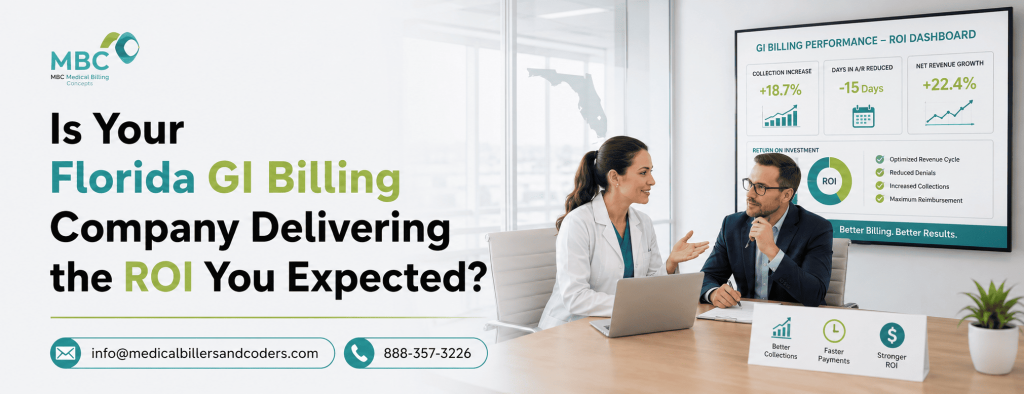
A gastroenterology practice can collect millions of dollars each year and still leave significant revenue uncollected. The problem may not be patient volume. It may be what happens between documentation, coding, claim submission, payer adjudication, payment posting, and A/R follow-up.
For Florida GI practices, evaluating a billing company by total collections alone is not enough. A better approach is to examine whether the billing process is improving clean claim performance, controlling denials, reducing A/R aging, identifying payment variances, and converting collectible revenue into cash.
That is where specialized Florida GI Billing becomes important. A billing partner should be able to explain not only how much the practice collected, but also where revenue is being delayed or lost.
Why ROI Matters in Florida GI Billing
Gastroenterology billing involves services such as colonoscopy, EGD, biopsy, polypectomy, capsule endoscopy, pathology-related workflows, infusion services, and evaluation and management encounters. Each service can create different coding, documentation, authorization, and reimbursement considerations.
Florida also has a substantial Medicare population and a large managed-care environment. For Medicare Part A and Part B claims, First Coast Service Options serves as the Medicare Administrative Contractor for Florida and maintains jurisdiction-specific coverage resources.
Florida Medicaid adds another layer. The Florida Agency for Health Care Administration states that most Florida Medicaid recipients are enrolled in the Statewide Medicaid Managed Care program, with gastrointestinal services included among the covered services for Managed Medical Assistance plans.
This makes payer-specific monitoring an important part of evaluating GI Billing Services.
What Should You Measure?
Your billing company’s ROI should be evaluated using multiple revenue-cycle indicators rather than one monthly collections figure.
| Metric | What to Review | What It Can Reveal |
| Clean Claim Rate | Claims accepted without correction | Front-end coding or claim errors |
| Days in A/R | Average outstanding balance age | Payment delays |
| Denial Rate | Denials by payer and procedure | Recurring billing problems |
| Net Collection Rate | Actual collections against collectible revenue | Revenue realization |
| 90+ Day A/R | Aging by payer and claim type | Recovery opportunities |
| Payment Variance | Expected versus actual reimbursement | Potential underpayments |
The important point is not that every practice should achieve one universal percentage. Performance should be compared with the practice’s historical results, contractual expectations, payer mix, procedure mix, and appropriate specialty benchmarks.
If your billing company cannot provide these numbers, it becomes difficult to determine whether its work is actually improving financial performance.
Florida GI Billing Has Specific Revenue-Cycle Challenges
Florida gastroenterology practices should pay particular attention to screening colonoscopy workflows. The U.S. Preventive Services Task Force recommends colorectal cancer screening for average-risk adults beginning at age 45, expanding the recommended screening population from the previous starting age of 50.
For a GI practice, screening encounters can subsequently involve findings that require diagnostic services. Correctly connecting the clinical documentation, diagnosis coding, procedure coding, and applicable payer requirements is therefore important.
Medicare Advantage is another consideration. CMS projected approximately 34 million Medicare Advantage enrollees for 2026, representing about 48% of Medicare enrollment nationally.
That national figure does not represent Florida specifically, but it demonstrates why GI practices should not evaluate payer performance solely at an aggregate level. Medicare Advantage and commercial plans can have different administrative requirements, making payer-level reporting valuable.
Where a Florida GI Practice Can Lose Revenue
Revenue leakage can occur before a claim is submitted, after a denial, or even after a claim has been paid.
A coding error may cause a claim to require correction. An authorization issue may delay payment. A denial may remain unresolved because nobody follows up within the payer’s required timeframe. A paid claim may also deserve review if the reimbursement does not match the expected contractual amount.
| Revenue Risk | What to Investigate | Appropriate Response |
| Colonoscopy denial | Diagnosis, procedure and documentation | Coding and documentation review |
| EGD or endoscopy denial | Coding and payer edits | Claim-level review |
| Authorization-related denial | Authorization status and requirements | Pre-service verification |
| 90+ day A/R | Claim history and payer responses | Old A/R Recovery |
| Repeated payer denials | Denial reason patterns | Denial Management |
| Payment variance | Expected versus actual payment | Payer reimbursement review |
This is why effective RCM Services should connect coding, billing, payment posting, denial follow-up, and A/R management instead of treating each function as an isolated task.
How Denial Management Affects Billing ROI
Denial Management should do more than resubmit rejected claims.
A strong process identifies why the denial occurred, determines whether the issue is correctable, tracks the appeal or resubmission, and records the underlying cause. If the same payer repeatedly denies a specific GI procedure for the same reason, the objective should be to correct the upstream process rather than repeatedly work the same denial.
For example, if a payer repeatedly requests additional documentation for a specific procedure, the billing team can identify that trend and communicate the requirement to the coding or clinical documentation team.
This turns denial data into an operational tool rather than simply an A/R task.
Don’t Ignore Old A/R
A billing company may report strong current collections while older balances continue to accumulate.
Old A/R Recovery focuses on unresolved claims that have remained outstanding for extended periods. The review should determine whether each balance is pending, denied, underpaid, awaiting documentation, in appeal, affected by timely filing concerns, or potentially uncollectible.
For Florida GI practices, aged A/R should be reviewed by payer, procedure, provider, dollar value, and claim age. That allows the practice to prioritize recoverable balances instead of simply working claims chronologically.
What Should a Florida GI Billing Company Actually Report?
A useful monthly report should answer practical questions.
Which payers are generating the most denials? Which GI procedures have the highest denial frequency? How much A/R is older than 90 days? Are payments matching expected reimbursement? Is the Net Collection Rate improving? Are denials being resolved faster?
These questions provide much more insight than a report that simply says the practice collected a certain amount during the month.
Specialized Medical Billing Services should give practice owners and administrators enough information to understand what is driving their financial results.
An Example of Measuring Revenue Opportunity
Consider a hypothetical Florida GI practice with $2.4 million in annual collectible revenue.
If the practice improves its effective collection rate from 93% to 97%, the difference is:
$2.4 million × 4% = $96,000
That represents a potential $96,000 improvement in collections under this simplified scenario.
This is an illustrative calculation, not a claim that Florida GI practices typically recover $96,000. Actual results depend on payer contracts, collectible revenue, patient responsibility, denial rates, procedure mix, timely filing, and existing billing performance.
The purpose of the calculation is to show why a seemingly small percentage-point improvement can have a meaningful financial effect.
How MBC Can Help Florida GI Practices
MBC’s Gastroenterology Billing Services can be evaluated around the revenue-cycle areas that directly affect financial performance, including claim accuracy, denial follow-up, A/R management, payer analysis, payment review, and aged A/R.
A Revenue Diagnostic can provide a starting point by examining recent claims and A/R performance to identify where reimbursement is being delayed, denied, underpaid, or left unresolved.
Pricing and Request Your Revenue Diagnostic
The Pricing of GI Billing Services depends on factors such as claim volume, provider count, payer mix, procedure complexity, coding requirements, and the level of A/R and Denial Management support required. A practice-specific review is more useful than relying on a flat industry rate.
Want to know whether your Florida GI billing company is delivering the ROI you expected?
Call 888-357-3226 or email info@medicalbillersandcoders.com to Request your Revenue Diagnostic for your Florida gastroenterology practice.
Conclusion
The ROI of a Florida GI billing company should be measured by more than monthly collections. Clean claim performance, denial trends, A/R aging, payer reimbursement, payment variance, and Net Collection Rate provide a clearer picture of whether the revenue cycle is actually performing efficiently.
For Florida GI practices, payer-specific requirements and complex procedure workflows make specialty-focused RCM Services particularly valuable. Reviewing these metrics consistently can help identify revenue leakage earlier, strengthen Old A/R Recovery, improve Denial Management, and give practice leaders a clearer basis for evaluating their billing partner.
Reference – Centers for Medicare & Medicaid Services
Frequently Asked Questions
Practices should review Clean Claim Rate, Days in A/R, denial rate, Net Collection Rate, 90+ day A/R, payer performance, and payment variance. Reviewing these metrics together provides a clearer picture of billing performance and potential revenue leakage than relying only on monthly collections or total revenue figures.
Florida GI Billing involves procedure-specific coding, documentation, payer requirements, endoscopy workflows, and screening-to-diagnostic scenarios. These factors create billing considerations that general medical billing processes may not fully address. A specialty-focused approach helps ensure claims are accurately coded, submitted, monitored, and followed up appropriately with payers.
Effective Denial Management identifies recurring denial causes, resolves eligible claims, and tracks payer-specific patterns. By addressing the underlying reasons behind denials, GI practices can reduce repeat errors, improve claim resolution, strengthen collections, and prevent avoidable reimbursement delays from affecting future gastroenterology claims and overall revenue performance.
Old A/R Recovery focuses on unresolved claims that have remained outstanding for extended periods. The process reviews claim history, payer responses, documentation, corrections, and appeals to determine which balances remain recoverable. Prioritizing older high-value claims can help practices recover revenue that might otherwise remain unresolved.
A Florida GI practice can identify revenue leakage by reviewing claims, denials, A/R aging, payer performance, payment variance, and reimbursement patterns. A Revenue Diagnostic can bring these areas together to identify where collectible revenue is being delayed, denied, underpaid, or potentially missed during the billing cycle.
How to Choose the Best GI Billing Company in Florida
Phone: 888-357-3226Fax: 888-316-4566
Email: sales@medicalbillersandcoders.com
Is Your Florida GI Billing Company Delivering the ROI You Expected?
Phone: 888-357-3226Fax: 888-316-4566
Email: sales@medicalbillersandcoders.com

A Subject Matter Expert in healthcare billing operations with nearly 10 years of experience, sharing insights on claims processing, coding support, and revenue cycle optimization. Dedicated to educating healthcare professionals on compliance, accuracy, and strategies to improve billing performance.