Specialities
 Services
 Resource Center
 Pricing
 About
About
 Contact
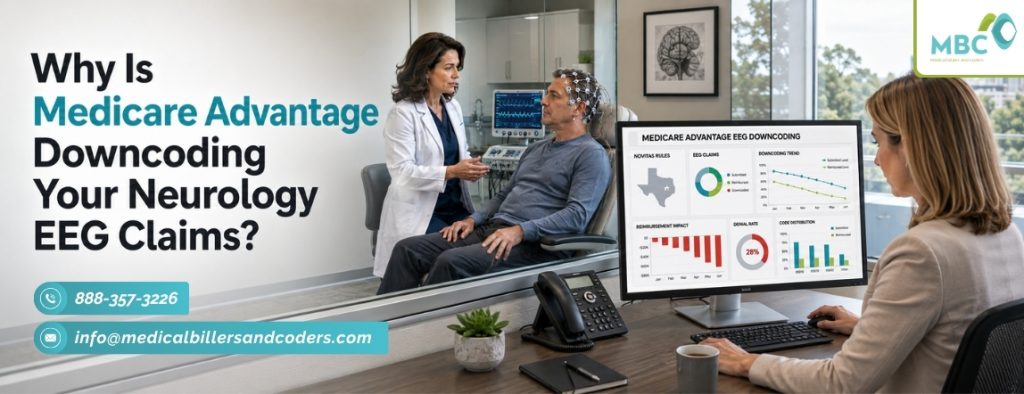
Medicare Advantage EEG downcoding happens when plans downcode neurology EEG claims because their algorithmic review systems scan interpretation reports for specific structured language, not clinical judgment. When a report is written the way physicians are trained to write it, in clinical narrative, the algorithm cannot find what it is looking for, so it defaults to a lower-acuity code, regardless of what the study actually showed.
This is not a clinical accuracy problem. Your neurologist’s diagnosis is correct. The Medicare Advantage EEG downcoding happens because the payer’s software is pattern-matching against structured phrase categories, and clinical narrative simply is not built to be machine-read. Your neurology claims can be clinically accurate and documentarily incomplete at the same time: the clinical accuracy satisfies your standard of care, while the documentary incompleteness satisfies the payer’s basis for a downcode.
A 2026 analysis published in npj Digital Medicine found that AI tools now direct an increasing share of Medicare Advantage coverage and payment determinations, with denial rates climbing sharply as health plans expand their use. This is not hypothetical: UnitedHealthcare’s MA plans have faced litigation over nH Predict, a proprietary AI tool used to drive post-acute care coverage decisions, and CMS has since stated that predictive algorithms cannot be the sole basis for a coverage determination.
Interpretation-report review by MA claims software sits in the same category of proprietary, largely undisclosed algorithmic tooling, applied one layer earlier, at the diagnostic study itself. A 2022 OIG report, cited in a congressional letter on MA oversight, found that 13% of prior authorization denials would have been approved under traditional Medicare rules, and a 2026 industry interview on AI-driven downcoding put the figure at roughly 10% of all claims. Neurology is exposed to this more than most specialties because EEG, EMG, and NCS interpretation is inherently narrative work.
For a CFO or practice administrator, the practical consequence of Medicare Advantage EEG downcoding is this: case volume can hold steady or grow while Medicare Advantage reimbursement per case still declines, because the revenue loss sits at the documentation-format layer, not the clinical-decision layer. The fix does not require your neurologists to practice differently; it requires them to document differently, in a format built for how the claim will actually be reviewed.
Medicare Advantage EEG downcoding differs from an ordinary denial in an important way: HFMA puts the rework cost for a single denied Medicare Advantage claim at roughly $48 in staff time, a cost your team can see and budget against. A downcode never generates that line item. It pays quietly, at the wrong level, on every claim, with no rework trigger and no denial report entry to flag it, which is what makes it more dangerous to a facility’s margin than a denial, not less.
The Three Pillars Behind Medicare Advantage EEG Downcoding and Margin Risk
1. MA Algorithmic Downcoding of Interpretation Reports. An EEG report documenting “abnormal EEG consistent with epilepsy” and a report documenting “interictal epileptiform discharges observed in the left temporal region” can describe the identical finding. Only one is written in the structured format MA algorithms recognize at the correct payment level. Same finding. Different format. Different payment.
2. MAC-Specific LCD Non-Compliance at the ICD-10 Specificity Level. Local Coverage Determinations vary by Medicare Administrative Contractor jurisdiction, and epilepsy coding frequently requires specificity to the seventh character to satisfy LCD requirements. A billing team applying one national coding standard across multiple MAC jurisdictions is filing claims against the wrong requirement by definition, and LCD-driven denials follow on a predictable schedule.
3. Payer-Specific NCS and EMG Bundling Rule Variance. What Medicare allows to be billed separately on a multi-study encounter, a commercial or MA plan frequently bundles. A general billing team applying uniform bundling logic across all payers is systematically underbilling or triggering denials on every multi-study visit, and the pattern repeats every time a patient returns for a follow-up panel.
Each pillar — including Medicare Advantage EEG downcoding — produces the same symptom: a neurologist performs the right study, reaches the right diagnosis, and the practice still gets paid at the wrong level. None looks like a denial on a standard report; each looks like a downcode or a bundled line item, which is why they go undiagnosed for months. The fix is not more billing staff. It is a partner who treats MA algorithm behavior, MAC-specific LCD requirements, and payer-specific bundling as one connected system, because a fix for pillar one that ignores pillar two still leaves revenue on the table.
Medicare Advantage EEG Downcoding: Narrative vs. Structured Format
| Finding | Narrative Format (Downcode Risk) | Structured Format (Algorithm-Compliant) |
|---|---|---|
| Epilepsy | “Abnormal EEG consistent with epilepsy” | “Interictal epileptiform discharges, left temporal region” |
| Nerve entrapment | “EMG shows signs of nerve compression” | “Denervation potentials, median nerve distribution, consistent with entrapment” |
| Neuropathy | “Nerve conduction study suggests neuropathy” | “Reduced conduction velocity, sural nerve, consistent with axonal neuropathy” |
Medicare Advantage EEG downcoding is not a one-time correction a practice can hand its neurologists in a memo. The structured phrasing that satisfies one payer’s algorithm this year is not guaranteed to satisfy it next year, and MA plans update their internal review criteria without publishing what changed. A format fix that works in January can quietly stop working by the following renewal cycle, with no notice beyond a rising downcode rate nobody is tracking against the change.
The LCD-specificity problem compounds this further. A multi-site neurology group operating across two or three MAC jurisdictions is not managing one documentation standard; it is managing as many standards as it has jurisdictions, each with its own seventh-character ICD-10 requirements and its own update schedule. Expecting a physician to internalize and maintain jurisdiction-specific coding nuance on top of a full clinical caseload is not a realistic operational ask, and it is not what physicians are trained or paid to do.
Consistency across providers is the harder problem still. Training the one neurologist whose EEG report triggered last month’s downcode does not fix the pattern; it fixes one provider’s habit until the next hire, the next locum, or the next busy week reverts the group back to narrative-format reporting. Sustaining structured-format compliance across every interpreting provider, on every study type, against payer criteria that shift without notice, is a maintained operational system, not a documentation tip.
That is the actual gap between reading this and solving it. Recognizing that a report needs to say “interictal epileptiform discharges” instead of “abnormal EEG” is straightforward. Building and maintaining the infrastructure that keeps every provider compliant with every MAC’s LCD requirements and every payer’s current algorithmic criteria, indefinitely, is the part that requires a dedicated partner rather than a one-time correction.
Generic RCM vs. MBC Neurology Revenue Operations
| Revenue Challenge | Generic RCM | Internal Billing Team | MBC Neurology Approach |
|---|---|---|---|
| Interpretation Report Format | Not reviewed for algorithm compliance | No visibility into payer algorithm behavior | Physician-facing format training tied to payer requirements |
| LCD/ICD-10 Specificity | One national standard applied | Inconsistent across MAC jurisdictions | MAC-specific coding protocols by jurisdiction |
| NCS/EMG Bundling | CMS rules applied to all payers | Manual, error-prone tracking | Payer-specific bundling logic by plan |
| Clean Claim Outcome | Inconsistent | Inconsistent | 97% clean claim rate |
MBC’s neurology revenue operations close all three gaps — including Medicare Advantage EEG downcoding — under one Revenue Integrity Framework: MAC-specific LCD coding protocols, payer-specific NCS and EMG bundling logic, and physician-facing documentation training that aligns interpretation report language with what Medicare Advantage algorithms are built to recognize. Clients working with MBC’s neurology team see results consistent with our broader enterprise client base: a 97% clean claim rate, up to a 30% reduction in A/R within 90 days, and 98% client retention, backed by 25+ years of specialty-specific revenue cycle experience. This is not a documentation tip sheet.
It is a denial root-cause engineering approach applied to a payer behavior most neurology practices have never diagnosed correctly, and it requires a dedicated account manager who tracks downcode patterns by CPT code and by MAC jurisdiction rather than treating each denial as a one-off event.
If your case volume is steady but your Medicare Advantage reimbursement on EEG, EMG, or NCS studies keeps landing below what the study justifies, the cause is almost never clinical, and it rarely shows up as a line item your team can point to. It shows up in the gap between billed revenue and net realized revenue, compounding against Yield EBITDA every reporting period it goes undiagnosed.
For a multi-provider neurology group approaching a sale, recapitalization, or payer contract renegotiation, that gap belongs on the same diligence checklist as payer mix and provider productivity, as an Enterprise Revenue Integrity issue, not a documentation footnote. Request Your Free Revenue Diagnostic and we will show you, by CPT code and by MAC jurisdiction, exactly where the downcoding is happening and why.
FAQs
Medicare Advantage plans increasingly use algorithmic and AI-assisted systems to review interpretation reports before approving payment at the billed level. These systems detect specific structured findings rather than evaluate clinical narrative the way a human reviewer would. When an EEG or EMG interpretation is written in standard clinical prose, the algorithm often cannot confirm the billed acuity level, so it defaults to a lower-paying code even though the diagnosis was correct.
Algorithmic downcoding occurs when a payer’s automated claims-review software reduces a claim’s payment level based on a pattern-matching review of the submitted documentation, rather than a clinical judgment made by a human reviewer. In neurology, this most often affects EEG, EMG, and nerve conduction study interpretations, where the clinical finding is accurate but the report’s language does not match the structured categories the algorithm was programmed to search for at the correct payment tier.
Local Coverage Determinations are issued separately by each Medicare Administrative Contractor and often require ICD-10 coding to a specific level of detail, particularly for epilepsy and seizure disorder diagnoses. A practice billing across multiple MAC jurisdictions using one uniform coding standard is likely applying the wrong LCD requirement in at least some of those jurisdictions, which produces denials that are difficult to appeal because the missing element is documentation specificity rather than a billing error.
No. Bundling rules for nerve conduction studies and EMG procedures performed during the same encounter frequently differ between traditional Medicare, Medicare Advantage plans, and commercial payers. Services that can be billed separately under Medicare’s national rules may be bundled under a commercial or Medicare Advantage plan’s internal policy, and a billing team applying one bundling standard across all payer types will consistently underbill or trigger avoidable denials on multi-study encounters.
Reducing Medicare Advantage downcode rates requires training physicians and interpreting providers to document EEG, EMG, and NCS findings in the structured language payer algorithms are built to recognize, alongside MAC-specific LCD coding protocols and payer-specific bundling logic. This is an operational and documentation fix rather than a clinical one, which is why practices that solve it typically do so through a specialized billing partner rather than by adding internal billing headcount.
Source: Centers for Medicare & Medicaid Services (CMS) — Local Coverage Determination Process

A Subject Matter Expert in healthcare billing operations with nearly 10 years of experience, sharing insights on claims processing, coding support, and revenue cycle optimization. Dedicated to educating healthcare professionals on compliance, accuracy, and strategies to improve billing performance.