Specialities
 Services
 Resource Center
 Pricing
 About
About
 Contact
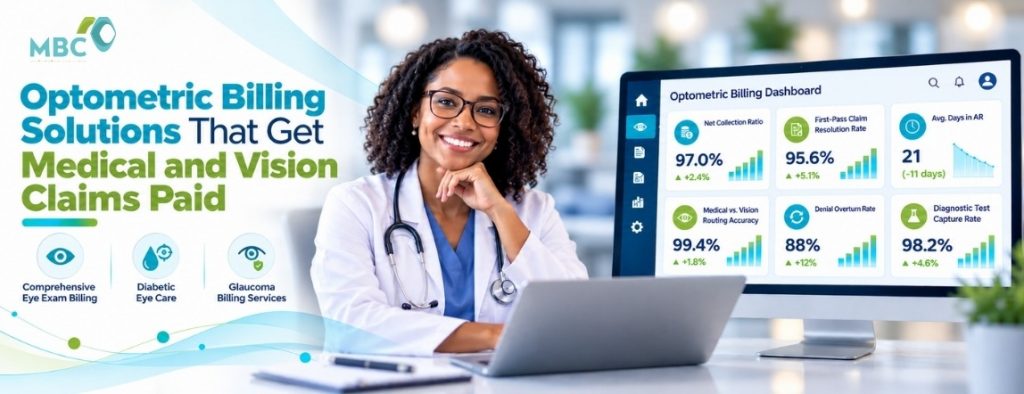
Every patient who sits in your exam chair forces a billing decision before anyone touches a claim. Is this a medical visit or a routine vision exam? Pick wrong and the claim bounces. Or it pays, and the money gets taken back months later. MBC’s optometric billing solutions are built around getting that call right, then capturing every test you performed and sending it to the payer that actually owes you.
Key Takeaways
- Optometry bills two insurance systems. Deciding medical or routine vision before the claim goes out matters more than any other step, and getting it wrong is the top cause of denials.
- By MBC’s estimate, the average practice loses about $78,000 a year to misrouted exams, missed testing charges and refraction errors.
- More than half of practices (56%) don’t consistently bill the OCT scans, visual fields and fundus photos their doctors perform. Glaucoma and diabetic visits lose the most.
- Medicare does not pay for refraction (92015). Explain the charge and collect it from the patient at the visit.
- Billing every test is not the goal. Optic nerve OCT (92133) and retinal OCT (92134) can’t be billed together, and Medicare bundles fundus photography with posterior OCT.
- Check your code list. 99201 was deleted in 2021, 92137 arrived in 2025 and 92288 in 2026.
- The exam level has to match the chart. Billing a comprehensive exam for every patient is a pattern auditors look for.
- A growing AR, an unknown denial rate, or one person who alone understands the vision plan portals are signs it is time to consider optometric billing solutions from an outside team.
Our optometrist billing services support practices in all 50 states, from single-doctor offices to multi-location eye care groups.
What our optometry clients see:
- 97.0% net collection ratio
- 95.6% of claims resolved on the first pass
- 21 average days in AR
- 99.4% medical vs. vision routing accuracy
Request a Revenue Diagnostic | Call 888-357-3226 | Email info@medicalbillersandcoders.com
What Are Optometric Billing Solutions?
Optometric billing solutions are outsourced services that run the full revenue cycle of an eye care practice. That means verifying medical and vision benefits, coding exams and diagnostic tests, submitting claims to both kinds of payers, posting payments, working denials and collecting aging balances.
Optometry needs its own version of billing for one reason. Almost no other specialty has to bill two separate insurance systems for the same patient, sometimes on the same day. A family doctor never has to ask which plan pays for which half of the visit. You do, dozens of times a day.
What Is Included
A complete setup covers three revenue streams, and each one follows different rules:
- Medical eye care: Glaucoma, diabetic eye disease, dry eye, infections, injuries and other ocular conditions, billed to health insurance with a supporting diagnosis.
- Routine vision care: Annual exams, refractions and standard contact lens fittings, billed to the vision plan or the patient.
- Optical and materials: Frames, lenses and contacts, billed against vision plan allowances with the balance collected from the patient.
Problems start when these streams get mixed. Keeping them on separate tracks is most of the job.
Who These Solutions Are Built For
- Independent optometrists who want billing off their own desk
- Group practices that need every location coding the same way
- OD/MD practices with a heavy medical payer mix
- Practices with a growing pile of unpaid claims and no time to chase it
- New practices that need credentialing and billing set up correctly from day one
Why Optometric Medical Billing Breaks Down In-House
Most billing problems in an optometry office don’t come from carelessness. They come from asking two or three people to run two insurance systems while also answering phones and checking patients in.
By our estimate, the average practice loses about $78,000 a year to misrouted exams, missed testing charges and refraction errors. Here is where optometric medical billing usually goes wrong.
1. Medical vs. Routine Vision Exam Routing
A patient books her “yearly eye exam” and mentions at check-in that her eyes have been burning for a month. That is now a medical visit with a medical diagnosis, and it belongs on her health plan.
If the front desk has already pulled her vision benefits and the claim goes out that way, it will be denied or underpaid. The reverse happens too: a routine exam sent to medical insurance with no pathology to support it. Misrouting is the largest single source of denials in optometry.
2. Coordinating Medical and Vision Plan Benefits
Plenty of visits have both a medical and a routine part. Which plan is primary for the exam? Who pays for the refraction? Can materials still go through the vision plan? Each payer answers differently, and the answers change. Without written rules for split billing, staff guess. The guesses turn into write-offs.
3. Missed Diagnostic Testing Charges
OCT scans, visual fields and fundus photos are billed separately from the exam. More than half of optometry practices (56%) don’t capture them consistently.
The doctor performs the test and documents it. The claim leaves with only the exam code on it. Glaucoma follow-ups and diabetic eye visits are hit hardest, because that is where most testing happens. On diabetic eye visits, 41% leave without a charge for the retinal imaging that was done. Practices without a system for capturing those tests see glaucoma-related denials at nearly three times the normal rate.
4. Refraction and Medicare Non-Covered Services
Medicare does not pay for refraction (CPT 92015). The charge belongs to the patient, and it needs to be explained and collected at the visit. Offices that skip that conversation end up writing the fee off. Or they send a statement weeks later that the patient didn’t expect and doesn’t pay.
5. Vision Plan Portals and Manual Claim Keying
Vision plans tend to run their own portals, each with its own authorization step, claim form and payment schedule. Keying those claims one at a time eats hours every week. It is also where small typing errors turn into rejected claims that nobody notices until the filing deadline has passed.
6. Staff Turnover and Credentialing Delays
When your one experienced biller leaves, the knowledge leaves with her. And when a new associate joins, every claim under that doctor’s name is at risk until credentialing is finished with each payer. Both situations are common. Both can stall cash flow for months.
Our Optometric Billing Solutions
You can hand us the whole revenue cycle or only the parts that are hurting. Each service below works on its own. They work better together.
1. Eligibility and Benefits Verification (Medical + Vision)
We check medical and vision coverage before the patient arrives: exam and materials eligibility, frequency limits, copays, deductibles and any referral or authorization requirement. Your front desk knows which plan the visit belongs to, and what to collect, before the patient sits down.
2. Charge Entry and Claim Scrubbing
Every encounter is reviewed against the chart before it becomes a claim. We confirm that the exam level matches the documentation, that each test performed has a charge, and that the diagnosis supports medical necessity. Claims are then checked against payer edits, so errors get fixed before submission. That is the cheapest moment to fix them.
3. Vision Plan Claims Submission
We key and submit routine exam, contact lens and materials claims through each plan’s portal. We track authorizations and compare what the plan paid against what it owed.
4. Medical Insurance Claims Submission
Medical eye care claims go to Medicare, Medicaid and commercial payers with the correct exam or E/M code, testing codes and modifiers. For our optometry clients, 95.6% of claims are resolved on the first pass.
5. Denial Management and Appeals
A denial is worked when it arrives, and we look for the reason behind it. If one payer keeps rejecting visual fields over frequency limits, the fix belongs at the source, not in a stack of appeals. We overturn 88% of the denials we appeal. You can read more about how our denial management team works.
6. AR Follow-Up and Old AR Recovery
Unpaid claims are followed up on a schedule, by payer and by age. If you are coming to us with a backlog, our old AR recovery service works those aging balances while current claims keep moving.
7. Payment Posting and Reconciliation
Payments are posted line by line against the contracted rate. Underpayments show up instead of vanishing into an adjustment. Patient balances are identified quickly and billed while the visit is still fresh in the patient’s mind.
8. Credentialing and Payer Enrollment
We handle enrollment and re-credentialing for new doctors and new locations, with medical payers and vision plans alike. We also track expiry dates so nobody lapses. Details are on our credentialing services page.
9. Revenue Reporting and Dashboards
You get a live view of collections, AR aging by payer, routing accuracy, testing capture by provider and denial reasons by code. There is no waiting for a month-end spreadsheet to find out how the practice is doing.
How Our Optometry RCM Services Work
Switching billing companies, or outsourcing for the first time, feels risky. That is a fair reaction. It is your cash flow. So here is exactly what happens when you start optometry RCM services with MBC.
Step 1: Revenue Diagnostic
We review a sample of your recent claims, denials and AR. You get a plain report showing where money is leaking: routing errors, uncaptured tests, exam level patterns and aging balances. What you do with it is up to you.
Step 2: Onboarding and System Access
We work inside the practice management system you already use. There is no software to buy and no data to migrate. We set up secure access, document your payer mix and fee schedules, and agree on who handles what.
Step 3: Daily Claims and Payment Workflow
Charges are reviewed and submitted within 24 to 48 hours of the visit. Payments are posted as they arrive. Your account manager is the single point of contact for your staff’s questions.
Step 4: Denial and AR Workdown
New denials are handled as they come in. Older AR is prioritized by dollar value and filing deadline, so nothing collectible times out.
Step 5: Monthly Reporting and Dashboards
You see your numbers every month, and the live dashboard shows them in between. Your account manager goes through routing accuracy, exam level distribution, testing capture and payer performance with you, and agrees specific actions for the next month.
Optometrist Billing Services for Every Practice Model
1. Solo and Independent Optometrists
In a one- or two-doctor office, billing usually falls to whoever has a spare hour. Our optometrist billing services give you a full billing department without adding a salary, and nothing stops when someone is out sick.
2. Multi-Location Optometry Groups
Groups need consistency. The same visit should be coded the same way in every office, and you should be able to compare locations and providers side by side. We standardize workflows across sites and report at both levels.
3. OD/MD Integrated Eye Care Practices
When optometrists and ophthalmologists share patients, billing gets more layered. There is co-management, surgical global periods and a heavier medical payer mix. We handle the medical side at the depth it needs and keep routine vision claims on their own track.
4. Practices With an Optical Dispensary
Frames, lenses and contacts bring materials claims, plan allowances and patient balances that all have to tie back to the exam. We bill materials to the right plan and keep optical revenue separate from professional fees in your reports. You can see how each side of the business is doing.
Optometric Billing and Coding Services
Coding decides whether a claim pays correctly or just pays. Our optometric billing and coding services are handled by coders who work on eye care every day. Four areas matter most.
1. Eye Exam Codes vs. E/M Codes
A medical eye visit can be billed with the eye exam codes (92002 to 92014) or with office E/M codes (99202 to 99215). The eye codes are chosen by the scope of the exam you documented. E/M codes are chosen by medical decision-making or time.
Neither is always the better choice. It depends on what was done and what the payer allows. One thing to check in your own system: 99201 was deleted in 2021, and we still find it sitting on old superbills.
Billing a comprehensive exam (92004 or 92014) for every patient, whatever the note says, is a pattern auditors look for.
2. Diagnostic Testing (OCT, Visual Field, Fundus Photography)
This is where most missed revenue sits. It is also where the bundling rules are strictest. Two of them catch practices out regularly.
First, optic nerve OCT (92133) and retinal OCT (92134) cannot be billed at the same encounter. Neither can be billed with 92137, the OCT angiography code added in 2025.
Second, Medicare’s coding edits treat fundus photography (92250) as mutually exclusive with posterior segment OCT on the same day, with only narrow exceptions.
So the aim is to bill every test that is separately payable, and to know which ones are not. Billing everything the equipment can produce is how practices end up in an audit.
3. Contact Lens and Medically Necessary Lens Billing
Routine fittings (92310 to 92313) go to the vision plan or the patient. Fittings for ocular surface disease (92071) and keratoconus (92072) are medical.
A common mix-up: 92311 is a corneal lens fitting for aphakia in one eye. It has nothing to do with bifocal or multifocal contacts.
4. Modifiers and ICD-10 Medical Necessity
A test is only payable when the diagnosis supports it. We match each test to a covered diagnosis under the payer’s policy, apply laterality where the code needs it, and watch frequency limits so repeat testing doesn’t deny.
Quick code reference
| Code | What it describes | What to watch |
| 92002 / 92004 | Eye exam, new patient: intermediate / comprehensive | Level must match the documented exam |
| 92012 / 92014 | Eye exam, established patient: intermediate / comprehensive | Don’t default every visit to comprehensive |
| 99202 to 99215 | Office E/M visits | Chosen by medical decision-making or time |
| 92015 | Determination of refractive state | Medicare does not pay; collect from the patient |
| S0620 / S0621 | Routine eye exam with refraction: new / established | Used by some vision plans; check each plan |
| 92083 | Visual field exam, extended | Needs interpretation and report; frequency limits apply |
| 92132 | Anterior segment imaging (OCT) | Medical indication required |
| 92133 / 92134 | Posterior segment OCT: optic nerve / retina | Never both at the same encounter |
| 92137 | Retinal OCT with OCT angiography (new in 2025) | Not with 92133 or 92134 |
| 92250 | Fundus photography with interpretation and report | Bundled with posterior OCT under Medicare edits |
| 92227 / 92228 / 92229 | Retinal imaging: remote staff review / remote physician interpretation / point-of-care autonomous (AI) analysis | One per encounter; not with 92250 or posterior OCT |
| 92020 | Gonioscopy | Document the angle findings |
| 92025 | Corneal topography | Medical indication only |
| 92310 to 92313 | Contact lens fitting: corneal, both eyes / aphakia, one eye / aphakia, both eyes / corneoscleral | Routine fits go to the vision plan or patient |
| 92071 / 92072 | Contact lens for ocular surface disease / keratoconus, initial fitting | Billed to medical insurance |
| G0117 / G0118 | Medicare glaucoma screening for high-risk patients | Once every 12 months |
| 92284 / 92288 | Dark adaptation: diagnostic (92284, reworded in 2026) / screening (92288, new in 2026) | Medicare does not cover 92288; some commercial plans may. Bill 92284 only for a diagnostic exam |
A note on 2026 rates. This year’s Medicare fee schedule applied a 2.5% efficiency cut to the work values of most non-time-based services. Eye exam and E/M codes were exempt. Testing codes generally were not, so it is worth rechecking what you are allowed for OCT, visual fields and fundus photography. For visit-by-visit billing notes on glaucoma and diabetic eye care, see our optometry billing services page.
Optometry Systems and Payers We Work With
1. Optometry EHR and Practice Management Systems
We work in your system, with the permissions you give us, so your clinical workflow doesn’t change. Our team has experience with optometry EHR and practice management software, including RevolutionEHR, Crystal PM, OfficeMate, MaximEyes and Compulink.
2. Vision Plans
MBC’s team bills VSP, EyeMed, Davis Vision, Spectera and regional plans. Each plan has its own portal, authorization process and fee schedule. We keep those rules current, so your staff doesn’t have to track billing guideline updates.
3. Medicare, Medicaid and Commercial Payers
Medical eye care is billed to Medicare Part B, Medicare Advantage plans, state Medicaid programs and commercial carriers.
Two Medicare benefits are easy to miss. Medicare covers a glaucoma screening once every 12 months for high-risk patients: people with diabetes, people with a family history of glaucoma, African Americans aged 50 and over, and Hispanic Americans aged 65 and over. It also covers a yearly eye exam for diabetic retinopathy in patients with diabetes.
We track eligibility for both, so they are billed when they come due.
In-House vs. Outsourced Optometry Medical Billing
There is no universal right answer here. In-house billing can work well when you have experienced, stable staff. It is still worth an honest comparison.
| In-house billing | Outsourced to MBC | |
| Coverage | Rests on one or two people; pauses for sick days and turnover | A team covering every business day |
| Coding knowledge | General, mostly learned on the job | Coders who work on eye care daily |
| Denials | Worked when there is time | Worked as they arrive, with the root cause tracked |
| Visibility | Month-end reports, if someone runs them | Live dashboard |
| Compliance | Reviewed occasionally | Exam levels and refraction billing reviewed continuously |
| Cost | Salary, benefits, training and software | Custom-quoted to your volume and scope |
Three signs it is time to look at outsourcing optometry medical billing: your AR keeps growing, nobody can tell you the denial rate, or one person is the only one who understands the vision plan portals. Our page on medical billing outsourcing covers the handover in more detail.
Optometry Revenue Cycle Management Results
Results are the only fair way to judge optometry revenue cycle management.
Performance Benchmarks
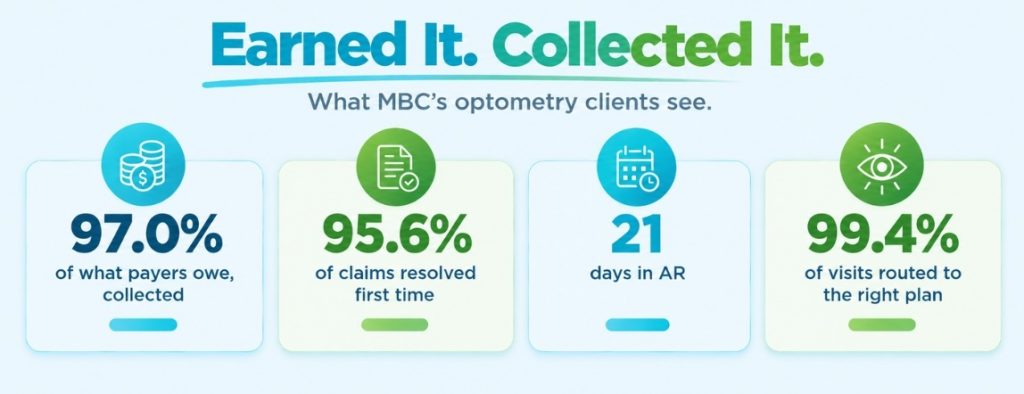
These figures come from the optometry practices and eye care groups we manage nationwide:
- 97.0% net collection ratio
- 95.6% first-pass claim resolution rate
- 21 days average in AR, 11 days faster than before
- 99.4% medical vs. vision routing accuracy
- 88% denial overturn rate
- 98.2% diagnostic test capture rate
In plain terms: almost every dollar you are contractually owed gets collected, most claims pay the first time, and the tests your doctors perform end up on the claim.
Client testimonial
I just wanted to take a moment to thank the entire MBC team for all of your hard work.
When you first took over our medical and vision billing, I honestly felt like our billing was so messed up that I wasn’t sure it could ever be fixed. There were so many outstanding claims and so much money that I thought we would never be able to recover.
In just about two months, I can already see such a big difference. You have helped us recover a significant amount of money that I truly thought was lost, and things are finally starting to look so much better.
I also really appreciate how responsive and helpful everyone has been. Whenever I have a question or concern, someone gets back to me quickly and takes the time to explain things and help find a solution. That means a lot to me as a practice owner.
I know there is still more work to do, but I want the entire team to know that I see the progress and I truly appreciate the work you are putting into our account.
Thank you for helping me feel confident about our billing again. Please keep up the great work. Your hard work is definitely noticed and appreciated!
Dr. Keisha Roden
North Ave Eye Care | New Rochelle, NY
Why Practices Choose MBC for Optometry Medical Billing Services
1. Dedicated Optometry Billing Team
Your account is handled by billers and coders who work on optometry claims daily. They already know the routing rules, the testing codes and the vision plan quirks. You don’t pay for their learning curve.
2. Senior RCM Principal on Every Account
Your first conversation is with someone who understands the economics of an optometry practice, not a salesperson reading from a script. That person stays involved after you sign.
3. Real-Time Revenue Dashboards
Your administrator can see where exam revenue is being captured and where testing charges are slipping, by provider and by payer. Our RCM dashboard page shows what that looks like.
4. HIPAA-Compliant Workflows
We connect securely to your EHR and imaging systems. Nothing gets re-keyed by hand, and patient data is handled under HIPAA requirements at every step.
See What Your Optometry Billing Is Leaving Uncollected
Book a 15-minute briefing with one of our Optometry RCM Principals. No sales pitch. We will look at your routing accuracy, testing capture and aging AR, and give you a realistic recovery estimate based on your own patient mix and payer contracts.
Request a Revenue Diagnostic | Call 888-357-3226 | Email info@medicalbillersandcoders.com
FAQs: Optometric Billing Solutions
They cover the full revenue cycle for an eye care practice: eligibility checks for medical and vision plans, coding, claim submission to both payer types, payment posting, denial appeals, AR follow-up, credentialing and reporting. You can outsource all of it or only selected parts.
There is no flat price. MBC custom-quotes every practice based on claim volume, payer mix, number of locations and the services you need, and you get a written quote after the Revenue Diagnostic.
No. Your patient data and your software stay yours. We work inside your system with the access you grant, under a HIPAA business associate agreement, and you can change or remove that access whenever you choose.
Ask how many optometry practices they bill for, how they handle medical and vision plans, and who will work your account day to day. Then ask what reports you will see, how denials are followed up, and what happens to your data if you leave.
We work inside your existing EHR and practice management system and bill the major national vision plans along with Medicare, Medicaid and all commercial payers.
Onboarding takes about two weeks. It covers secure system access, payer and fee schedule setup, and a review of open AR. Your current claims keep moving during the transition, so cash flow isn’t interrupted.
The reason for the visit decides it. If the patient has a medical complaint or diagnosis, such as glaucoma, diabetic eye disease, dry eye or an infection, the exam goes to medical insurance. A routine exam with no medical finding goes to the vision plan. We classify each visit at intake and verify it again before the claim goes out.
Codes 99202 to 99215 are office evaluation and management (E/M) codes. Optometrists use them for medical eye visits, such as an infection, an injury or a glaucoma follow-up, and the level is chosen by medical decision-making or time.
Yes. An optometrist can bill 99213 or 99214 for a medical visit within the state’s scope of practice, as long as the chart supports the level: low complexity for 99213, moderate for 99214. Check each payer’s rules, because not every plan accepts E/M codes from optometrists.
Use 92014 when you performed and documented a comprehensive eye exam on an established patient. Use 99214 when the visit centers on managing a medical problem of moderate complexity and the exam itself was not comprehensive.
92015 is the code for refraction, the test that determines a glasses prescription. It is billed separately because it is not part of the eye exam codes and Medicare does not cover it, so the charge goes to the vision plan or the patient.
Original Medicare does not pay for routine eye exams for glasses or contacts. It pays for medical eye exams whenever they are medically necessary, with no fixed yearly number, plus one diabetic retinopathy exam a year and one glaucoma screening every 12 months for high-risk patients.

A Subject Matter Expert in healthcare billing operations with nearly 10 years of experience, sharing insights on claims processing, coding support, and revenue cycle optimization. Dedicated to educating healthcare professionals on compliance, accuracy, and strategies to improve billing performance.