Specialities
 Services
 Resource Center
 Pricing
 About
About
 Contact
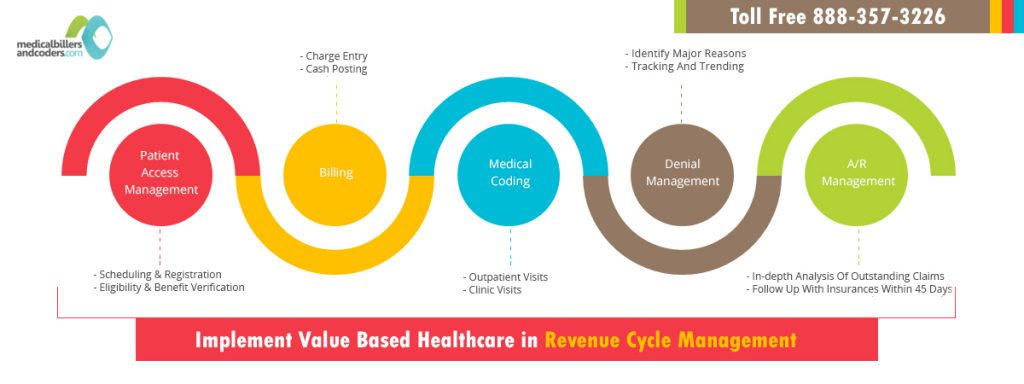
Not only do value based healthcare models are targeting to make healthcare providers more accountable for the services they provide to the patients, but they are also conniving to shift financial accountability away from the payers to the healthcare organizations. However, many health care providers are left questioning how to align their healthcare revenue cycle management policies with value based reimbursement arrangements?
Recently, the health care industry has been witnessing a number of challenges in the coming years because of the new payment reforms from CMS and Medicaid services and not to forget commercial health payers. Because of the rising billing issues, there has been a greater push to implement value based care reimbursements. This will lead to the newer development of bundled payment contracts and CMS projects such as the Comprehensive Care for Joint Replacement Model.
However, other facilities like clinics and hospitals have become accustomed to the fee-for-service payment system and revenue cycle managers which are now finding it complex to the new value based care transition. On the other hand, there are innumerable solutions and strategies that providers can integrate to gain a greater understanding of how to keep their healthcare revenue cycle strong and streamlined.
It is believed that executing revenue cycle analytics and population health management techniques will help health care providers presenting the opportunities to avoid losing revenue in the midst of a value-based care reimbursement model. It is beneficial for the providers to better manage revenue and claims data analysis when preparing for the transition toward a value based care payment contract whether through an accountable care organization or a bundled payment.
1. Data Analytics – Track Outcomes & Maximizes Claim Revenues
Data analytics tools are the primary thing to maximizing claims revenue in a value-based world, especially since health care providers can monitor their performances in real-time and make improvements to claims management systems. These are the powerful analytic tools that are able to take clinical and outcomes data, which combines it with financial data to accurately measure where we improve quality based on outcomes results.
With 97% percent of hospitals possessing certified EHR technology, EHRs are said to be a good starting point for revenue cycle analytics, especially since value based healthcare relies on clinical data to measure quality.
2. Population Health Management – Enhanced Quality & Cut Rising Costs
With a greater push on implementing the value based healthcare system, health care providers are looking for various ways to enhance population health management programs that target such as chronologically ill patients and baby boomers.
It is a very well-known phenomenon that a small proportion of patients always account for a disproportionate share of costs, so one can expect lots of return from focusing on those high-cost patients. You need a procedure to identify high-risk patients and then a care management program to manage the care of those high-risk patients.
3. Improves Patient Revenue To The Front End Revenue Cycle Tasks
From a revenue cycle perspective, getting the most accurate information upfront starts with patient scheduling and patient registration. This error of blunder has become especially problematic for many health care providers in the wake of healthcare consumers enrolling in more high-deductible insurance plans causing medical bills to exceed a patient’s ability to pay.
Health care providers are finding that high-deductible plans and a lack of financial communication have caused patient-generated revenue to drop. But, increasing healthcare transparency and patient engagement strategies can help health care providers collect payments and induce more patients to the practice.
Having quality patient data collection likewise helps health care providers to capture the necessary data and documentation needed for payment through alternative payment methods.
FAQs
Value-based healthcare models aim to make healthcare providers more accountable for the quality and efficiency of care they deliver. These models also shift financial responsibility from payers to healthcare organizations, encouraging better outcomes at lower costs.
Healthcare providers can align with value-based reimbursement by integrating data analytics and population health management strategies. These tools help track outcomes, manage high-risk patients, and streamline revenue cycle tasks to ensure better financial performance.
Data analytics allows healthcare providers to monitor clinical performance in real-time, link clinical and financial data, and make informed improvements to their claims processes. It is essential for maximizing claim revenue and improving care quality under value-based contracts.
Population health management targets high-cost, high-risk patients—such as those with chronic conditions—to improve care coordination and reduce unnecessary spending. Effective identification and management of these patients can significantly cut healthcare costs.
Accurate patient scheduling and registration are crucial, especially with the rise of high-deductible insurance plans. Enhancing front-end processes helps collect complete and accurate patient data, supports transparent communication, and improves the chances of timely and full patient payments.

With almost 12 years of experience in healthcare revenue cycle management, this Revenue Cycle Specialist brings deep expertise in medical billing, claims optimization, and practice profitability. Shares industry-backed insights focused on improving collections, reducing denials, and driving operational excellence.