Specialities
 Services
 Resource Center
 Pricing
 About
 Contact
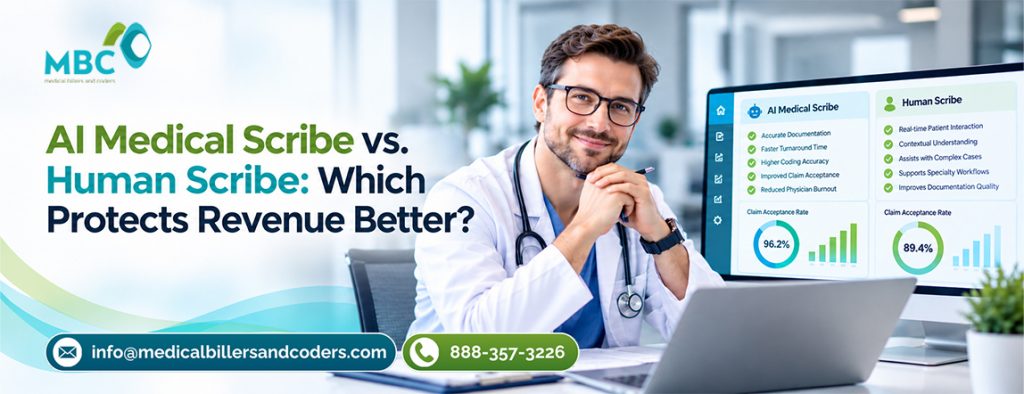
For multi-provider groups with complex, coding-sensitive encounters, a human medical scribe protects revenue better than an AI medical scribe, because a trained person captures the medical decision-making that defends an E/M level, while AI mainly speeds up the note.
The gap matters more in 2026 than it did two years ago. Payers now judge documentation by whether it supports the code billed, not by how complete it looks.
Key Takeaways
- An AI medical scribe lowers documentation cost per provider, but cost savings are not the same as revenue protection.
- Independent studies show AI-generated notes still contain omissions and fabricated details, which can drive both undercoding and unsupported codes.
- Payers are responding to rising E/M intensity: Cigna has applied one-level reductions to many level 4 and 5 E/M claims since October 2025 when documentation does not support them.
- A human medical scribe covers revenue tasks beyond the note, including pre-charting, order entry, referral routing and same-day chart closure.
- The strongest model for most enterprise groups is human-led: a virtual medical scribe for complex care, or an AI scribe with human review where volume is high and visits are routine.
Why Scribe Selection Is Now a Revenue Decision
Physician use of ambient documentation is climbing fast. Doximity data shows regular physician use of ambient and AI medical scribe tools rose from 20% to 29% between April 2025 and January 2026.
Payer behavior has shifted alongside it. Trilliant Health found that high-intensity new-patient E/M coding rose 12 to 20 percentage points at health systems after AI scribe adoption, and reached 80% at one system. Fuller notes are pushing more claims into 99214 and 99215 territory.
The response is already visible on remittances. Cigna’s E/M downcoding policy, active since October 2025, reduces qualifying level 4 and 5 claims by one level unless the record supports the billed complexity. In July 2026, the U.S. Government Accountability Office warned that AI documentation inaccuracies may contribute to both over- and under-reimbursement.
That combination changes the question practices should ask. It is no longer “which scribe saves the most physician time?” It is “which scribe produces documentation that survives payer review and supports net realized revenue?”
How Each Model Works
The Human Medical Scribe
A human medical scribe documents the encounter in real time, either in the exam room or as a remote medical scribe listening through a secure connection. The scribe works inside the EHR alongside the clinician.
Beyond the note, an experienced scribe pulls prior results, drafts orders, queues referrals and prepares the chart before the next visit. Because the scribe understands the clinical context, they can ask the provider to clarify an assessment before the note is signed.
The AI Medical Scribe
An AI medical scribe records the conversation, transcribes it with speech recognition and uses a large language model to draft a structured note, usually in SOAP format. The clinician reviews, edits and signs.
The draft appears within seconds of the visit. Some tools also suggest ICD-10 codes. Most do not place orders, route referrals or complete structured EHR fields without the clinician.
The Hybrid Medical Scribe
A hybrid medical scribe model pairs an AI draft with a trained human reviewer who checks accuracy and specialty detail before the clinician signs. The value of hybrid depends entirely on what the reviewer checks. A reviewer who verifies MDM support protects revenue; one who only fixes grammar does not.
Table 1: AI Medical Scribe vs Human Scribe, Revenue View
| Revenue factor | Human medical scribe | AI medical scribe | AI scribe with human review |
|---|---|---|---|
| Pricing model | In-house salary and overhead, or a virtual service billed per hour, per encounter or flat monthly rate | Per-provider software subscription; varies by vendor, tier and EHR integration | Software subscription plus human review fees; varies by review depth |
| Capture of medical decision-making | Strong; scribe can clarify intent in real time | Variable; misses context the clinician does not say aloud | Strong if reviewer checks MDM support |
| Omission and fabrication risk | Attention and fatigue errors | Omissions and hallucinations documented in independent studies | Reduced by human check |
| E/M level drift and downcode exposure | Lower; documentation tracks actual complexity | Highest; note length can outpace MDM support | Lower if reviewer audits level against MDM |
| Work beyond the note | Pre-charting, orders, referrals, inbox, chart prep | Note only (some add code suggestions) | Note plus partial EHR support in some models |
| Scalability | Limited by hiring, training and coverage | Instant | Scales with review staff |
| Best revenue fit | Complex, procedural and audit-exposed specialties | High-volume, routine visits | Mixed-acuity multi-specialty groups |
Scribing costs vary by specialty, visit volume and coverage requirements; compare current quotes rather than published list prices.
Documentation Accuracy: Where Revenue Leaks Start
Every claim inherits the quality of the note behind it. When the note is wrong, the revenue error follows in one of two directions.
Omissions cause undercoding. If the note leaves out a reviewed outside record, an independent test interpretation or a drug therapy decision, the documented MDM falls short of the work performed. The practice bills a lower level, or a payer reduces the higher level that was billed.
Fabrications cause unsupported codes. If the note includes an exam element or counseling discussion that never happened, the claim may be paid on documentation that will not hold up in an audit. That is recoupment risk, not revenue.
What Independent Studies Show About AI Note Accuracy
Independent research shows both failure types persist in AI output. A 2026 JMIR Medical Informatics pilot found omissions in 18% and hallucinations in 11.5% of reviewed AI-generated notes. A Mayo Clinic evaluation of five commercial platforms averaged 3.0 potentially harmful errors per simulated case. A 2025 JMIR Human Factors study of six AI scribes in primary care found that none was consistently error-free.
The evidence is not one-sided. A 2026 simulated general-practice study in the Australian Journal of General Practice found no statistically significant difference in overall note quality between AI and human documentation. Human scribes make errors too, particularly when fatigued or newly trained.
The difference is in how errors get caught. A human medical scribe can flag a gap during the visit, while the patient is still in the room. With an AI medical scribe, the only safeguard is the physician’s review at the end of a full clinic day, which is exactly when review quality drops.
E/M Coding, Downcoding and Denials
Since the 2021 E/M guideline changes, office visit levels rest on medical decision-making or total time. MDM has three elements: the number and complexity of problems, the data reviewed, and the risk of patient management.
A long note does not satisfy any of them on its own. This is the core problem with AI scribe E/M coding. Ambient tools are built to capture everything said, which produces thorough-looking documentation that may still lack the specific MDM elements a payer reviewer looks for.
A Real-World E/M Downcoding Scenario
Consider a common scenario. A patient with diabetes and chronic kidney disease presents for follow-up, and the physician adjusts insulin after reviewing outside labs. An AI draft records the conversation in detail but describes the lab review vaguely and never states the prescription drug management decision clearly. The claim goes out as 99215. Under a policy like Cigna’s, it is reduced to 99214 on review, and an appeal requires the documentation the note never contained.
A trained human medical scribe handles the same visit differently. They document the outside lab source, record the insulin change as a management decision and confirm the assessment with the physician. The note supports the level billed, so the claim holds.
To be fair to AI, the largest real-world study so far found no denial increase. A UCSF cohort study in JAMA Network Open, covering more than 1.2 million ambulatory encounters, linked AI scribe adoption to a 5.8% rise in weekly RVUs with no increase in claim denials, worth an estimated $3,044 per physician per 12 months at 2025 Medicare rates. However, that was a single health system with mature coding oversight, observed before payer downcoding programs had fully matured. AI scribe downcoding exposure is a newer risk that early studies were not designed to measure.
Compliance and Audit Exposure
The clinician who signs a note is legally responsible for it, whether a person or software drafted it. AI does not share that liability.
Unsupported high-level codes create more than a payment reduction. Patterns of E/M levels that documentation does not support can attract payer audits, extrapolated recoupments and, in serious cases, False Claims Act scrutiny. Cloned or padded documentation has been a long-standing OIG concern, and generative tools can produce similar-looking notes at scale.
Ambient recording also adds privacy obligations. Practices need a business associate agreement with the vendor, clear audio retention and deletion policies, and patient notice or consent processes. Several states, including California, Florida, Illinois and Pennsylvania, require all-party consent for recording conversations, so consent workflows must be built in, not assumed.
A human medical scribe carries its own compliance requirements: HIPAA training, access controls and supervision. But those controls are familiar to most compliance teams, and they do not involve storing recorded patient conversations.
Workflow Coverage Beyond the Note
Revenue does not depend on the note alone. It depends on how quickly the chart closes, whether orders and referrals are complete, and whether charges are captured.
This is where human scribes hold a structural advantage. A 2026 Annals of Emergency Medicine study of 198,178 emergency department encounters found that human scribes reduced adjusted median physician documentation time per note by 3.3 minutes, compared with 1.6 minutes for ambient AI scribes. Notably, neither group showed a difference in work RVUs per shift hour, so time saved does not automatically become revenue.
Human scribes contribute to revenue tasks AI does not touch:
- Pre-charting that surfaces open care gaps and pending results before the visit.
- Order and referral drafting so services are ordered correctly and tied to the right diagnosis.
- Prior authorization preparation with the clinical details payers ask for.
- Same-day chart closure, which shortens the gap between the visit and claim submission.
Chart lag is an underrated revenue leak. Every day a chart stays open delays the claim, and charts finalized days later are more likely to miss details that support the level billed.
What Medical Scribing Really Costs
On subscription price alone, an AI medical scribe usually looks cheaper than a human scribe. But AI medical scribe cost varies by vendor, pricing tier and depth of EHR integration, and published rates change often. Any comparison should rest on current written quotes, not list prices.
Human scribing has no single market rate either. Virtual medical scribe services are commonly billed per hour, per encounter or as a flat monthly rate, and the price for a multi-provider group depends on five factors:
- Specialty and documentation complexity, since multi-problem and procedural visits take more scribe time than routine follow-ups.
- Visit volume per provider and across the group.
- Coverage requirements, such as live real-time scribing, 24-hour chart turnaround, a dedicated full-time scribe or coverage across shifts and sites.
- The scribing model selected: in-person, virtual or AI with human review.
- Scope beyond the note, including pre-charting, order drafting and referral routing.
Total Cost of Documentation: AI Medical Scribe vs Human Scribe
Subscription price is also the wrong denominator. A true comparison should measure total cost per finalized, defensible encounter:
Total documentation cost = scribe fees + physician review and edit time + coding correction time + revenue lost to downcodes and denials + audit exposure
AI shifts cost into the parts of that formula that do not appear on an invoice. Physician edit time is billed against your most expensive labor. Downcodes appear as quiet underpayments on remittances, not as line items. Audit exposure stays invisible until a payer asks for records.
In-house scribes carry their own hidden costs: recruiting, training, benefits and coverage gaps when a scribe leaves. A virtual service moves hiring, training, quality review and backup coverage to the vendor, so those line items leave your payroll.
MBC does not publish fixed scribing rates, because a single rate cannot reflect a cardiology group’s documentation load and a primary care group’s visit volume at the same time. Instead, MBC builds a custom estimate from your specialty mix, visit volume and coverage hours, and returns a coverage plan with a cost range within one business day. You can get your scribing cost estimate on MBC’s medical scribing services page.
To compare fairly, price the human or virtual option from a custom quote and the AI option from a current vendor quote. Then add physician edit time and downcode exposure measured during a pilot, using your own payer mix.
Which Model Protects Revenue Better in Your Practice?
The right answer depends on encounter complexity, payer mix and how much of your revenue rides on E/M levels. The table below maps each model to common enterprise segments.
Table 2: Which Scribing Model Fits Your Practice
| Practice segment | Recommended model | Why it protects revenue |
|---|---|---|
| High-volume primary care and urgent care | AI medical scribe with human review | Routine visits suit AI drafting; review catches level drift before claims go out |
| Multi-specialty groups | Human-led hybrid | Human scribes for complex specialties, AI with review for routine follow-ups |
| Cardiology, neurology and oncology | Human medical scribe or virtual medical scribe | Multi-problem MDM and high-risk management decisions need real-time context |
| Orthopedics and surgical specialties | Human medical scribe | Procedure documentation, global period tracking and orders require EHR work AI does not do |
| Behavioral health | Human or hybrid | Nuanced narratives and sensitive disclosures raise both accuracy and privacy risk |
| Emergency departments | Human medical scribe | Larger documentation time savings and fast order entry in unpredictable workflows |
| PE-backed platforms scaling across sites | Human-led hybrid with central coding audit | Standardizes documentation quality across acquired practices and limits audit exposure |
Where an AI Medical Scribe Still Makes Sense
An AI medical scribe is a reasonable choice when visits are short and repeatable, clinicians reliably edit before signing, and a coding team audits E/M distribution every month. It also helps with burnout: a JAMA Network Open study of 263 clinicians found burnout fell from 51.9% to 38.8% within 30 days of ambient AI use.
The risk is treating AI as a finished solution. Without a human checkpoint between the draft and the claim, the practice relies on tired physicians to catch documentation gaps that payers are now actively looking for.
How to Pilot Before You Commit
Time needed: 90 days
Before switching models across your group, run a controlled 60 to 90 day pilot with a representative mix of providers and visit types. Track these metrics against a baseline:
- Set a baseline and choose a pilot group
Pick a representative mix of providers and visit types and capture current performance for every metric below before the 60 to 90 day pilot begins.
- Track E/M level distribution
E/M level distribution by provider, before and after.
- Monitor downcode rate by payer
Downcode rate by payer, especially Cigna and other payers with E/M review programs.
- Watch documentation-related denials
Documentation-related denials, such as CARC CO-16 (missing information) and CO-50 (medical necessity).
- Measure chart closure time
Chart closure time from visit to signed note.
- Measure physician edit minutes
Physician edit minutes per note.
- Calculate total cost per finalized encounter
Total cost per finalized encounter, including review and rework.
- Audit a sample of high-level visits
Pair the pilot with a coding audit of a random sample of high-level visits. If the documentation does not support the level, the scribing model is creating risk, regardless of how much time it saves.
MBC Spotlight
Medical Billers and Coders (MBC) sits downstream of the note, where documentation quality turns into paid or denied claims. That position lets us evaluate any scribing model by the only output a CFO cares about: a clean, defensible claim.
MBC’s human scribing teams provide live real-time documentation, 24-hour chart turnaround and dedicated full-time scribes across 32+ specialties, and every note passes compliance audit and editing before it reaches your EHR. Our certified coders also audit MDM support behind high-level E/M claims, whichever scribing model a group runs. Our Revenue Integrity Framework connects documentation gaps to denial root causes and payer variance by payer.
With 25+ years in revenue cycle management, a 97% clean claim rate, a 30% A/R reduction within 90 days and 98% client retention, MBC helps enterprise groups protect net realized revenue as documentation technology changes.
Request a Revenue Diagnostic to see how your current scribing model is shaping your E/M mix, downcode exposure and documentation-related denials.
References
- Centers for Medicare & Medicaid Services (CMS). Evaluation and Management Services Guide (MLN006764).
- CMS. Evaluation & Management Visits, Physician Fee Schedule.
Frequently Asked Questions
Not across the board. An AI medical scribe can replace human scribes for short, routine visits if clinicians edit every note and coders audit E/M levels monthly. For multi-problem visits, procedural specialties and audit-exposed payer mixes, human scribes protect more revenue because they capture medical decision-making and handle orders, referrals and chart prep. Most multi-provider groups get the best result from a human-led mix, validated through a 60 to 90 day pilot.
Neither model is reliably more accurate. A 2026 JMIR Medical Informatics pilot found omissions in 18% and hallucinations in 11.5% of reviewed AI notes, and a 2025 study of six primary care AI scribes found none consistently error-free. Human scribes make fatigue and training errors instead. The revenue difference is timing: a human scribe can correct a gap during the visit, while AI errors surface only at physician review or payer audit.
There is no single rate. Virtual medical scribing is commonly billed per hour, per encounter or as a flat monthly rate, and cost depends on specialty, visit volume, coverage hours, turnaround and any extra tasks such as pre-charting. AI scribe subscriptions vary by vendor and tier. MBC builds a custom estimate for each group rather than quoting a fixed rate, so compare quotes on total cost per finalized encounter.
Evidence suggests they can. Trilliant Health found high-intensity new-patient E/M coding rose 12 to 20 percentage points after AI scribe adoption at several health systems. Higher levels are appropriate only when medical decision-making supports them. Payers such as Cigna now reduce qualifying level 4 and 5 claims by one level when documentation falls short, so a fuller note can turn into a downcode rather than added revenue.
A hybrid medical scribe model uses AI to draft the note and a trained human to review it before the clinician signs. It pairs AI speed with a human accuracy check. The revenue benefit depends on what the reviewer checks: confirming that medical decision-making supports the E/M level protects revenue, while light proofreading adds cost without reducing coding or audit risk.
No. The clinician who signs a note is legally responsible for its content, whether AI or a person drafted it. If an AI note includes an exam element or discussion that never happened and the claim is paid, the practice faces recoupment and audit exposure. Every AI draft needs clinician review before signature, and high-level E/M claims benefit from a coding check before submission.
Integration varies widely by vendor and EHR. Some AI scribes write directly into the EHR note, while others require clinicians to copy and paste text, which adds time and error risk. Most AI tools do not complete structured fields, place orders or route referrals. Human scribes work inside the EHR directly, so they cover those revenue-linked tasks regardless of the platform your group runs.
No tool is HIPAA compliant on its own; compliance depends on how it is deployed. Practices need a signed business associate agreement, encryption, access controls and a clear policy for how long recorded audio is kept. Patient notice or consent is also required, and states such as California, Florida, Illinois and Pennsylvania require all-party consent to record conversations. Human scribes carry no audio storage obligation.

A Subject Matter Expert in healthcare billing operations with nearly 10 years of experience, sharing insights on claims processing, coding support, and revenue cycle optimization. Dedicated to educating healthcare professionals on compliance, accuracy, and strategies to improve billing performance.