Specialities
 Services
 Resource Center
 Pricing
 About
 Contact
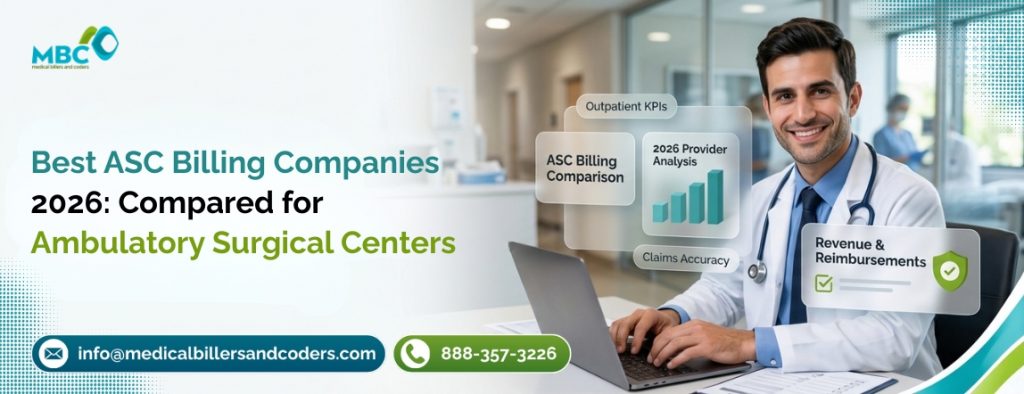
The best ASC billing companies in 2026 are Medical Billers and Coders (MBC), Surgical Notes, Coronis Health, AdvancedMD RCM and CareCloud. MBC leads for multi-OR and PE-backed ASC networks on facility-fee coding, implant capture and payer policy tracking.
ASC billing is not physician practice billing performed in a surgical setting. It is a distinct revenue cycle discipline built on the CMS Ambulatory Payment Classification (APC) system — a facility-fee reimbursement structure with its own code logic, implant documentation requirements, and payer coverage policies that differ fundamentally from the RBRVS-based physician fee schedule that most billing companies are built to manage.
This is why experienced ASC Billing Companies play a critical role in helping ambulatory surgery centers maintain compliance, reduce denials, and optimize reimbursement accuracy.
According to VMG Health ASC benchmarking data, the average ambulatory surgical center collects 92%–94% of its collectible facility fee revenue. Top-performing ASCs collect 95%–98%. At $3M in annual ASC facility billing, that 3–4 percentage-point performance gap represents $90,000–$120,000 in recoverable revenue that the wrong billing company writes off annually due to facility fee coding errors, implant documentation failures, and APC grouping mistakes.
We evaluated the leading ASC billing companies against five criteria specific to ambulatory surgical center revenue cycle management. Here is what the comparison reveals.
The best ASC billing company depends on facility size and specialty mix. For multi-OR and PE-backed ASC networks, MBC leads on facility-fee coding, implant capture and payer policy tracking.
Key Takeaways
- ASC billing runs on the CMS ASC Payment System, not the physician fee schedule.
- Match the vendor to your specialty mix.
- Outsource when cost to collect rises and Net Collection Rate stalls.
- The CY 2027 rule adds 600+ procedures to the ASC CPL from January 1, 2027.
- Track monthly KPIs; switch through a 90-day parallel transition.
Written by: MBC ASC Revenue Cycle Team
Reviewed by: [Reviewer Name], CPC, CPMA, CASCC
Last Updated: November 25, 2026
What Does an ASC Billing Company Handle?
An ASC billing company owns the facility-side revenue cycle. Most medical billing services are built for professional claims, so check ASC scope line by line.
| Stage | What the partner owns | Risk if missed |
|---|---|---|
| Pre-surgery | Eligibility, prior authorization by CPT | Authorization denials |
| Patient financial | Good Faith Estimates, pre-surgery collections | Bad debt |
| Coding | ASC CPL and payment indicators (J8, N1) | Non-payable lines billed |
| Implants | Invoice matching from OR logs | Unbilled device cost |
| Claims | Medicare: 837P/CMS-1500 to Part B MAC; many commercial payers: UB-04 | Format rejections |
| Posting | Contract-rate check on every ERA | Silent underpayments |
| Denials and AR | Root-cause fixes, appeals, old AR recovery | Timely filing write-offs |
| Credentialing | Facility enrollment and revalidation | Held claims |
| Reporting | KPIs by surgeon, payer, procedure | No CFO visibility |
Software vs. service: Software (SIS, HST Pathways, Waystar) automates the work. A billing company runs it and owns collections.
Explore MBC’s ASC billing services.
How We Evaluated ASC Billing Companies
- ASC Facility Fee Coding Expertise: Certified coders with specific training in the CMS ASC Payment System, APC grouping logic, and facility-specific CPT modifier requirements — not generalists applying physician fee schedule knowledge to facility claims.
- Implant and Device Documentation Workflow: Systematic invoice documentation capture for device-intensive procedures under both APC device offset and CMS passthrough categories — a standard workflow requirement, not a reactive audit response.
- Payer-Specific ASC Coverage Policy Management: Active tracking of payer-specific ASC covered procedure lists, coverage exclusions, and benefit policy updates that differ from the same payer’s physician office coverage — a critical function most generalist billing companies do not perform.
- Net Collection Rate on Facility Fee Claims: NCR benchmarked against VMG Health ASC data, not aggregate billing company averages that blend ASC and physician practice performance.
- Multi-OR and Multi-Specialty ASC Scalability: Ability to support multi-OR, multi-specialty ASC operations with concurrent procedure claim accuracy and OR utilization reporting for administrator visibility.
Quick Comparison: Best ASC Billing Companies 2026
| Company | Best For | ASC Facility Fee Expertise | Reported NCR | Implant Documentation | Enterprise Fit |
|---|---|---|---|---|---|
| Medical Billers and Coders (MBC) | Multi-OR ASCs and PE-backed surgical networks | APC-certified, ASC-specific coders | 97%+ | Standard pre-submission workflow | ★★★★★ |
| Surgical Notes | Single-specialty ASCs seeking ASC-focused billing | ASC-focused | ~94% | Included | ★★★★☆ |
| Coronis Health | Health system-affiliated ASCs | Broad RCM, ASC module | ~93% | Varies by contract | ★★★★☆ |
| AdvancedMD RCM | AdvancedMD platform ASC users | Physician-focused, limited ASC depth | 95% FPAR* | Not included | ★★★☆☆ |
| CareCloud | Mid-size ASCs seeking workflow structure | General multi-specialty | ~90% | Practice-managed | ★★☆☆☆ |
*FPAR = First Pass Acceptance Rate on claim submission, not ultimate facility fee revenue recovery. AdvancedMD does not provide in-house medical coding for ASC facility fee claims.
#1 — Medical Billers and Coders (MBC): Best for Multi-OR and PE-Backed ASC Networks
MBC’s ASC billing practice is built on three technical requirements that distinguish ASC facility-fee billing from every other specialty: APC grouping accuracy, implant invoice documentation, and payer-specific ASC coverage policy management. These are not areas where physician billing expertise transfers — they require dedicated ASC billing training and the administrative infrastructure to enforce documentation standards at the charge entry stage.
Why MBC Leads in ASC Billing
APC Grouping and Facility Fee Code Accuracy: The CMS ASC Payment System groups procedures into APCs that determine facility reimbursement — a system that differs structurally from the physician RBRVS fee schedule. MBC’s ASC billing coders are trained on APC grouping logic, facility-specific CPT modifier requirements (modifier 73 for procedures discontinued before anesthesia administration, modifier 74 for procedures discontinued after), and the annual CMS ASC payment rate updates that change covered procedure lists and payment rates each January 1.
Applying physician fee schedule logic to ASC facility claims results in systematic underpayments that most ASC administrators never identify because they lack a benchmark for the correct APC payment.
Implant Invoice Documentation as Pre-Submission Standard: CMS requires manufacturer invoice documentation for device-intensive procedures claiming implant cost passthrough. Missing or delayed invoice documentation at claim submission results in denials that require retrospective appeals — creating cash flow gaps and administrative burden at high-volume, device-intensive ASCs.
MBC’s ASC billing workflow includes an implant documentation checkpoint at charge entry: the claim does not move to submission without the required invoice. This single workflow standard eliminates the most common category of ASC facility fee denials for orthopedic, spine, and ophthalmology ASCs.
Payer-Specific ASC Coverage Policy Tracking: Commercial payers frequently publish ASC-covered procedure lists that differ from their physician office coverage and from CMS ASC policy. A procedure covered under Medicare’s ASC benefit may be excluded from a specific commercial payer’s ASC facility fee benefit, requiring billing to the physician’s office instead.
Experienced ASC Billing Companies like MBC actively track payer-specific ASC coverage policies and update billing workflows when payer policies change, preventing one of the most common commercial payer ASC denials: billing a procedure to the ASC facility benefit that the payer excludes from ASC reimbursement.
97%+ NCR on ASC Facility Fee Claims: MBC delivers 97%+ Net Collection Rate on ASC facility billing through APC-accurate coding, pre-submission implant documentation, payer-specific coverage policy management, and real-time claim scrubbing against ASC-specific payer rules. For a multi-OR ASC billing $4M annually in facility fees, each percentage point above the national median in NCR represents $40,000 in recovered revenue.
Best For: Multi-OR ambulatory surgical centers, PE-backed surgical networks, single-specialty ASCs with high device-intensive procedure volumes (orthopedic, spine, ophthalmology), and multi-specialty ASCs requiring concurrent procedure billing accuracy across OR schedules.
#2 — Surgical Notes: Best for Single-Specialty ASCs Seeking ASC-Focused Billing
Surgical Notes is one of the few ASC billing companies purpose-built for the ambulatory surgical center market — not a general RCM company with an ASC module added. Its coding staff receives ASC-specific training, and its workflow infrastructure is designed around the APC system rather than the physician fee schedule. For single-specialty ASCs with moderate procedure complexity, Surgical Notes delivers genuine ASC billing expertise.
The limitation appears at multi-specialty, high-volume ASCs with complex payer mixes and significant device-intensive procedure volumes. Its infrastructure is optimized for single-specialty centers with predictable procedure mixes — not the concurrent multi-specialty OR scheduling complexity of larger PE-backed surgical networks.
Best For: Single-specialty ASCs (ophthalmology, GI, orthopedic) seeking a dedicated ASC billing specialist without enterprise multi-site requirements.
#3 — Coronis Health: Best for Health System-Affiliated ASCs
Coronis Health’s enterprise RCM infrastructure supports ASC facility billing as part of its broader health system revenue cycle capabilities. For ASCs operating as hospital outpatient departments or health system-affiliated facilities already integrated into Coronis’s RCM platform, the ASC billing module provides functional coverage.
Independent ASCs and PE-backed surgical networks evaluating Coronis as a standalone ASC billing partner should assess whether the assigned billing team has dedicated ASC facility-fee expertise — or whether they are applying broader health-system RCM knowledge to the specific requirements of the ASC Payment System.
Best For: Health system-affiliated ASCs already integrated into Coronis’s broader RCM infrastructure.
#4 — AdvancedMD RCM: Best for AdvancedMD Platform ASC Users
AdvancedMD’s RCM offering provides billing services integrated with its practice management platform. For ASCs operating on AdvancedMD, the integrated workflow reduces administrative friction between scheduling, documentation, and claim submission.
The structural limitation for ASC facility fee billing is identical to that of its physician practice: AdvancedMD does not provide in-house medical coding. ASCs using AdvancedMD RCM must maintain their own ASC-certified coding staff internally. For an ASC where APC grouping accuracy and implant documentation are the primary drivers of NCR performance, this creates the same split-accountability gap that undermines revenue cycle performance in physician practices.
Best For: ASCs already on the AdvancedMD platform with established in-house ASC-certified coding staff who need support with billing submissions and AR management.
#5 — CareCloud: Best for Mid-Size ASCs Seeking Workflow Visibility
CareCloud’s live dashboards and structured denial-management workflows provide valuable operational visibility for ASC administrators managing moderate claim volumes. However, CareCloud’s billing infrastructure is built for physician practice revenue cycles — not the APC-based facility fee system that governs ASC reimbursement.
ASCs evaluating CareCloud should specifically ask whether their assigned billing team has documented ASC facility fee certification — not just general billing experience — before committing to a contract.
Best For: Small ASCs seeking basic claims management and reporting dashboards within the CareCloud ecosystem, with in-house coding staff managing ASC-specific code selection.
Which ASC Billing Company Fits Your Specialty?
Pick proven depth in your highest-revenue specialties. Ask for specialty-level denial data.
| Specialty | Key billing risk | Check the vendor for |
|---|---|---|
| Orthopedics, spine | Implants, device-intensive cases | Implant reconciliation; J8 handling |
| GI | Screening turns diagnostic | PT and 33 modifier accuracy |
| Ophthalmology | Premium IOL patient-pay split | Separating covered vs. non-covered charges |
| Pain management | LCD frequency limits | MAC-level LCD edits pre-submission |
| Multi-specialty | Multiple procedure discounting | Modifier 73/74 accuracy |
In-House vs. Outsourced ASC Billing
Outsource when your team cannot keep pace with payer rules, implants and turnover. A Revenue Diagnostic confirms it with your data.
| Factor | In-house | Outsourced ASC specialist |
|---|---|---|
| Cost | Fixed salaries, software, training | Variable, tied to collections |
| Coverage | At risk during turnover | Team-based |
| Coding depth | One or two coders | Certified ASC coders |
| CMS updates | When time allows | Core function |
| Denials | Case by case | Root-cause engineering |
| Reporting | Spreadsheets | Facility dashboards |
Quick math
- Cost to collect = billing cost per 12 months ÷ net collections per 12 months
- Outsource if the collections lift exceeds the fee difference
Hybrid: keep scheduling in-house; outsource coding, claims, AR and denials. See MBC’s medical billing services.
How Do ASC Billing Companies Price Services?
Most charge a percentage of net collections. MBC’s fee structure is custom-quoted by volume, specialty and payer mix.
| Model | Best fit | Watch for |
|---|---|---|
| % of collections | Most ASCs | How “collections” is defined |
| Per-claim | High-volume single specialty | No incentive to work denials |
| Flat monthly / FTE | Stable volume | Same fee when volume drops |
| Hybrid | Multi-OR, PE-backed groups | Clear KPI targets |
Confirm before comparing prices
- Net collections or gross charges?
- Old AR included?
- Coding, credentialing, patient statements in scope?
- Who pays clearinghouse and ERA/EFT setup?
- Exit terms and AR runout?
Four ASC Revenue Failure Points Every Administrator Should Monitor
APC Grouping Underpayments: When a billing company applies physician fee schedule logic to ASC facility claims, the resulting APC grouping errors generate systematic underpayments — not denials. Underpayments are accepted by the billing company as correct payment and are never appealed. An ASC receiving consistent underpayments has no visibility into the loss unless it benchmarks APC payments against the published CMS ASC payment rates for each procedure.
Missed Implant Passthrough Revenue: CMS updates its ASC device-intensive passthrough list annually. Billing companies that do not actively track the passthrough-eligible device list miss out on additional reimbursement above the APC rate for qualifying implants. This revenue gap accumulates monthly at orthopedic and spine ASCs without triggering a denial, because the base APC payment is accepted without the passthrough add-on being claimed.
Payer Coverage Exclusion Denials: Commercial payers publish ASC-covered procedure exclusion lists that change annually with payer contract renewals. Procedures excluded from ASC facility coverage must be billed to the physician’s office benefit instead. Billing companies that do not track payer-specific ASC exclusion lists generate clean-claim denials on procedures that would have been paid under a different place of service — avoidable revenue loss with a simple workflow correction.
OR Utilization Reporting Gaps: Multi-OR ASC administrators require OR utilization data by surgeon, procedure type, and payer to make staffing and scheduling decisions that protect facility contribution margin. Billing companies that cannot produce OR utilization reporting from claim data leave ASC administrators making capacity decisions without a revenue cycle context.
What Does the CY 2027 CMS Final Rule Change?
- Payment: 2.3% ASC update, effective January 1, 2027, for ASCs meeting quality reporting.
- CPL: 600+ procedures added to the ASC Covered Procedures List.
- Catch: the weight scalar cuts pay for half of the top 30 Medicare-revenue ASC procedures (Becker’s ASC).
- ASCQR: missed reporting removes 2 percentage points from the update.
Your billing partner must, before January 1:
- Load new CPL codes and payment indicators
- Re-price Medicare-benchmarked commercial contracts
- Set prior authorization for procedures leaving the Inpatient Only list
- Confirm ASCQR submissions
- Model case margin before adding new high-cost procedures
Source: CMS Hospital Outpatient PPS and ASC rules.
Which KPIs Should Your Billing Company Report?
Report monthly by payer, surgeon and procedure. Blended data hides claim denials until cash drops.
| KPI | Why it matters |
|---|---|
| Days in AR | Cash predictability |
| % AR over 90 days | Write-off risk |
| Clean claim rate | Rework cost (MBC: 97%) |
| Denial rate by root cause | Shows the highest-value fix |
| Net Collection Rate | Revenue actually captured |
| Implant recovery | Largest device-case leak |
| Payer variance | Silent underpayments |
| Cost to collect | Whether the vendor pays for itself |
Five Red Flags It Is Time to Switch
- Late or blended reports: facility and physician data mixed.
- Repeat denials: no root-cause plan.
- Rising AR over 90 days: reported as “normal.”
- Account manager turnover: new contact every quarter.
- No implant reconciliation: billed devices not matched to invoices.
Two or more? Start with a Revenue Diagnostic of your current AR.
Request Your Revenue Diagnostic
Questions to Ask Before Signing
Expertise
- How many coders hold the AAPC CASCC credential?
- Which ASC specialties do you bill today?
- Can you work inside SIS, HST Pathways or AdvantX?
Performance
- Clean claim rate and NCR for ASC claims only?
- Sample monthly report before signing?
- How do you verify contracted rates?
Security
- Will you sign a HIPAA BAA?
- SOC 2 Type II or equivalent?
- Who audits your coding, and how often?
Contract
- Who owns our data on exit?
- What happens to open AR at termination?
- Dedicated RCM Principal or rotating team?
What Does a 90-Day Transition Look Like?
Run new claims and old AR in parallel to protect cash.
| Phase | Actions | Safeguard |
|---|---|---|
| Days 1–30 | System access, contract load, EDI/ERA/EFT enrollment | Prior vendor works old AR |
| Days 31–60 | Go-live, coding audit, denial baseline | Daily claim acknowledgment checks |
| Days 61–90 | Old AR recovery, payer variance review, KPI dashboard | Target: 30% A/R reduction within 90 days |
Medicare MAC re-confirmation by state
- Texas: Novitas Solutions (JH)
- Florida: First Coast Service Options (JN)
- California: Noridian (JE); pain cases follow LCD L39240 (Epidural Steroid Injections)
Prevent go-live denials: review reasons for denials in ASC claims, tighten prior authorization, and use denial management services.
Is Your ASC Collecting What It Is Owed?
If your ASC is experiencing APC underpayments, implant documentation denials, or payer-specific coverage-exclusion write-offs, you are incurring avoidable revenue loss on every OR schedule. MBC’s ASC billing specialists deliver APC-certified coding, implant documentation management, and payer-specific coverage policy tracking as standard services — not add-ons to a physician practice billing model.
Request a complimentary ASC AR analysis and identify the specific facility fee revenue gaps your current billing workflow is generating.
FAQs: Best ASC Billing Companies
ASC billing operates on the facility fee model under the CMS Ambulatory Payment Classification system — a fundamentally different reimbursement structure from the RBRVS-based physician fee schedule. ASC billing requires expertise in APC grouping logic, facility-specific CPT modifiers, device-intensive procedure cost reporting with implant invoice documentation, and payer-specific ASC coverage policies that differ from the same payer’s physician benefit. A billing company that handles physician practice billing well does not automatically handle ASC facility billing correctly.
According to MGMA and VMG Health ASC benchmarking data, top-performing ambulatory surgical centers achieve Net Collection Rates of 95%–98% for facility-fee billing. The national ASC median sits near 92%–94%. An ASC billing company delivering below 91% NCR on facility claims is incurring systematic revenue loss due to avoidable coding failures — not payer behavior.
The five most common ASC billing errors are: facility fee code selection errors, applying physician fee schedule logic to ASC APC groupings; missing implant invoice documentation for device-intensive procedures; OR time documentation gaps for extended procedure time-based add-on billing; payer-specific ASC coverage policy violations; and anesthesia billing coordination errors when facility anesthesia services are billed separately from the surgical procedure claim.
Using the same billing company for both the ASC facility fee and the affiliated physician group’s professional fee creates compliance and revenue risks. Billing companies optimized for physician practice billing frequently misapply physician fee-schedule logic to ASC facility claims, resulting in undetected underpayments because the same team manages both claim types. Separating ASC facility billing from physician professional billing with a specialist who understands the APC system eliminates this risk.
CMS reimburses ASC implant costs through the device offset percentage built into the APC payment rate for most device-intensive procedures, and through the device-intensive pass-through category for high-cost devices that exceed the APC payment threshold. For passthrough devices, ASCs must submit the invoice for the actual acquisition cost with the claim. CMS updates the passthrough-eligible device list annually. Billing the wrong mechanism — or missing the passthrough designation for an eligible device — generates either underpayment or recoupment liability.
Most ASC billing companies charge a percentage of net collections, while some use per-claim, flat monthly or hybrid pricing. The rate depends on case volume, specialty mix, payer mix and scope, such as old AR recovery and credentialing. Always confirm whether the fee applies to net collections or gross charges. MBC’s fee structure is custom-quoted after a Revenue Diagnostic.
Outsource when in-house cost to collect is rising, Days in AR are climbing, or coding depends on one or two staff members. Outsourcing turns fixed staffing cost into a variable cost tied to collections. Many multi-OR facilities keep patient-facing tasks in-house and outsource coding, claims, denials and AR follow-up to an ASC specialist.
Run parallel tracks. Your prior vendor finishes existing AR while the new partner submits all new claims from go-live. Start EDI, ERA and EFT enrollment with every payer in week one, since enrollment delays cause most cash gaps. Most well-planned ASC transitions stabilize within about 90 days.

A Subject Matter Expert in healthcare billing operations with nearly 10 years of experience, sharing insights on claims processing, coding support, and revenue cycle optimization. Dedicated to educating healthcare professionals on compliance, accuracy, and strategies to improve billing performance.