Specialities
 Services
 Resource Center
 Pricing
 About
About
 Contact
SNF billing is not long-term care billing applied to a nursing environment. It is a distinct revenue cycle discipline built on the CMS Patient-Driven Payment Model (PDPM) — a case-mix reimbursement structure with its own ICD-10 classification logic, ADL documentation requirements, and consolidated billing rules that differ structurally from the fee-schedule models most SNF billing services companies and general medical billing providers are configured to manage.
This is why experienced SNF Billing Services Companies play a critical role in helping skilled nursing facilities protect net realized revenue, maintain revenue integrity, and reduce AR aging across complex Medicare and Medicaid payer environments.
According to CMS cost report benchmarking data, the average skilled nursing facility collects 90%–93% of its billable Medicare Part A revenue. Top-performing SNFs collect 95%–97%. At $2M in monthly collections — within the $1M to $5M or more per month range where this gap compounds fastest — that 4–5 percentage-point performance differential represents $960,000 to $1.2M in recoverable revenue per 12 months that the wrong billing partner writes off through PDPM classification errors, missed ADL scoring, and consolidated billing failures.
For a broader view of how SNF billing stacks up across the RCM landscape, see Best Medical Billing Companies 2026: Compared & Reviewed.
How We Evaluated SNF Billing Services Companies
PDPM Classification and ICD-10 Accuracy: Coders trained specifically in PDPM’s five payment components — PT, OT, SLP, Nursing, and Non-Therapy Ancillary — not generalists applying outpatient fee-schedule logic to Part A facility claims. Miscoding a single ICD-10 primary diagnosis can shift a resident into the wrong PDPM clinical category, triggering systematic underpayment that never generates a denial.
ADL Documentation Capture: SNF reimbursement under PDPM’s nursing component is directly tied to MDS-assessed ADL scores. Facilities where nursing documentation does not capture functional status accurately — transfers, eating, bed mobility, toilet use — are consistently underpaid on every claim without triggering an identifiable error.
Consolidated Billing Compliance: CMS consolidated billing rules require the SNF to bill most Part A ancillary services on the facility claim. Billing companies unfamiliar with consolidated billing exclusions generate both compliance exposure and double-billing denials that damage payer relationships and extend AR aging.
Denial Management Infrastructure and Old AR Recovery: SNF denials concentrate in three categories: medical necessity, ADL documentation gaps, and consolidated billing violations. Effective denial root-cause engineering requires staff trained in SNF-specific appeals — not a general denial management team applying hospital or physician billing protocols.
Payer Variance Detection Across Medicare, Medicaid, and Managed Care: SNFs operate under three simultaneous payer environments — Medicare Part A fee-for-service, state Medicaid per diem, and Medicare Advantage managed care — each with distinct rate structures, authorization requirements, and billing timelines. Payer variance detection across all three is a core RCM Services function, not an optional add-on.
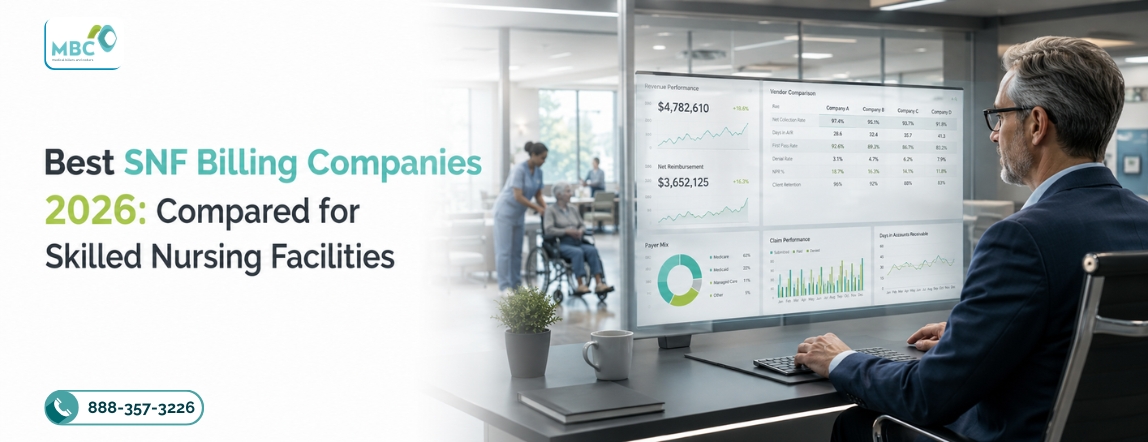
Quick Comparison: Best SNF Billing Services Companies 2026
| Company | Best For | PDPM/RUG Expertise | Reported NCR | ADL Documentation Support | Enterprise Fit |
| Medical Billers and Coders (MBC) | Multi-facility SNF operators and Medicare-heavy census | PDPM-certified, SNF-specific coders | 97%+ | Pre-submission MDS coordination | ★★★★★ |
| Optima Health | Single-site SNFs using Optima EHR | SNF-focused, platform-integrated | ~93% | Included | ★★★★☆ |
| Netsmart RCM | Health system-affiliated SNFs on Netsmart EHR | Broad post-acute RCM module | ~92% | Varies by contract | ★★★★☆ |
| PointClickCare Billing | PointClickCare platform SNF users | Platform-integrated, limited coding depth | ~90% | Practice-managed | ★★★☆☆ |
| Generic RCM Vendors | Small SNFs seeking basic claims processing | Physician-adapted, limited SNF depth | 85–88% | Not included | ★★☆☆☆ |
#1 — Medical Billers and Coders (MBC): Best for Multi-Facility SNF Operators
MBC’s SNF billing practice is built on three technical requirements that separate skilled nursing facility revenue cycle management from every adjacent post-acute discipline: PDPM classification accuracy, ADL-linked documentation workflows, and consolidated billing compliance. These are not areas where physician or ASC billing expertise transfers — they require dedicated SNF billing training and the administrative infrastructure to enforce documentation standards at charge entry.
Why MBC Leads in SNF Billing
PDPM Classification and ICD-10 Primary Diagnosis Accuracy: The CMS Patient-Driven Payment Model assigns residents to clinical categories — Medical Management, Acute Neurological, Non-Orthopedic Surgery, and others — based on the primary ICD-10 diagnosis coded on the MDS. MBC’s SNF billing coders are trained on PDPM’s five payment components, clinical category assignment logic, and the annual CMS SNF payment rate updates that adjust per diem rates and case-mix index values each October 1.
Applying outpatient or physician fee-schedule coding logic to SNF Part A claims results in systematic clinical category misassignment — generating underpayments that most administrators never identify because they lack a benchmark for the correct PDPM per diem.
ADL Score Documentation as Pre-Submission Standard: Under PDPM’s nursing component, the resident’s ADL self-performance scores — captured on MDS Section G — directly determine the nursing case-mix index and the associated per diem reimbursement. Facilities where nursing staff document functional status inconsistently or conservatively are consistently underpaid on every claim, without generating a denial, because the submitted MDS scores are accepted as correct.
MBC’s SNF billing workflow includes an ADL documentation review checkpoint at charge entry, coordinated with MDS staff before the claim moves to submission. This single workflow standard eliminates the most common category of SNF nursing component underpayment — preventable revenue leakage that accumulates per billing cycle across every resident.
Consolidated Billing Compliance Across Ancillary Services: CMS consolidated billing requires the SNF to bill the vast majority of Part A ancillary services — therapy, lab, radiology, most DME — on the facility claim rather than allowing ancillary providers to bill Medicare directly. Billing companies unfamiliar with the consolidated billing exclusion list generate both compliance exposure and ancillary provider billing conflicts that create payer relationship problems and AR aging beyond 90 days.
MBC’s credentialing and billing workflows integrate consolidated billing compliance as a standard SNF function — not a reactive audit response.
97%+ NCR on SNF Facility Claims: MBC delivers 97%+ Net Collection Rate on SNF billing through PDPM-accurate ICD-10 coding, ADL documentation coordination, consolidated billing compliance management, and real-time claim scrubbing against SNF-specific payer rules. For a multi-facility SNF operator billing $3M monthly, each percentage point above the national median in NCR represents $360,000 in recovered revenue per 12 months.
The MBC Revenue Integrity Framework supports ongoing payer variance detection across Medicare, Medicaid, and Medicare Advantage — identifying underpayment patterns before they compound across billing cycles. A dedicated account manager per facility ensures that AR Aging thresholds and denial root-cause engineering insights are communicated directly to the administrator, not filtered through a call center.
Best For: Multi-facility SNF operators, Medicare-heavy census facilities, skilled nursing facilities transitioning from legacy RUG-IV to PDPM workflows, and post-acute networks requiring consolidated billing accuracy across complex payer mixes.
Pricing Structure
MBC’s SNF Billing Services pricing is structured as a percentage of collections — aligning MBC’s revenue with each facility’s net realized revenue growth rather than a flat-fee model that creates no incentive for performance. For SNF operators collecting $1M to $5M or more per month, MBC provides a transparent pricing structure that scales with census volume and payer complexity. The Complimentary 90-Day AR Diagnostic is included at engagement start, establishing a baseline denial pattern and AR Aging benchmark before the billing contract begins — ensuring the pricing structure reflects the actual scope of revenue cycle work required.
Is Your SNF Collecting What It Is Owed?
If your facility is experiencing PDPM underpayments, ADL documentation gaps, or consolidated billing denials, you are incurring avoidable revenue loss on every census day. MBC’s SNF billing specialists deliver PDPM-certified coding, MDS-coordinated ADL documentation workflows, and payer-specific consolidated billing compliance as standard RCM Services — not add-ons to a physician practice billing model.
Request Your Free Revenue Diagnostic and identify the specific SNF billing gaps your current workflow is generating.
FAQs: Best SNF Billing Services Companies
SNF billing operates on the Patient-Driven Payment Model (PDPM) — a per diem reimbursement structure based on the resident’s ICD-10 primary diagnosis, functional status (ADL scores from MDS Section G), and five clinical payment components. Unlike physician fee-schedule billing, SNF claims are not tied to individual procedure codes but to the resident’s clinical classification across an entire Medicare Part A stay. A Medical Billing Services company that handles physician or ASC billing correctly does not automatically understand PDPM component weighting, consolidated billing rules, or MDS-driven documentation requirements.
Top-performing skilled nursing facilities achieve Net Collection Rates of 95%–97% on Medicare Part A facility billing. The national SNF median sits near 90%–93%. An SNF Billing Services partner delivering below 89% NCR is incurring systematic revenue loss through PDPM classification errors, ADL documentation gaps, or consolidated billing failures — not payer behavior outside their control.
The five most common SNF billing errors are: ICD-10 primary diagnosis misassignment driving PDPM clinical category errors; ADL self-performance score underreporting on MDS Section G; consolidated billing violations where ancillary providers bill Medicare directly for covered Part A services; Medicare Advantage authorization expiration denials on extended stays; and therapy minute documentation gaps affecting the SLP and PT/OT payment components under PDPM.
Using the same billing company for both the SNF facility and its affiliated attending physicians creates structural revenue risk. Billing companies optimized for physician professional fee billing frequently misapply outpatient coding logic to SNF PDPM claims, generating clinical category misassignments that produce underpayments accepted as correct. Separating SNF facility billing from physician professional billing — with an SNF specialist who understands PDPM — eliminates this compounding revenue gap.
MBC’s SNF billing team manages both legacy RUG-IV retroactive claim corrections and active PDPM claim workflows. For facilities that transitioned from RUG-IV and have not conducted an old AR recovery audit on pre-PDPM claims, MBC’s Complimentary 90-Day AR Diagnostic identifies uncollected RUG-IV revenue that remains recoverable within the Medicare timely filing window. Ongoing PDPM workflows include annual payment rate update integration each October 1 and system-agnostic compatibility with all major SNF EHR and MDS platforms.

A Subject Matter Expert in healthcare billing operations with nearly 10 years of experience, sharing insights on claims processing, coding support, and revenue cycle optimization. Dedicated to educating healthcare professionals on compliance, accuracy, and strategies to improve billing performance.