Specialities
 Services
 Resource Center
 Pricing
 About
About
 Contact
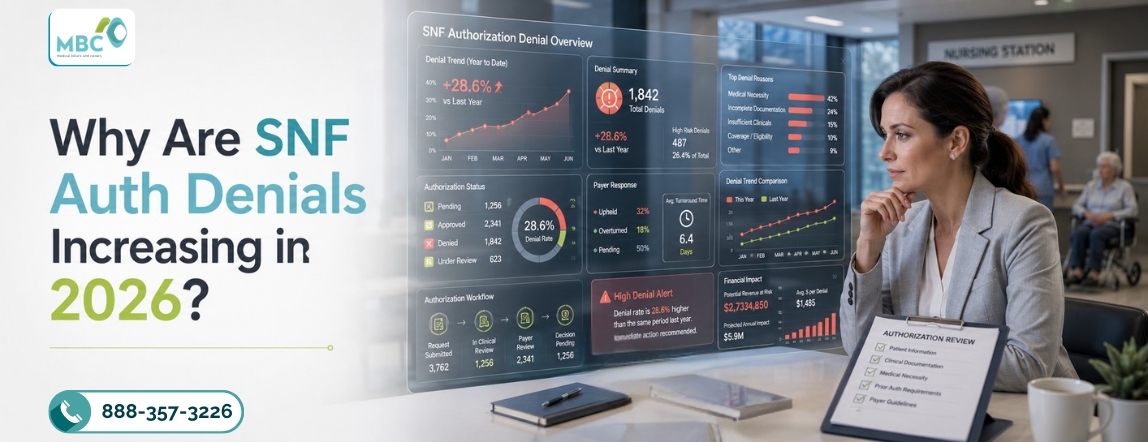
SNF auth denials are not a documentation problem — they are a revenue integrity failure. In 2026, they are costing skilled nursing facilities an average of $340,000 per 12 months in preventable write-offs.
The Authorization Landscape Has Fundamentally Shifted
The authorization environment for skilled nursing facilities has changed more in the past 18 months than in the prior decade combined. Medicare Advantage penetration now exceeds 54% in major metro markets, and each plan operates its own prior authorization criteria, clinical threshold language, and appeals infrastructure. What clears Humana may trigger an immediate denial at UnitedHealthcare. What was approved at 14 skilled days last year is now capped at 10 by the same payer — with no published policy update.
Three structural forces are converging to accelerate SNF auth denials in 2026. First, payers have embedded AI-assisted clinical review engines into their authorization workflows. These systems flag admissions using diagnostic clustering and historical utilization patterns, generating automatic denials before a human reviewer ever sees the file. Second, CMS’s expanded use of Recovery Audit Contractors has created a compliance climate where managed care payers are tightening medical necessity thresholds preemptively. Third, SNF staffing pressures have eroded the clinical documentation precision that payers now demand at intake — not at day 30.
| Payer Category | Primary Auth Trigger | Average Denial Rate (2025–2026) |
| Medicare Advantage | Insufficient skilled need documentation | 31% |
| Medicaid Managed Care | Level of care mismatch at admission | 28% |
| Commercial/Workers’ Comp | Delayed auth submission (>24 hrs post-admission) | 22% |
| Dual Eligible Plans | Coordination of benefits errors | 19% |
What Payers Are Actually Looking For — And Where SNFs Fall Short
The clinical language gap is where most SNF auth denials originate. Payers require documentation that demonstrates a skilled need — not a custodial need. This distinction, which appears simple, fails in practice because intake nurses and therapy evaluators often document functional deficits rather than skilled interventions required to treat them.
“Patient requires assistance with ADLs” is a custodial statement. “Patient requires skilled nursing assessment and management of complex medication regimen including titration of anticoagulation therapy following surgical intervention” is an authorization-compliant skilled need. The difference between these two sentences can determine whether a 21-day stay is authorized or denied at day 3.
MBC’s Revenue Integrity Framework identifies five recurring documentation failures that drive SNF auth denials:
- Admitting diagnosis coded at insufficient specificity — ICD-10 codes selected at the category level rather than the etiology/manifestation level
- Therapy evaluations submitted without functional baseline measurements that justify skilled intervention intensity
- Missing three-day qualifying hospital stay documentation or observation status misclassification
- Physician certification of skilled need not obtained within the payer’s required window (typically 48–72 hours post-admission)
- Concurrent condition complexity not documented — leaving payers with no clinical rationale for extended stay authorization
| Documentation Gap | Denial Type Generated | Revenue Impact per Incident |
| Custodial vs. skilled language | Medical necessity denial | $4,200–$8,400 per admission |
| Missing qualifying stay proof | Technical/eligibility denial | Full claim value |
| Late auth submission | Administrative denial | $3,100–$6,800 per stay |
| Insufficient therapy justification | Level of care denial | $2,600–$5,200 per week |
The Old A/R Problem: When Auth Denials Age Into Write-Off Territory
SNF auth denials that are not worked within 30 days of receipt begin their migration into old A/R — and once they cross the 90-day mark, most internal billing teams treat them as uncollectable. This is where revenue integrity breaks down structurally.
MBC’s denial root-cause engineering process has recovered an average of 38% of SNF auth denials that facilities had already categorized as aged or written off. The recovery mechanism is not aggressive appeals — it is retroactive clinical documentation reconstruction combined with payer-specific escalation pathways that most SNF billing teams do not have access to.
The revenue at stake in old A/R is not marginal. For a 120-bed SNF operating at 85% occupancy, unrecovered auth denials sitting in the 90–180 day bucket represent $180,000–$420,000 in claims that still have viable appeal pathways — if worked with payer variance detection tools and the clinical expertise to reconstruct the skilled need narrative.
MBC’s Complimentary 90-Day AR Diagnostic identifies exactly this population of recoverable denials, quantifies the revenue at stake, and maps the appeal pathway before any engagement begins.
Denial Management Infrastructure: What 2026 Requires
Managing SNF auth denials in 2026 requires infrastructure that most facilities do not have internally and that most generic medical billing services do not offer. The requirement is not faster claim submission — it is payer variance detection at the authorization stage, before the denial is generated.
Payer variance detection means tracking each managed care plan’s authorization approval patterns by diagnosis category, admission source, and attending physician across a rolling 12-month window. When a payer begins tightening approvals in a specific DRG cluster — as UnitedHealthcare did with post-surgical orthopedic admissions in Q4 2025 — an RCM partner with payer variance intelligence can adjust clinical documentation submission protocols before the denial rate spikes.
MBC’s SNF billing services infrastructure includes:
- Pre-Authorization Protocol Layer — clinical documentation review against each payer’s current LCD and medical necessity criteria before submission, not after denial receipt.
- Real-Time Auth Tracking Dashboard — authorization status visibility across all active admissions, flagging pending decisions that are approaching payer response deadlines.
- Denial Root-Cause Engineering — every denial is categorized by root cause (clinical, administrative, technical, payer-specific), with appeals routed to the team with the specific payer relationship and clinical expertise to overturn it.
- Old A/R Recovery Unit — dedicated team working 90–365 day aged denials using retroactive documentation reconstruction and payer escalation protocols.
This infrastructure is what separates RCM services built for skilled nursing complexity from general medical billing services that apply the same workflow across all care settings.
Revenue Integrity and Yield EBITDA: The CFO Perspective
For CFOs and revenue cycle directors at SNF groups operating across multiple states, SNF auth denials are not a billing department problem — they are a Yield EBITDA problem. Every authorization that converts to a denial and ages into write-off territory is direct EBITDA compression that does not appear on the denial report — it disappears silently into the bad debt line.
MBC’s Revenue Integrity Framework tracks net realized revenue per patient day as the primary SNF performance metric, not gross charges or clean claim rate. This distinction matters because a 97% clean claim rate means nothing if authorization denials are removing 12% of net realized revenue before claims are even submitted.
For PE-backed SNF groups and health system-affiliated facilities, net realized revenue per patient day — and its trajectory over a 90-day onboarding window — is the financial output that determines whether RCM services are generating positive Yield EBITDA contribution or simply processing transactions.
MBC’s fee structure is built on this outcome alignment. Facilities engaging MBC’s SNF billing services begin receiving denial root-cause reporting within the first 30 days, with a 30% A/R reduction target established at onboarding and tracked against baseline through the 90-day mark.
Request Your Free Revenue Diagnostic
SNF auth denials in 2026 are not random — they follow payer-specific patterns that MBC’s Revenue Integrity Framework is built to detect, intercept, and reverse. Whether your facility is experiencing rising denial rates on Medicare Advantage admissions, accumulating old A/R from technical denials, or losing Yield EBITDA to write-offs that should have been appealed, the starting point is the same.
Request Your Free Revenue Diagnostic and receive a 90-day baseline assessment of your SNF auth denial composition, old A/R recovery potential, and net realized revenue trajectory — before any engagement begins.
The 5 Questions SNF Administrators Are Asking in 2026
Q1: Why are our Medicare Advantage auth approval rates declining even though our census is stable?
Medicare Advantage plans are tightening SNF authorization thresholds independent of your census or clinical performance. AI-assisted review engines are applying stricter skilled need criteria based on diagnosis clustering and national utilization benchmarks. If your clinical documentation language has not been updated to match each plan’s current medical necessity vocabulary — which changes without public notice — your approval rate will decline even as your patient acuity remains constant. MBC’s payer variance detection identifies these threshold shifts within 30 days of their implementation, allowing documentation protocols to be adjusted before denial rates accelerate.
Q2: What is the difference between a technical denial and a medical necessity denial, and why does it matter for appeals?
Technical denials result from administrative failures — late authorization submission, missing qualifying hospital stay documentation, incorrect coordination of benefits sequencing, or wrong plan ID on the claim. Medical necessity denials result from payers determining that the clinical documentation does not support the level of care billed. These two denial categories require entirely different appeals infrastructure. Technical denials require administrative documentation correction and resubmission within the payer’s timely filing window. Medical necessity denials require clinical documentation reconstruction, physician attestation, and in many cases, peer-to-peer review requests with the payer’s medical director. Applying a technical denial workflow to a medical necessity denial — which most generic RCM services do — results in a second denial and permanent revenue loss.
Q3: At what point do SNF auth denials become unrecoverable, and is our old A/R actually dead?
Most SNF auth denials have viable appeal pathways up to 365 days from the date of service, depending on the payer’s contract terms and state prompt payment regulations. The 90-day threshold is a billing team convention, not a legal or contractual deadline. Denials categorized as written off at 90–180 days are frequently recoverable with the right payer-specific escalation pathway and retroactive clinical documentation. MBC’s Complimentary 90-Day AR Diagnostic has identified recoverable revenue in old A/R buckets at facilities that had formally written off those balances. The question is not whether the revenue is recoverable — it is whether your current RCM services have the infrastructure and payer relationships to recover it.
Q4: How does MBC’s pricing structure work for SNF billing services, and is there a minimum volume requirement?
MBC’s fee structure is performance-aligned and scales with facility revenue — there is no flat per-claim rate that penalizes complex high-acuity cases. Pricing is established after the Complimentary 90-Day AR Diagnostic, which gives both parties a clear baseline of current denial rates, old A/R composition, and net realized revenue per patient day. This diagnostic informs the engagement scope and ensures MBC’s fee structure reflects the specific revenue recovery opportunity at your facility, not a generic rate card. There is no minimum census requirement for SNF billing services engagement.
Q5: What should we look for when evaluating whether our current billing company is actually managing auth denials or just processing them?
The distinction between denial management and denial processing is measurable. A billing company that is managing auth denials will provide monthly root-cause analysis by denial category, payer, and attending physician — with trend data showing whether specific denial types are increasing or decreasing as a direct result of intervention. A company that is processing denials will provide a denial rate percentage and a list of appeals filed. Ask your current vendor for a 90-day denial root-cause trend report segmented by payer and denial type. If they cannot produce it, they are processing — not managing. MBC’s denial management infrastructure generates this report as a standard deliverable, and it is the primary tool used to drive the 30% A/R reduction that SNF clients average within 90 days of onboarding.

A Subject Matter Expert in healthcare billing operations with nearly 10 years of experience, sharing insights on claims processing, coding support, and revenue cycle optimization. Dedicated to educating healthcare professionals on compliance, accuracy, and strategies to improve billing performance.