Specialities
 Services
 Resource Center
 Pricing
 About
About
 Contact

SNF managed care contracts are quietly eroding margins at most skilled nursing facilities through four simultaneous payment failures: Medicare Advantage plans underpaying against contracted per diem rates without detection, prior authorization denials on stays that qualify under traditional Medicare standards, PDPM ICD-10 mapping errors that misclassify residents into lower-paying clinical categories, and SNF VBP Program withhold reductions that partially or fully offset the 3.2% FY2026 Medicare PPS rate increase.
As Medicare Advantage has become the predominant enrollment option for Medicare-age beneficiaries, revenue from SNF managed care contracts now accounts for a larger share of SNF operating margins than traditional Medicare FFS payments. For skilled nursing facilities collecting $1M–$5M per month, each of these four payment failures results in $15,000–$80,000 per month in undetected, unrecovered revenue loss — compounding with each billing cycle until the root cause is identified and corrected.
Why SNF Managed Care Contract Revenue Is More at Risk in 2026 Than Prior Years
The FY2026 SNF Prospective Payment System Final Rule (CMS-1827-F, effective October 1, 2025) finalized a 3.2% Medicare FFS rate increase — the largest component being a 3.3% market basket update offset by a 0.7% productivity adjustment and corrected by a 0.6% forecast error adjustment — totaling $1.16 billion in additional Medicare payments to SNFs nationally. For individual facilities, however, the net benefit depends entirely on two factors most SNF operators do not monitor in real time: PDPM coding accuracy and SNF VBP Program performance scores.
SNF VBP Program reductions total $208.36 million in FY2026. SNFs that underperform on quality metrics — hospital readmission rates, staffing levels, healthcare-associated infections, falls with major injury, discharge function scores, and successful community discharge rates — absorb the 2% Medicare FFS withhold without recovering it through incentive payments. For a facility collecting $2M per month in Medicare FFS revenue, a VBP underperformance scenario converts a $64,000 monthly rate increase into a net payment reduction.
Simultaneously, 34 PDPM ICD-10 code mapping changes took effect on October 1, 2025. Several diagnosis codes previously mapped to the “medical management” clinical category — which generates higher per diem payments — were remapped to “return to provider,” signaling that CMS considers those diagnoses too vague to justify a skilled Part A stay. SNFs that continued using these codes as primary MDS diagnoses after October 1, 2025, are generating automatic claim denials and PDPM misclassification, which suppress per diem reimbursement on every affected admission.
The Four Ways SNF Managed Care Contracts Erode Margins Without Detection
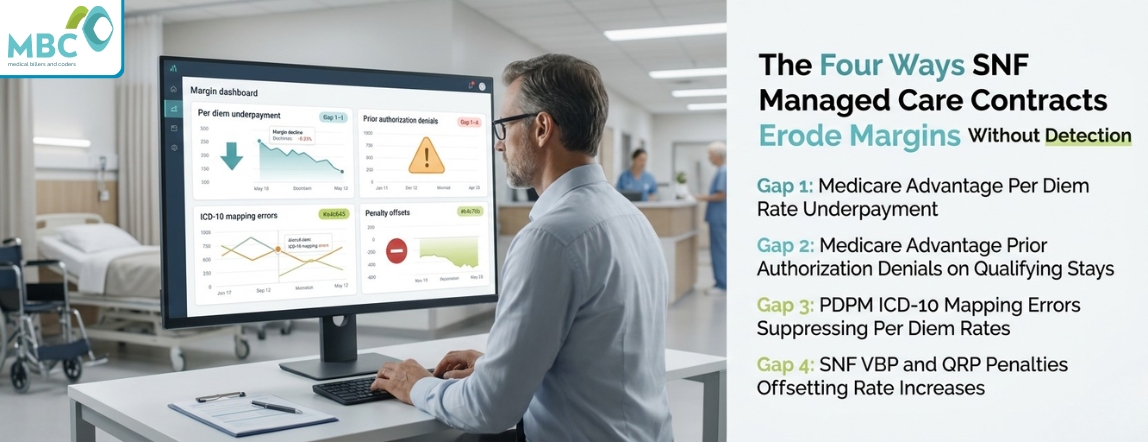
Gap 1: Medicare Advantage Per Diem Rate Underpayment
Medicare Advantage plans negotiate per diem rates with SNFs through individual contracts that vary by plan, by clinical category, and in some cases by admission type. These contracted rates are updated at renewal and may diverge from what MA plans actually remit on individual claims. Without a contract management system that compares every remittance against the contracted per diem rate for the specific MA plan and clinical category, SNFs cannot identify when a plan is paying $285 per diem on a contract that specifies $312.
Forvis Mazars confirms that SNFs lacking a structured contract repository — with effective and renewal dates, payment methodology, billing codes and related rates, and electronic payer IDs — are unable to diagnose underpayments when they occur and are unable to escalate contract disputes before timely appeal windows close. The revenue impact of undetected MA per diem underpayments for a facility with a 40–60% MA census across multiple plan contracts amounts to $20,000–$60,000 per month in contractually owed but uncollected revenue.
Permanent Fix: Implement a contract management system with rate-specific remittance comparison for every MA plan. Generate a monthly variance report showing actual payments received versus contracted per diem by plan, clinical category, and admission date. Escalate variances exceeding $10 per diem within 30 days of identification — before payer-specific dispute windows close.
Gap 2: Medicare Advantage Prior Authorization Denials on Qualifying Stays
The OIG has documented that Medicare Advantage organizations have denied prior authorization requests for SNF admissions that met traditional Medicare coverage criteria — a pattern that CMS addressed in the CY2024 MA Final Rule by establishing that MA plans cannot deny physician-ordered SNF admissions that would be covered under traditional Medicare. The CY2026 MA Final Rule (CMS-4208-F, effective January 1, 2026) further restricted plans from reopening previously approved inpatient admission decisions except for obvious error or fraud.
Despite these protections, prior-authorization delays and mid-stay terminations continue to cause revenue losses for SNFs. When a plan issues a prior authorization and then attempts a post-payment denial, SNFs have the right to appeal under the CY2026 protections — but only if the billing team tracks the authorization number, documents the approval, and files the appeal before the plan-specific deadline. SNFs that lack payer variance detection protocols, which identify every MA plan’s authorization status and appeal window for each active admission, absorb these denials as write-offs rather than as recoverable revenue.
Permanent Fix: Build a prior authorization tracking workflow that records authorization numbers on every MA admission at intake, flags mid-stay termination attempts against CY2026 CMS protections, and initiates an appeal within the plan-specific deadline when a denial contradicts an approved authorization. Train billing staff on the specific CMS guidance prohibiting post-payment denial of previously approved stays under CMS-4208-F.
Gap 3: PDPM ICD-10 Mapping Errors Suppressing Per Diem Rates
The PDPM uses primary ICD-10 diagnosis codes entered on the MDS assessment to assign residents to clinical categories that determine per diem payment rates across five components: physical therapy, occupational therapy, speech-language pathology, nursing, and non-therapy ancillary services. A resident whose primary diagnosis maps to a higher-paying clinical category may generate $50–$175 more per diem than one mapped to “medical management” or “return to provider” — a difference of $1,500–$5,250 over a 30-day stay.
The 34 ICD-10 code mapping changes effective October 1, 2025, created a new category of PDPM revenue loss: codes that previously generated valid clinical category assignments now route to “return to provider,” meaning the MDS cannot be completed with that code as the primary diagnosis without clinical team intervention to identify a more specific qualifying diagnosis. SNFs that did not update their MDS documentation protocols before October 1, 2025, are generating lower PDPM per diem rates or outright claim denials on every admission using remapped codes.
Permanent Fix: Audit all active MDS assessments and pending admissions against the FY2026 PDPM ICD-10 mapping file (effective October 1, 2025). For every admission using a remapped diagnosis code, work with the clinical team to identify and document a more specific qualifying primary diagnosis before the MDS is finalized. Build a monthly PDPM coding audit into the billing workflow to verify that clinical category assignments reflect actual patient acuity and current ICD-10 mapping rules.
Gap 4: SNF VBP and QRP Penalties Offsetting Rate Increases
The SNF VBP Program withholds 2% of every Medicare FFS Part A payment and redistributes between 50% and 70% back to SNFs based on quality performance scores. SNFs that underperform receive less than the full withhold back — meaning their net Medicare FFS rate is below the nominal 3.2% FY2026 increase. SNFs that fail to submit required quality data under the SNF Quality Reporting Program face an additional 2-percentage point payment reduction applied directly to all applicable services.
For a facility collecting $1.5M per month in Medicare FFS Part A revenue, the 2% VBP withholding amounts to $30,000 per month, held pending performance-based redistribution. A facility at the 25th percentile of VBP performance scores may recover only 50–60% of that withheld — a permanent monthly loss of $12,000–$15,000 relative to a high-performing peer. QRP non-compliance adds another $30,000 per month in payment reductions on top of VBP underperformance, compounding into a net revenue position well below the published rate update.
Permanent Fix: Track VBP performance metrics monthly against the program’s current measure set: hospital readmission rates, staffing levels, healthcare-associated infections, falls with major injury, discharge function scores, and successful community discharges. Build QRP data submission deadlines into a compliance calendar with 30-day advance reminders. Monitor the gap between your facility’s VBP incentive payment and the full 2% withholding as a key financial performance metric.
SNF Managed Care Contract Revenue Leakage: Four Gaps and Monthly Impact
| Revenue Gap | Root Cause | Permanent Fix | Monthly Impact ($1M–$5M SNF) |
| MA per diem underpayment | No rate-specific remittance comparison against contracted per diem by plan and clinical category | Contract management system with a monthly variance report; dispute escalation within 30 days | $20,000–$60,000 |
| MA prior authorization denials on qualifying stays | Authorization not tracked by admission; post-payment denials not appealed within plan deadlines | Auth tracking per admission; appeal workflow per CMS-4208-F protections; staff training on CY2026 MA rules | $15,000–$50,000 |
| PDPM ICD-10 mapping errors | 34 code remappings effective October 1, 2025 not reflected in MDS documentation protocols | MDS audit against FY2026 PDPM mapping file; clinical team diagnosis review for remapped codes | $15,000–$45,000 |
| VBP withhold and QRP penalty | Quality performance below redistribution threshold; QRP data submission missed or incomplete | Monthly VBP metric tracking; QRP submission calendar with 30-day advance reminders | $12,000–$60,000 |
| TOTAL MONTHLY LEAKAGE | SNF collecting $1M–$5M per month without contract integrity and PDPM audit infrastructure | Four-gap revenue integrity closure + payer variance detection | $62,000–$215,000 per month recoverable |
Table 1: SNF Managed Care Contract Revenue Leakage — Four Gaps, Root Causes, and Monthly Impact
How MBC’s Revenue Integrity Framework Closes SNF Managed Care Contract Gaps
SNF managed care contracts require a revenue integrity infrastructure that operates at four levels simultaneously: contract-level rate tracking, admission-level authorization management, MDS-level PDPM coding accuracy, and VBP/QRP performance monitoring. No single billing function covers all four. The MBC Revenue Integrity Framework is purpose-built for SNF operators navigating this complexity — applying payer variance detection protocols to identify MA underpayments before appeal deadlines, denial root-cause engineering to separate recoverable authorization denials from permanent write-offs, and PDPM coding audits to protect per diem rates against ICD-10 mapping errors.
As the leading medical billing company in the USA with 25+ years of SNF billing expertise, MBC delivers medical billing services that track the financial performance metrics SNF CFOs and administrators need to manage Yield EBITDA: net collection ratio by payer and clinical category, MA per diem variance by plan, PDPM clinical category distribution against expected case mix, VBP performance score trending, and Days in AR by payer type. While most billing vendors deliver monthly AR aging reports, MBC provides the contract integrity and coding accuracy infrastructure that translates the FY2026 3.2% rate increase into real margin improvement, rather than a nominal figure absorbed by underpayments and penalties.
The starting point is a Complimentary 90-Day SNF Revenue Diagnostic — a structured review of your MA contract rates against current remittance by plan, your PDPM ICD-10 mapping compliance status against the October 2025 changes, your VBP performance trajectory against the redistribution threshold, and your authorization tracking workflow against CY2026 CMS protections. The diagnostic identifies your specific revenue leakage sources and the monthly recovery potential from closing each one, before you commit to any billing change.
The 3.2% Rate Increase Is Only Real If Your Contracts Are Paying It.
Medical Billers and Coders (MBC) delivers SNF Billing Services, Old AR Recovery, RCM Services, and Denial Management Services with 25+ years of SNF billing expertise. Dedicated account manager. No EHR change required.
→ Request Your 90-Day SNF Revenue Diagnostic
Frequently Asked Questions
Most SNF managed care contracts are not being fully paid because SNFs lack the per diem rate comparison infrastructure to detect when MA plans remit below contracted rates — a gap that Forvis Mazars identifies as one of the most common SNF revenue leakage sources — generating $20,000–$60,000 per month in undetected underpayments for facilities with 40–60% MA census across multiple plan contracts.
CMS finalized a 3.2% SNF PPS rate increase for FY2026 (CMS-1827-F, effective October 1, 2025), totaling $1.16 billion nationally — but individual facility margins depend on VBP performance scores, since $208.36 million in VBP withholds may not be returned to underperforming facilities, and on PDPM coding accuracy, since 34 ICD-10 code mapping changes effective October 1, 2025 create per diem reductions for SNFs that did not update MDS documentation protocols.
CMS finalized 34 changes to PDPM ICD-10 code mappings effective October 1, 2025, remapping several diagnoses from higher-paying clinical categories to “return to provider” — meaning SNFs using those codes as primary MDS diagnoses generate lower per diem rates or claim denials; a PDPM per diem difference of $50–$175 per day compounds to $1,500–$5,250 over a 30-day stay per affected admission.
The CY2026 MA Final Rule (CMS-4208-F, effective January 1, 2026) restricts MA plans from reopening previously approved inpatient admission decisions except for obvious error or fraud, and the CY2024 MA rule established that MA plans cannot deny physician-ordered SNF admissions that meet traditional Medicare coverage criteria — protections that SNFs can only enforce if they track authorization numbers per admission and file appeals within plan-specific deadlines.
The SNF VBP Program withholds 2% of all Medicare FFS Part A payments and redistributes 50–70% back as incentive payments based on quality performance; facilities underperforming on readmission rates, staffing levels, infection rates, falls, and discharge function scores recover less than the full withhold, creating a permanent net revenue reduction of up to $15,000 per month on $1.5M in Medicare FFS revenue relative to high-performing peers.
References
- Centers for Medicare & Medicaid Services. (2025). FY 2026 skilled nursing facility prospective payment system (SNF PPS) final rule (CMS-1827-F): Rate update, PDPM ICD-10 mapping changes, and value-based purchasing program updates.
- Centers for Medicare & Medicaid Services. (2025). Patient-driven payment model (PDPM): FY 2026 ICD-10 mapping file (effective October 1, 2025).
- Centers for Medicare & Medicaid Services. (2025). Contract year (CY) 2026 Medicare Advantage and Part D final rule (CMS-4208-F): Policy and technical changes.
- U.S. Department of Health & Human Services, Office of Inspector General. (2022). Some Medicare Advantage organization denials of prior authorization requests raise concerns about beneficiary access to medically necessary care.
- Forvis Mazars. (2025). Medicare Advantage: Opportunities to improve SNF revenue realization (contract management and underpayment detection).
- Federal Register. (2025, August 4). Medicare program; prospective payment system and consolidated billing for skilled nursing facilities (CMS-1827-F).

Catering to more than 40 specialties, Medical Billers and Coders (MBC) is proficient in handling services that range from revenue cycle management to ICD-10 testing solutions. The main goal of our organization is to assist physicians looking for billers and coders, at the same time help billing specialists looking for jobs, reach the right place.