Specialities
 Services
 Resource Center
 Pricing
 About
About
 Contact
The fastest claim processing in medical billing starts before a patient checks out — it begins the moment eligibility is verified in real time. When every handoff in your revenue cycle is automated, electronic, and pre-scrubbed, claims reach payers the same day and reimbursements arrive within a week. That’s not aspirational. That’s the operational baseline for high-performing practices today.
Yet most facilities are still losing weeks — and hundreds of thousands of dollars — to preventable delays. Here’s what actually moves the needle.
The Real Bottlenecks Slowing Down Your Claims
Slow reimbursements are rarely a payer problem. They’re an operational problem. Three root causes account for the majority of claim delays:
- Eligibility errors caught too late. Roughly 9% of claims are denied simply because eligibility wasn’t verified upfront. By the time the denial lands, the patient has already left and rework begins. Under CAQH CORE Phase II standards, real-time HIPAA 270/271 eligibility responses must arrive within 20 seconds — but most practices aren’t wired to use them consistently.
- Manual coding creating a daily backlog. Traditional coding workflows take 7 to 30 minutes per inpatient case. Multiply that across a busy practice and you have claims sitting 48 to 72 hours before they’re even ready to submit. AI-assisted coding, by contrast, can automate over 50% of cases with a 54.6% exact match ratio and surface the top 10 relevant codes with 95.5% accuracy — without sacrificing compliance oversight.
- Paper claims still in the mix. According to CMS HIPAA Transaction Standards, electronic claims are processed significantly faster than paper equivalents. Data consistently shows 69% of electronic claims are adjudicated within 7 days, versus just 29% of paper claims. If your practice hasn’t gone fully electronic, that gap is costing you cash flow every single week.
Manual vs. Automated Claims: The Numbers Side by Side
| Metric | Manual Workflow | Automated Claims Processing |
| Submission Speed | Days (manual entry/mail) | Same-day electronic submission |
| Payer Response Time | 30+ days for paper | ~7 days for 69% of e-claims |
| Error Detection | After denial (reactive) | Before submission (proactive scrubbing) |
| Cost Per Claim | ~$25 | Under $1 |
| AR Days Impact | Increases aging & backlog | Reduces to 18–22 days range |
| Staff Time on Follow-Up | High (portal logins, calls) | Minimal (bulk automated status checks) |
The cost difference alone — $25 manual vs. under $1 automated — means a practice submitting 500 claims monthly is overspending $12,000 every month on avoidable administrative overhead.
What Automated Claims Processing Actually Looks Like in Practice
The fastest claim processing in medical billing isn’t a single tool. It’s a layered infrastructure — and each layer compounds the impact of the one before it.
Layer 1: Front-end eligibility: Real-time 270/271 verification runs automatically at scheduling and again at check-in. Coverage gaps surface before the appointment, not after the claim rejects.
Layer 2: Automated coding assist: Clinical notes feed into AI-assisted coding tools that flag the highest-probability CPT and ICD-10 combinations. Human coders review exceptions rather than building codes from scratch.
Layer 3: Pre-submission scrubbing: Claims are checked against payer-specific edits, modifier rules, and bundling logic before they leave your system. This is where Claims Processing Best Practices create the most measurable impact — catching modifier errors, missing diagnosis pointers, and duplicate billing that would otherwise trigger an automatic denial.
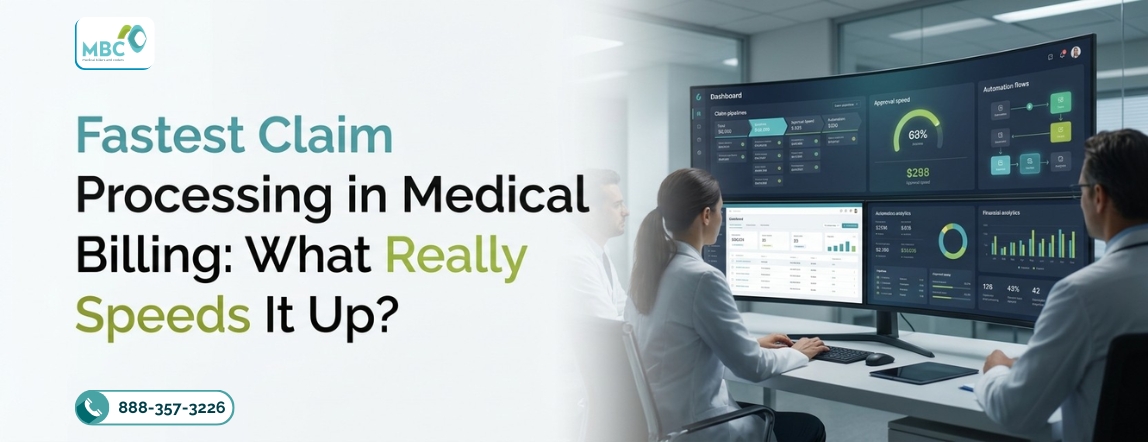
Layer 4: Electronic submission + bulk status tracking: Claims submit electronically via a clearinghouse, and status updates pull automatically. Staff aren’t logging into 12 payer portals — they’re reviewing a single dashboard that flags aging claims and denial patterns.
Layer 5: Denial root-cause analytics: When denials do occur, they’re categorized automatically by denial code, payer, and provider. This turns your denial data into a feedback loop that tightens upstream processes over time.
Working with an experienced revenue integrity partner means all five layers are running simultaneously — not bolted on one at a time.
Automated Claims Processing: Why AI Is Transforming Medical Billing
The AR Days Benchmark You Should Actually Be Hitting
Days in Accounts Receivable (AR Days) is the most honest measure of how fast your claims process is actually working. The industry standard is 40 to 45 days. Best-in-class revenue cycle management brings that to 18 to 22 days.
The practices that consistently achieve this benchmark share a few operational traits: next-business-day claim submission as a default, automated eligibility at every patient touchpoint, and a denial management workflow that escalates high-dollar claims within 48 hours of rejection.
If your AR Days are trending above 45, the issue isn’t your payers. It’s the gaps between your clinical, coding, and billing teams — gaps that automation closes systematically.
How to Evaluate Your Current Claim Velocity
Before switching platforms or outsourcing your billing, run an internal audit on three metrics:
- Your first-pass acceptance rate — anything below 95% signals a systemic issue upstream, either in eligibility, coding, or data entry.
- Your average days to submit — claims should leave your system within 24 hours of service. If your average is 3 to 5 days, you have a coding or workflow bottleneck.
- Your denial rate by category — eligibility denials and coding denials have different fixes. Knowing which category is dominant tells you where to invest.
If you’re not measuring these, your billing process is running blind. The fastest medical billing and coding services are built on real-time visibility — not monthly reports.
The Real ROI: What Faster Claims Mean Financially
Here’s what changes when you achieve genuinely fast claim processing:
A practice processing 600 claims per month at $25 manual cost saves $14,400 monthly — $172,800 annually — by moving to automated workflows. Reduce AR Days from 55 to 22 and you’re accelerating cash by up to 12%, which eliminates the working capital gap that forces facilities to defer equipment purchases or carry unnecessary credit lines.
For any facility serious about margin performance, exploring transparent RCM pricing models against your current collection rate is the first practical step.
Ready to Stop Losing Revenue to Claim Delays?
MBC’s billing infrastructure is built to deliver the fastest claim processing in medical billing — with same-day electronic submission, real-time scrubbing, and denial recovery that recovers written-off revenue before it ages out.
Call us:888-357-3226 Email us: info@medicalbillersandcoders.com
Request your complimentary Revenue Velocity Audit — we’ll identify exactly where your claims are slowing down and quantify what faster processing is worth to your bottom line.
FAQs
With fully automated eligibility, coding, and electronic submission, 69% of e-claims are adjudicated within 7 days — significantly faster than the 30+ days typical for paper-based or manual workflows.
It means real-time eligibility responses must arrive within 20 seconds, allowing staff to verify coverage and collect accurate co-pays before the patient leaves — preventing eligibility denials entirely.
Industry best practice is under 40 days. High-performing revenue cycle management operations consistently achieve 18 to 22 days through automation and proactive denial management.
Electronic claims include automated scrubbing that catches errors before submission, and payers prioritize e-claim queues. Paper claims require manual data entry at the payer side — adding weeks to processing time.
Yes, when used as a human-in-the-loop model. AI surfaces high-confidence code suggestions; certified coders verify and approve. This speeds throughput by 60–70% while maintaining accuracy and audit readiness.

With almost 12 years of experience in healthcare revenue cycle management, this Revenue Cycle Specialist brings deep expertise in medical billing, claims optimization, and practice profitability. Shares industry-backed insights focused on improving collections, reducing denials, and driving operational excellence.