Specialities
 Services
 Resource Center
 Pricing
 About
 Contact
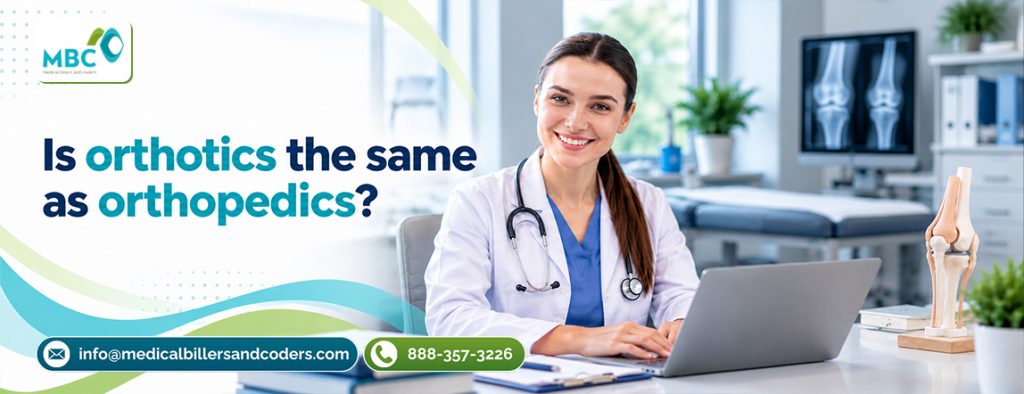
No, orthotics and orthopedics are not the same. Orthopedics is a branch of medicine that diagnoses and treats conditions of the skeletal system, including bones, joints, and tendons, while orthotics refers to devices such as braces and inserts that support, align, and stabilize a weakened or injured body part. They are also billed differently: orthopedic claims depend on precise ICD-10 documentation such as laterality and encounter type, while orthotics are billed under Medicare’s DMEPOS rules through the DME MAC and need a prescription, eligibility checks, and, for certain codes, prior authorization.
Is orthotics the same as orthopedics? If you are looking for an answer then you are at the right place. An orthotic is a device that supports and stabilizes a joint or weakened/injured body part, creating proper alignment, pressure relief, and management of pain while orthopedics is a branch of medicine that focuses on the care of the skeletal system and its interconnecting parts like bones, joints, tendons.
When people talk about orthopedic doctors, they usually mean orthopedic surgeons, since orthopedic surgery is one of the more common procedures patients encounter. However, while all orthopedic surgeons are orthopedic specialists, not every orthopedic specialist is a surgeon. Many manage musculoskeletal conditions without surgery. Orthotics, on the other hand, refers to the devices themselves. The clinician who designs and fits them is an orthotist, who typically completes a master’s degree in orthotics and prosthetics, an accredited residency, and board certification.
Orthotics fall into two broad groups: prefabricated and custom. Prefabricated orthotics, including off-the-shelf braces, cost less and are often available without a visit to an orthotist. Custom orthotics are molded or fabricated for one patient, cost more, and require a prescription. For Medicare, that order must come from a physician, nurse practitioner, physician assistant, or clinical nurse specialist. Medicare generally does not cover foot orthotics or shoe inserts, except therapeutic shoes and inserts for qualifying diabetic patients or inserts that are part of a covered leg brace.
Key Takeaways
- Orthotics and orthopedics are distinct; orthopedics treats skeletal system issues, while orthotics involves devices that support and stabilize injuries.
- Orthopedic billing relies on precise ICD-10 documentation, whereas orthotics billing requires a prescription and follows Medicare DMEPOS rules.
- Not every orthopedic specialist is a surgeon, and orthotists are certified clinicians who design and fit orthotic devices.
- Several knee, spinal and upper limb orthoses now require Medicare prior authorization before the item is delivered.
- Both fields demand in-depth knowledge of reimbursement guidelines, particularly for Medicare, Medicaid, and commercial plans.
Basics of orthopedics billing and orthotics billing:
Orthopedics Billing
Most orthopedic claim denials come from a small set of causes: services billed inside a global surgical period, missing or incorrect modifiers such as 25, 57, 59 or the X{EPSU} set, NCCI bundling edits, missing prior authorization, and documentation that does not support medical necessity. Duplicate submissions still occur, but they are usually a symptom of weak claim tracking rather than the root problem. Orthopedic groups reduce these denials by:
- Verifying eligibility and authorization requirements before the visit or procedure
- Checking global period status before billing post-op encounters
- Scrubbing claims against NCCI edits and payer modifier rules before submission
- Auditing documentation for laterality, site and encounter type
Laterality
ICD-10-CM requires the physician to document right, left, or bilateral for many fractures and joint disorders. On the procedure side, laterality is reported with modifiers such as RT, LT and 50. A mismatch between the diagnosis side and the procedure modifier is a common denial trigger.
Site Specificity
Many orthopedic diagnoses require the exact anatomic site. For spinal stenosis or spondylosis, for example, the documentation should name the spinal region, such as cervical, thoracic or lumbar. Unspecified codes are increasingly flagged by payers and can lead to denials or requests for records.
Place of Occurrence
ICD-10-CM includes external cause codes for where an injury happened. Reporting them is not nationally required, but some payers and state programs ask for them, especially on workers’ compensation and auto injury claims. When used, the place of occurrence code is reported once, at the initial encounter.
Type of Encounter
Injury and fracture codes use a seventh character to show the phase of care: A for active treatment, D for a subsequent encounter during healing or recovery, and S for sequela. “A” refers to active treatment, not the first visit. A patient seen by a new orthopedic surgeon for ongoing fracture care may still be coded with A. Fracture codes also use additional seventh characters to show delayed healing, nonunion or malunion.
Orthotics Billing
Orthotics billing starts before the device is delivered. The workflow covers order intake, patient and insurance entry, HCPCS L-code and diagnosis selection, eligibility verification, collection of a complete written order, prior authorization where required, claim submission, denial management, and AR follow-up. Medicare orthotics claims go to the DME MAC rather than the Part A/B MAC. An orthopedic group that dispenses braces must be enrolled as a DMEPOS supplier to bill Medicare for them.
Medicare Rules That Now Shape Orthotics Billing
Prior Authorization for Knee, Spinal and Upper Limb Orthoses
Medicare requires prior authorization as a condition of payment for several orthoses. Lumbar sacral orthoses L0648 and L0650 and knee orthoses L1832 and L1851 have required it nationwide since October 2022. Spinal orthoses L0456, L0457 and L0486 and knee orthosis L1833 were added for dates of service on or after October 28, 2026. Upper limb orthoses L3761 and L3916 are being phased in. These items also require a face-to-face encounter and a written order before delivery. Unless the supplier holds a prior authorization exemption, a claim for a listed brace delivered without an affirmed decision is denied, regardless of medical necessity.
PDAC Coding Verification
Certain codes, including L0648, L0650, L1832, L1833 and L1851, may only be billed for products that the Pricing, Data Analysis and Coding (PDAC) contractor has verified and listed on its Product Classification List. Billing an unverified product under these codes results in denial, even with prior authorization in hand.
Off-the-Shelf, Custom-Fitted and Custom-Fabricated Codes
The L-code depends on how much the device is modified. Off-the-shelf orthoses need minimal self-adjustment. Custom-fitted orthoses are prefabricated but substantially modified by a qualified professional. Custom-fabricated orthoses are built for one patient from a mold or measurements. Billing a custom-fitted code without documentation of the fitting is a frequent audit finding. Claims also need RT or LT and, where the policy requires it, the KX modifier to confirm coverage criteria are met.
Competitive Bidding Returns for Off-the-Shelf Braces
CMS has restarted the DMEPOS Competitive Bidding Program, with off-the-shelf back, knee and upper extremity braces included in a national remote item delivery program. Contracts are expected in late summer or early fall 2027, with the round starting January 1, 2028. Physicians and treating practitioners can still furnish off-the-shelf orthotics to their own patients as part of a visit without being a contract supplier, which makes in-office dispensing an important decision for orthopedic groups to review now.
Orthopedics vs Orthotics Billing at a Glance
| Area | Orthopedics Billing | Orthotics Billing |
|---|---|---|
| What is billed | Physician services, procedures, surgery | Braces, supports and orthotic devices |
| Code sets | CPT, ICD-10-CM | HCPCS L-codes, ICD-10-CM |
| Medicare claim goes to | Part A/B MAC | DME MAC |
| Key requirements | Laterality, site, seventh character, global period, modifiers | Written order, face-to-face for listed items, prior authorization, PDAC verification |
| Common denial triggers | Global period conflicts, modifier errors, NCCI bundling | Missing prior auth, unverified product, wrong OTS or custom code, missing RT/LT or KX |
| Enrollment | Standard Medicare provider enrollment | DMEPOS supplier enrollment |
Summary
Orthotics and orthopedics are related but billed under different rules. Orthopedic revenue depends on ICD-10-CM specificity, global period tracking and correct modifiers. Orthotics revenue depends on what happens before delivery: a complete order, prior authorization for listed codes, PDAC-verified products and the right L-code. For orthopedic groups that dispense braces, both sets of rules apply on the same patient, and a gap in either one leaves money on the table.
Get Your Orthotics Claims Reviewed
If your group dispenses braces, the October 2026 prior authorization additions and the return of competitive bidding make this a good time to check where orthotics claims are being denied or underpaid. MBC’s orthopedic billing team reviews your orthotics prior authorization workflow, L-code selection and DME MAC denials alongside your professional claims. Request an orthotics claims review, call 888-357-3226, or email info@medicalbillersandcoders.com.
FAQs:
A: Orthopedic medical billing involves managing the financial aspects of orthopedic healthcare services, including coding, claims submission, and reimbursement.
A: Orthopedic refers to the medical specialty focused on the treatment of musculoskeletal conditions and injuries, while orthotic refers to devices designed to support and stabilize weakened or injured body parts, such as braces or inserts.
A: Not exactly. Medicare places braces in a separate orthotics benefit category within DMEPOS (durable medical equipment, prosthetics, orthotics and supplies), not the DME benefit itself. In practice, orthotics are still billed to the DME MAC with HCPCS L-codes and follow DMEPOS rules on orders, documentation and supplier enrollment.
A: Lumbar sacral orthoses L0648 and L0650 and knee orthoses L1832 and L1851 require it nationwide. Spinal orthoses L0456, L0457 and L0486 and knee orthosis L1833 were added for dates of service from October 28, 2026, and upper limb orthoses L3761 and L3916 are being phased in.
A: Yes, if the group is enrolled as a DMEPOS supplier and bills the DME MAC. Under the competitive bidding rules, physicians and treating practitioners can furnish off-the-shelf orthotics to their own patients during a visit without being a contract supplier, provided enrollment and documentation requirements are met.
A: No. Medicare only accepts orthotics orders from a physician, nurse practitioner, physician assistant, or clinical nurse specialist. A physical therapist can evaluate the patient and recommend a brace, but the written order must be signed by an eligible practitioner, or the claim will be denied.
A: For braces on the CMS Required Face-to-Face Encounter and Written Order Prior to Delivery List, the ordering practitioner must see the patient within six months before the written order and document why the brace is needed. The written order must be in the supplier’s file before the item is delivered.
A: The KX modifier tells Medicare that the coverage criteria in the applicable local coverage determination have been met and that supporting documentation is on file. Leaving it off when the policy requires it leads to denial, and adding it without documentation creates audit and recoupment risk.
A: Generally no. Medicare excludes foot orthotics and shoe inserts with two main exceptions: therapeutic shoes and inserts for diabetic patients who meet the coverage criteria, and inserts that are an integral part of a covered leg brace. Commercial plans may cover them, so verify benefits before dispensing.
A: Not necessarily. Each commercial and Medicare Advantage plan sets its own prior authorization list, and many require authorization for custom-fabricated or high-cost braces that traditional Medicare does not. Orthopedic groups should check requirements by plan and HCPCS code before delivery, rather than assuming Medicare rules apply.
Sources:

A Subject Matter Expert in healthcare billing operations with nearly 10 years of experience, sharing insights on claims processing, coding support, and revenue cycle optimization. Dedicated to educating healthcare professionals on compliance, accuracy, and strategies to improve billing performance.