Specialities
 Services
 Resource Center
 Pricing
 About
About
 Contact
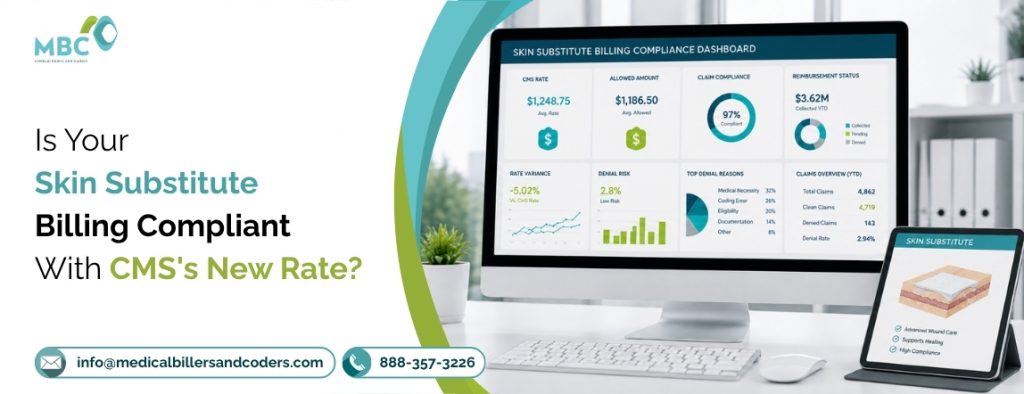
No, your skin substitute billing is likely not compliant if you are still coding and pricing products under the old per-product ASP methodology. Effective January 1, 2026, CMS replaced individual product-based payment with a single flat national rate of $127.14 per square centimeter for most skin substitutes used in physician offices and hospital outpatient departments.
If your billing team hasn’t rebuilt its coding logic, documentation workflow, and fee schedule around this rate, every claim you submit carries real audit and denial risk. This shift is the single biggest change to wound care reimbursement in years, and it’s catching a lot of practices off guard. Below, we break down exactly what changed, why CMS made the move, and what multi-site wound care groups and specialty centers need to do right now to protect revenue.
Key Takeaways
- Starting January 1, 2026, Skin Substitute Billing requires compliance with a flat rate of $127.14 per square centimeter, replacing the old per-product ASP model.
- CMS reclassified skin substitutes as ‘incident-to’ supplies, bundling payments with application procedures and removing financial incentives for higher-cost products.
- Billing teams must align HCPCS codes with FDA classifications, document applied versus discarded product, and account for local coverage gaps.
- Practices need to update coding processes and conduct internal audits to avoid compliance risks and ensure accurate reimbursements.
- Failure to adapt to the new Skin Substitute Billing regulations can lead to increased denials, underpayments, and audits.
What Changed in Skin Substitute Billing for 2026
Under the previous system, each skin substitute product received its own HCPCS code and its own average sales price (ASP)-based payment limit, meaning reimbursement could range anywhere from roughly $200 to more than $3,000 per square centimeter depending on the product selected.
That pricing structure rewarded higher-cost product selection rather than clinical outcomes, and it left facilities relying on outsourced medical billing services with a constantly moving pricing target.
CMS finalized a fundamentally different approach in the CY 2026 Medicare Physician Fee Schedule Final Rule (CMS-1832-F), released October 31, 2025. Most skin substitutes are now reclassified as “incident-to” supplies rather than separately payable biologicals.
That means the product itself is no longer billed at a manufacturer-driven price; instead, it’s bundled into a single, standardized payment tied to the covered application procedure.
CMS initially set the rate at approximately $127.28 per square centimeter, then issued a technical correction on November 26, 2025, adjusting the figure to $127.14 per square centimeter based on updated utilization data and recalculated practice-expense inputs.
This is the rate that governs correct skin substitute billing today, for both non-facility (office) settings and hospital outpatient departments under OPPS.
Why CMS Overhauled the Reimbursement Model
The change didn’t happen in a vacuum. Medicare Part B spending on skin substitutes climbed from $252 million in 2019 to more than $10 billion in 2024, a nearly 40-fold increase in five years, while patient volume roughly doubled over the same period.
An HHS Office of Inspector General review flagged the growth as disproportionate and identified aberrant billing patterns, including unusually high-volume claims from clinicians in specialties not typically associated with these products.
For any center relying on internal staff rather than dedicated RCM services, catching these patterns before a payer does is now a core part of compliant skin substitute billing.
CMS concluded that the old model created a direct financial incentive to select higher-priced products regardless of clinical necessity. Moving skin substitutes into a flat, supply-based payment structure removes that incentive and ties reimbursement to the procedure, not the product’s list price.
For any organization managing revenue cycle management across multiple wound care sites, this is the context every coder and biller needs to understand before touching a claim.
The Compliance Risk Hiding in Your Current Workflow
Rate compliance for skin substitute billing goes beyond simply updating a fee schedule. Three areas are generating the most denials and audit exposure right now:
- HCPCS code alignment. CMS now categorizes skin substitutes by FDA regulatory pathway, not brand or clinical indication. The HCPCS code you bill must match the product’s FDA classification exactly — a mismatch is a fast track to a compliance flag.
- Discarded product documentation. Under the 2026 rules, reimbursement is limited strictly to the portion of the product actually applied to the patient. Discarded or unused material is no longer separately billable, so documentation must clearly capture applied square centimeters versus wasted material on every claim.
- Local coverage gaps. CMS withdrew its finalized Local Coverage Determinations for skin substitute grafts used in diabetic foot ulcer and venous leg ulcer treatment on December 24, 2025, which means coverage criteria in some jurisdictions remain in flux even as the payment rate itself is locked in.
Practices that fail to close these gaps aren’t just leaving money on the table; they’re building a documentation trail that invites payer scrutiny.
Old Model vs. New Model: A Quick Comparison
| Element | Pre-2026 (ASP-Based Model) | 2026 (Flat-Rate Model) |
| Payment basis | Individual product ASP, unique code per product | Single national rate: $127.14/cm² |
| Payment range | Roughly $200–$3,000+ per sq cm | Flat rate regardless of brand |
| Classification | Billed as separately payable biological | Billed as “incident-to” supply |
| Coding logic | Product-specific HCPCS code | Coded by FDA regulatory category |
| Discarded product | Often bundled into billed amount | Not separately billable |
| Financial incentive | Rewarded higher-cost product selection | Neutral toward product cost |
What Multi-Site Wound Care Groups Should Do Now
Getting ahead of this requires more than a policy memo. Facilities need updated coding crosswalks by FDA category, revised documentation templates that isolate applied-versus-discarded product, and a billing team that understands the corrected $127.14 rate cold, not the outdated proposed figures still circulating online.
Practices with a mix of specialties, including orthopedic, podiatry, and general wound care, benefit from reviewing our specialty-specific billing resources to see how these changes intersect with procedure-level coding in each area.
State-level coverage nuances also still matter, especially with LCD withdrawals affecting different Medicare Administrative Contractor jurisdictions differently. Organizations operating across multiple states should check jurisdiction-specific coverage guidance through our state-by-state billing coverage directory before finalizing 2026 claim workflows.
Internal audits are worth running now, not after the first wave of denials arrives. Pull a sample of recent skin substitute claims and check three things: whether the HCPCS code matches the product’s current FDA regulatory category, whether applied square centimeters are documented separately from any discarded material, and whether your fee schedule reflects $127.14 rather than an earlier proposed figure.
A gap in any one of these areas is enough to trigger a payer audit, and correcting course now is far less costly than appealing denials months from now.
This is exactly the kind of structural payment shift where outsourced skin substitute billing services earn their value: dedicated coders tracking FDA category updates, documentation audits built specifically around applied-versus-discarded product rules, and claim scrubbing calibrated to the corrected rate before submission — not after a denial.
Summary
CMS’s CY 2026 Medicare Physician Fee Schedule Final Rule replaced product-specific ASP pricing for most skin substitutes with a single flat rate of $127.14 per square centimeter, effective January 1, 2026. The change was driven by explosive spending growth and OIG findings of aberrant billing, and it reclassifies these products as incident-to supplies rather than separately payable biologicals.
Compliant skin substitute billing now depends on precise FDA-category coding, tight documentation of applied versus discarded product, and awareness of jurisdiction-specific coverage gaps left by the LCD withdrawal. Practices relying on outdated per-product pricing logic are exposed to denials, underpayment, and audit risk — all of which are preventable with the right coding infrastructure and revenue cycle management support in place.
Not sure your current claims are compliant with the corrected rate?
MBC’s wound care billing specialists can review your skin substitute coding, documentation, and denial patterns against the 2026 CMS methodology — at no cost to you.
Request a Facility Yield Audit today: call 888-357-3226, email info@medicalbillersandcoders.com, or visit our pricing page to see how our medical billing and coding services can protect your margin under the new rate.
Reference: Medicare Physician Fee Schedule Final Rule (CMS-1832-F)
FAQs: Skin Substitute Billing
CMS finalized a flat national rate of $127.14 per square centimeter for most skin substitute products, effective January 1, 2026, replacing the prior per-product ASP pricing.
Medicare Part B spending on these products rose from $252 million in 2019 to over $10 billion in 2024, prompting CMS and HHS-OIG to address aberrant billing and remove the incentive to select higher-priced products.
Yes, in 2026 CMS continues to reimburse the application procedure and product separately, but the product is now classified as an incident-to supply paid at the flat rate rather than priced individually.
No. Under the 2026 rules, reimbursement is limited to the portion of the product actually applied to the patient; discarded material is not separately billable.
Yes. The flat-rate policy applies consistently across non-facility office settings and hospital outpatient departments under OPPS, with parallel provisions addressed in the ASC final rule.

A Senior Sales Manager with 18 years of experience in wound care billing services, healthcare sales, and provider relationship management. Passionate about increasing awareness of effective wound care solutions while helping healthcare organizations improve revenue performance, operational efficiency, and patient outcomes.