Specialities
 Services
 Resource Center
 Pricing
 About
 Contact
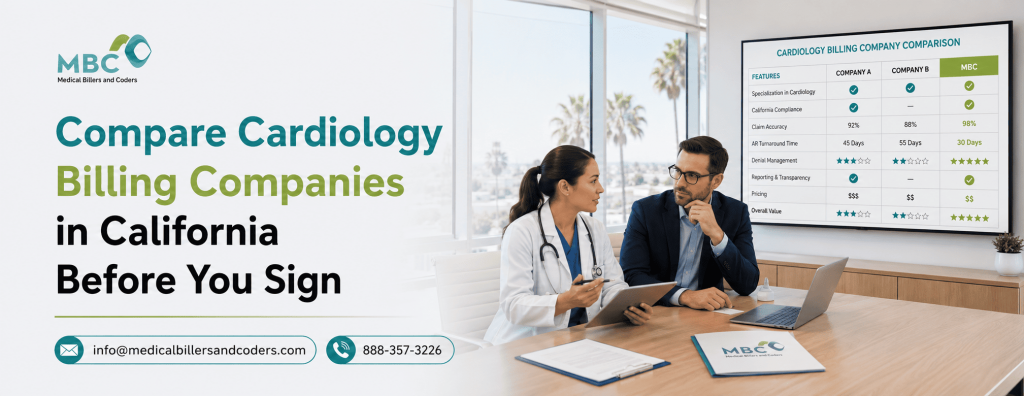
Compare Cardiology Billing Companies in California using more than percentage fees. A billing company may quote a lower rate, but weak denial follow-up, slow AR recovery, limited cardiology coding expertise, or poor payer reporting can mean that lower fee never translates into better financial performance.
California cardiology practices should evaluate billing partners on coding expertise, claim accuracy, payer knowledge, Denial Management, Old AR Recovery, reporting, and complete RCM Services. The goal is a partner that captures collectible revenue while giving the practice clear visibility into billing performance.
Why Cardiology Billing Requires Specialized Expertise
Cardiology practices handle a wide range of diagnostic and procedural services. Cardiac catheterization, electrophysiology procedures, echocardiography, stress testing, cardiac imaging, and pacemaker or ICD procedures each involve different coding, documentation, and authorization requirements.
A general billing workflow may not provide enough specialty-specific oversight. Cardiology Medical Billing Services should connect clinical documentation with accurate coding, claim submission, payment posting, and denial follow-up.
California adds another layer of payer complexity. Medicare claims for California fall under Medicare Administrative Contractor Jurisdiction E, administered by Noridian Healthcare Solutions, as confirmed by CMS.gov. Practices also work with Medi-Cal managed care organizations and commercial insurers that carry their own administrative requirements.
What to Compare Before Choosing Cardiology Billing Companies in California
Ask each vendor to explain how it manages coding accuracy, clean claims, Denial Management, A/R follow-up, Old AR Recovery, payer knowledge, reporting, and contract terms. The right partner among Cardiology Billing Companies in California should answer these questions before the contract is signed, not after problems begin.
| Evaluation Area | What to Look For |
| Cardiology coding | Experience with cardiac procedures, diagnostics, modifiers, and documentation |
| Clean claims | Cardiology-specific claim performance rather than an overall company average |
| Denial Management | Denials categorized by payer, procedure, provider, and reason |
| A/R management | Structured follow-up for outstanding claims |
| Old AR Recovery | A defined process for claims older than 90 days |
| Payer knowledge | Experience with California Medicare, Medi-Cal, and commercial payers |
| Reporting | Regular reports showing actionable financial metrics |
| Contract | Clear pricing and well-defined included services |
Do Not Compare Billing Companies on Price Alone
Billing fees matter, but they should not be the only consideration. For example, assume a cardiology practice has $3.1 million in collectible revenue. If its Net Collection Rate increases from 91% to 96%, that five-point gain represents approximately $155,000 in additional collected revenue on the same collectible base. This is an illustrative calculation, not a universal benchmark; actual results depend on payer contracts, claim volume, procedure mix, documentation, and coding accuracy.
The better question is not “What percentage do you charge?” Ask instead what measurable financial improvements the billing process can produce, and how the company will report them.
Evaluate Denial Management and Old AR Recovery
Denial Management should be a major part of any vendor comparison. Cardiology claims can be denied for medical necessity, authorization, coding, modifiers, documentation, and eligibility, and simply resubmitting claims without identifying the underlying cause allows the same problems to continue.
A specialized Denial Management process should track denials by payer, procedure, provider, reason, and claim age, so administrators can determine whether denials are isolated incidents or evidence of a recurring problem. Ask prospective vendors for an example denial report; a vendor that can only provide a total denial percentage without explaining the reasons behind it may not give you enough information to evaluate performance.
Old AR Recovery deserves the same scrutiny. Older claims become harder to collect because of payer deadlines, missing documentation, prior denials, or incomplete follow-up. Ask how the company handles claims more than 90 days old, and confirm whether Old AR Recovery is included in the standard agreement or billed separately.
Look at the Complete RCM Process
Effective RCM Services should cover more than claim submission. A comprehensive revenue cycle process includes charge capture, coding, claim submission, payment posting, Denial Management, and financial reporting, with regular visibility into key performance indicators.
| Metric | What It Shows |
| Clean Claim Rate | Quality of claims before submission |
| Days in A/R | Speed of outstanding revenue collection |
| Denial Rate | Volume of claims requiring intervention |
| Net Collection Rate | Effectiveness of collecting collectible revenue |
| 90+ Day A/R | Exposure from aging balances |
| Payment Variance | Difference between expected and actual reimbursement |
| Payer Performance | Financial performance by payer |
California Payer Experience Matters
Not every billing company with national experience has the same depth of California expertise. Before selecting a vendor, ask whether its team understands the payer mix specific to your practice, including Medicare, Medi-Cal managed care organizations, and commercial insurers, and whether it monitors payer policy changes and folds relevant updates into authorization, coding, and follow-up workflows.
Red Flags When Comparing Billing Companies
A vendor that provides only one company-wide clean claim or denial rate may not be measuring cardiology performance accurately.
When comparing Cardiology Billing Companies in California, watch for unclear contract terms, separate charges for routine follow-up, no defined Old AR Recovery process, and an inability to explain how cardiology-specific claims are reviewed. The billing company should walk through its process clearly before you sign.
Pricing and Request Your Revenue Diagnostic
The cost of Cardiology Medical Billing Services varies based on provider count, claim volume, payer mix, and the level of RCM Services required. Instead of comparing fees alone, review MBC’s cardiology billing pricing structure and request your free Revenue Diagnostic to examine A/R aging, denial patterns, payer performance, and potential revenue leakage before you sign.
Ready to compare your numbers against real benchmarks?
Call 888-357-3226 or email info@medicalbillersandcoders.com to Request Your Revenue Diagnostic.
Conclusion
Choosing among Cardiology Billing Companies in California requires more than finding the lowest billing fee. A lower rate can still cost more if the vendor lacks cardiology coding expertise, structured Denial Management, or a defined Old AR Recovery process. Compare coding accuracy, payer knowledge, Denial Management, Old AR Recovery, reporting depth, and contract transparency before you sign.
A qualified partner should demonstrate, with numbers, how its process improves claim accuracy and financial visibility. Request your free Revenue Diagnostic to compare vendors using your practice’s actual billing performance, not marketing promises.
Reference – Centers for Medicare & Medicaid Services
Frequently Asked Questions
Compare cardiology-specific coding expertise, clean claim performance, denial rates, Days in A/R, payer knowledge, Denial Management, Old AR Recovery, reporting, technology, and contract terms. A strong vendor should provide measurable performance data instead of relying only on general company-wide billing statistics.
California cardiology practices may work with Medicare, Medi-Cal managed care organizations, and commercial insurers, each with different administrative requirements. A billing company familiar with California payer workflows can better manage claim submission, authorization, documentation, follow-up, and payer-specific billing issues as they arise.
Effective Denial Management identifies the reasons claims are denied, resolves eligible claims, and tracks recurring problems. Reviewing denials by payer, procedure, provider, and reason helps practices identify preventable errors and reduce repeated claim problems that can delay or reduce reimbursement.
Old AR Recovery focuses on unresolved claims that have remained outstanding for extended periods, particularly balances older than 90 days. The process reviews claim history, payer responses, documentation, appeals, and previous follow-up to determine which outstanding balances may still be recoverable.
No. A lower fee does not necessarily mean lower overall billing costs. Practices should compare coding accuracy, denial performance, A/R recovery, collection results, and reporting. The most useful way to compare Cardiology Billing Companies in California is by measurable performance, not fee alone.
Choosing Among Cardiology Billing Companies in California Before You Sign
Phone: 888-357-3226Fax: 888-316-4566
Email: sales@medicalbillersandcoders.com