

 Specialities
 Services
 Resource Center
 Pricing
 About
 Contact
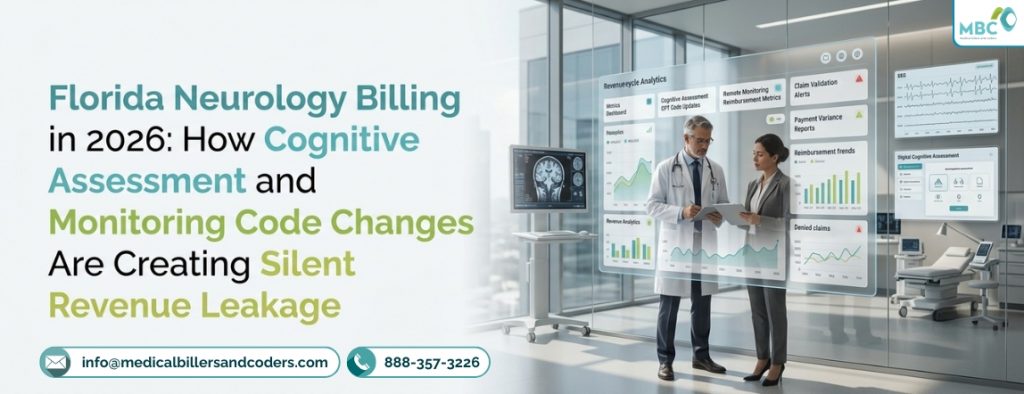
Florida neurology billing in 2026 is generating silent revenue leakage through accepted-but-downcoded cognitive assessment and monitoring claims — because Florida Blue, Humana, and Palmetto GBA updated their claims adjudication logic in Q1 2026 to enforce the revised AMA CPT documentation standards, and practices still billing under 2025 protocols are being repriced at lower CPT code values without a single denial issued.
Florida’s 60%+ Medicare Advantage penetration rate in Miami-Dade, Broward, Palm Beach, Hillsborough, and Duval counties places the majority of a Florida neurology practice’s Medicare volume inside MA plan claims review systems — each operating its own 2026 downcode triggers for CPT 96116 and 95716, the two highest-volume codes in Florida’s cognitive assessment and monitoring billing mix. For a national baseline on the 2026 CPT changes driving this exposure, see Neurology CPT Audit 2026: Which Cognitive, Infusion, and Monitoring Codes Changed and What’s at Risk.
Why Florida Carries a Higher 2026 Neurology Billing Risk Than the National Average
Three structural factors make Florida’s neurology billing services in the 2026 environment more exposed than the national average:
- MA penetration above 60% in five metro markets. Miami, Orlando, Tampa, Jacksonville, and Fort Lauderdale all exceed the 51% national MA average, meaning most Medicare neurology claims in Florida are adjudicated using payer-specific logic — not standard Medicare LCD enforcement — with each plan enforcing the 2026 CPT documentation standards on its own timeline.
- Florida’s aging demographic concentrates volume in the highest-risk codes. Florida ranks first nationally in Medicare-eligible residents aged 75 and older — the demographic that generates the highest utilization of neurobehavioral testing (96116, 96130) and long-term EEG monitoring (95716, 95720). The codes most affected by the 2026 documentation changes are also the highest-volume codes in most Florida neurology practices.
- Florida Medicaid managed care adds a second layer of compliance. Florida’s 100% managed care Medicaid program — through Sunshine Health, Molina Healthcare Florida, and WellCare — applies plan-specific prior authorization requirements for cognitive assessment services (99483) that differ from Medicare LCD criteria, creating dual-compliance exposure for practices serving both populations.
For how medical billing services in Florida are structured across Medicare, MA, and Medicaid, see Florida Medical Billing Services.
The Two Code Families Creating Silent Revenue Leakage in Florida
Cognitive Assessment (96116, 96130–96133, 96136–96139)
Florida Blue began enforcing the 2026 AMA CPT clarification in Q1 2026 — auto-repricing same-date 96116 and 96136 submissions to 96138 when the clinical record does not separate physician exam time from technician-administered testing. No denial is issued. No remark code is generated. The revenue is simply paid at the lower rate.
Humana, dominant in South and Central Florida, applies parallel logic to 96130/96131 — bundling the interpretation service into the administration code when the interpretation report is embedded in the same clinical note rather than filed as a separately signed document.
| CPT Code | Florida Payer Enforcement | Per-Session Revenue at Risk |
|---|---|---|
| 96116 | Florida Blue auto-downcode to 96138 since Q1 2026 | $85–$140 |
| 96121 | Humana denial — technician supervision of undocumented | $60–$95 |
| 96130 | Humana bundling into 96136 — report not separately signed | $95–$130 |
| 99483 | Florida Medicaid MCO — denied without prior authorization | $110–$160 |
Florida exposure: 80 sessions per month = $124,800 per 12 months in silent cognitive testing revenue loss.
Long-Term EEG Monitoring (95700 Series)
The Palmetto GBA MAC — Florida’s Medicare Administrative Contractor — entered full LCD enforcement on the 95700 series in January 2026. The two dominant downcode patterns in Florida:
95716 → 95715: Palmetto GBA requires video monitoring to be documented as a physician-ordered component of the monitoring plan — not inferred from equipment capability. Florida epilepsy programs at University of Florida Health, Jackson Memorial, and Tampa General are the highest-volume 95716 billers and the most common source of this documentation gap, because video monitoring is standard equipment and is rarely separately ordered in writing.
95720 → 95716: Palmetto GBA requires timestamped physician review logs for continuously monitored LTVE. Remote neurology monitoring programs serving North Florida and the Panhandle — where physician review is performed remotely — are generating this downcode when EMR timestamps are absent.
| CPT Code | Florida MAC Risk | Per-Day Revenue at Risk |
|---|---|---|
| 95716 | Palmetto GBA downcode to 95715 — video order absent | $90–$150 |
| 95720 | Palmetto GBA downcode to 95716 — physician timestamps missing | $110–$170 |
| 95706 | Denied — technologist start/stop times inferred, not documented | $60–$95 |
Florida exposure: 35 monitoring days per month = $63,000 per 12 months in LTVE downcode losses.
For how these standards connect to broader neurology billing services compliance infrastructure, see Mastering 2024 Neurology Billing Guidelines for Reimbursement.
Combined Florida Neurology Silent Revenue Leakage in 2026
| Risk Category | Monthly Volume | Per-12-Month Revenue at Risk |
|---|---|---|
| Cognitive testing downcode (96116, 96130) | 80 sessions | $124,800 |
| Monitoring downcode (95716, 95720) | 35 days | $63,000 |
| Medicaid MCO cognitive denials (99483) | 20 sessions | $28,800 |
| Total Florida exposure | $216,600 |
None of this surfaces on a denial report. Per MGMA benchmarking data, neurology practices at the collection-rate median consistently show a 7–9% gap relative to top performers — a gap driven primarily by accepted-but-downcoded claims that standard Denial Management workflows never flag. For how Old AR Recovery applies to prior-year Florida claims still within the appeal window, see Old AR Recovery Services.
MBC Spotlight: Neurology Billing Services in Florida for 2026
MBC’s Neurology Billing Services in Florida are built around Florida’s specific 2026 payer enforcement environment — Florida Blue’s Q1 cognitive testing logic, Humana’s neuropsychological testing bundling rules, Palmetto GBA’s LTVE LCD, and Florida Medicaid MCO prior authorization requirements.
Our dedicated account manager runs monthly remittance analysis on every claim with 96116, 96130, 95716, or 95720 — flagging accepted-but-downcoded payments within 15 days of the Explanation of Payment and routing them through payer-specific appeals before the timely filing window closes. Our system-agnostic platform integrates with Epic, Athenahealth, eClinicalWorks, and Modernizing Medicine, applying pre-submission documentation checklists at charge entry before the claim leaves your system.
With MBC’s 97% clean claim rate and 30% A/R reduction within 90 days, our Revenue Integrity Framework closes the CPT audit exposure at the documentation layer — not after the revenue is already lost. MBC’s Pricing Structure is percentage-based with no setup fees — full MBC’s fee structure at our Pricing page.
Practices completing MBC’s Complimentary 90-Day AR Diagnostic in Florida identify an average of $80,000 to $220,000 in neurology revenue gaps tied to cognitive and monitoring CPT downcodes specific to Florida’s 2026 payer enforcement.
Request Your Free Revenue Diagnostic
If your Florida neurology practice is billing cognitive assessments or long-term EEG monitoring under 2025 documentation protocols, Florida Blue, Humana, and Palmetto GBA are already repricing those claims at lower values. Request Your Free Revenue Diagnostic and let MBC’s neurology billing services in Florida specialists identify exactly which claims are being downcoded and recover that revenue before the appeal window closes. Contact us at info@medicalbillersandcoders.com or call 888-357-3226.
Frequently Asked Questions
Florida Blue and Humana began enforcing 2026 AMA documentation standards for 96116 and 96130 in Q1 2026, auto-downcoding non-compliant claims without issuing denials, while Palmetto GBA’s full LTVE LCD enforcement is generating monitoring downcodes across Florida epilepsy programs statewide.
Florida Blue enforces the 96116/96136 documentation separation rule; Humana enforces the 96130/96131 standalone interpretation report standard; United Healthcare enforces the 96136 physician co-signature requirement.
Video monitoring must be documented as an explicit physician-ordered component of the LTVE monitoring plan — not assumed from equipment capability — with physician review timestamps present in the EMR for the full monitoring period.
Florida’s 60%+ MA penetration means most Medicare neurology volume flows through individual payer claims review systems that enforce their own 2026 CPT downcode triggers — differing in timing and mechanism from standard Medicare LCD enforcement — making a single-payer compliance approach insufficient.
Through active remittance analysis comparing paid amounts against applicable fee schedule rates for every cognitive testing and monitoring claim, identifying underpayments below the billed code’s value, and filing payer-specific appeals within the timely filing window, a recovery process standard denial workflows cannot execute.
Florida Neurology Billing in 2026: How Cognitive Assessment and Monitoring Code Changes Are Creating Silent Revenue Leakage
Phone: 888-357-3226Fax: 888-316-4566
Email: sales@medicalbillersandcoders.com
Catering to more than 40 specialties, Medical Billers and Coders (MBC) is proficient in handling services that range from revenue cycle management to ICD-10 testing solutions. The main goal of our organization is to assist physicians looking for billers and coders, at the same time help billing specialists looking for jobs, reach the right place.
