

 Specialities
 Services
 Resource Center
 Pricing
 About
About
 Contact
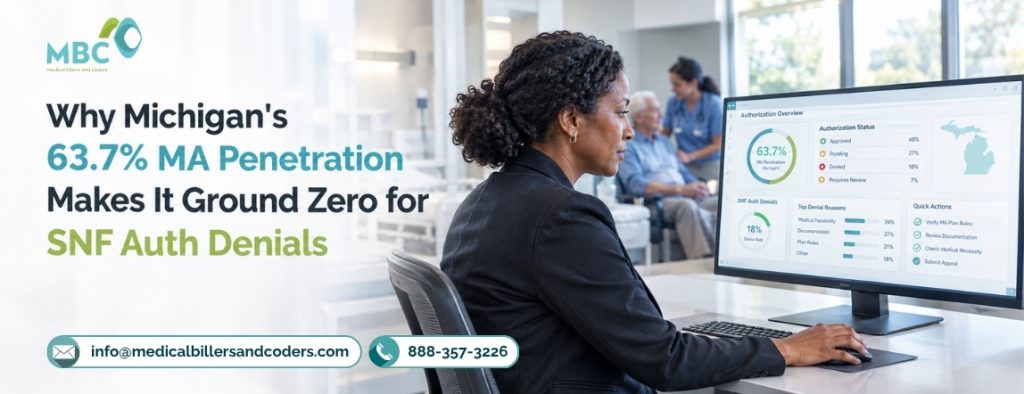
Michigan leads the nation with a 63.7% Medicare Advantage penetration rate as of August 2026 — the only state above 60%. That means a larger share of Michigan’s SNF admissions run through MA prior authorization than in any other state. This is driving a sharp rise in SNF Auth Denials statewide. Combined with a Certificate of Need program that caps nursing home bed supply statewide, that concentration changes the math. The national MA denial pattern — a 12% overall SNF denial rate with 95% of appeals overturned — becomes a Michigan-specific access and revenue problem that generic SNF billing services are not built to solve.
Key Takeaways
- Michigan’s 63.7% MA penetration rate is the highest in the nation, 2.1 points ahead of second-place Alabama, per CMS’s August 2026 data.
- Michigan’s Certificate of Need program (CON-217) caps nursing home bed supply, so denied or delayed MA admissions cannot simply shift to open capacity elsewhere in the state.
- WPS Government Health Administrators, the Jurisdiction 8 MAC covering Michigan and Indiana, administers the LCDs Michigan SNFs must document against, on top of each MA plan’s own internal criteria.
- HHS OIG’s June 2026 national report found a 12% overall SNF denial rate with a 95% appeal overturn rate, a pattern that compounds faster in a state where most residents are already in an MA plan.
- Michigan SNFs need payer-specific documentation and default-appeal workflows sized to MA volume, not a generic RCM approach built for lower-penetration states.
Michigan Isn’t a Typical State-Level SNF Auth Denial Story
Most state-specific billing content differentiates on a Medicaid program name or a regional payer quirk. Michigan’s SNF denial exposure is different because of scale. When 63.7% of Michigan’s Medicare population sits in an MA plan, prior authorization is not an occasional hurdle for a Michigan SNF. It is the default admission pathway for most of the facility’s Medicare census. Generic medical billing services built for lower-penetration states simply weren’t designed for that math.
CMS’s August 2026 penetration data puts Michigan first among all 48 ranked states, 2.1 percentage points ahead of Alabama at 61.6%. No other state crosses 60%. That gap matters because HHS OIG’s June 2026 review of the 19 largest MA organizations found a 12% national SNF denial rate. That rate ranges from 0.4% to 23% by carrier, with 95% of appealed denials overturned. In a state where roughly two-thirds of the Medicare population runs through that authorization gauntlet, the same national denial rate produces a proportionally larger volume of denials, appeals, and delayed admissions. That volume would be smaller in a state where MA penetration sits closer to the national average.
For a Michigan facility administrator, this reframes what “denial rate” even means as a planning figure. A 12% national denial rate applied against a Medicare census that is two-thirds MA-covered generates a materially larger absolute number of denied admissions per month. The same rate against a census where MA makes up a third or a quarter of admissions would produce far fewer. Two facilities with identical clinical acuity and identical documentation quality can post very different denial totals. The reason is simple: one sits in a lower-penetration state and the other sits in Michigan.
The Bed Supply Problem That Makes Denials Worse in Michigan
A denial or a delayed authorization is a temporary problem in a market with open SNF capacity nearby. Michigan does not have that release valve. The state’s Certificate of Need program, administered by MDHHS under review standard CON-217, requires state approval before new nursing home beds can be added. Michigan has operated under a long-standing bed-supply cap that limits new licensed capacity statewide.
That means a Michigan hospital discharge planner facing an MA prior authorization denial cannot simply route the patient to the next available facility across town. A planner in a state with looser bed-supply rules might have that option. Capacity is tighter. The operational cost of a denial, delayed discharge, extended hospital length of stay, and the administrative burden of an appeal lands harder on Michigan facilities and the hospital systems that discharge into them.
This is also why SNF Auth Denials compound rather than simply add up for a Michigan facility. High MA penetration produces more denials per facility, and a capped bed supply removes the option of diluting that denial volume across more licensed capacity statewide. The two conditions reinforce each other in a way that a facility in a lower-penetration, less bed-constrained state simply does not experience at the same scale. Left untracked, claim denials compound just as fast as bed-supply pressure does.
What This Means for a Michigan SNF’s Documentation Strategy
Michigan SNFs bill under WPS Government Health Administrators, the Jurisdiction 8 Medicare Administrative Contractor covering both Michigan and Indiana. WPS’s Local Coverage Determinations set the baseline skilled-need documentation standard. MA plans in Michigan then layer their own internal review criteria on top. Those criteria vary by carrier the same way they do nationally.
With that many Michigan residents in MA plans, a facility cannot treat MA authorization as a secondary workflow behind traditional Medicare billing. It has to be the primary documentation discipline, built payer by payer. The volume of MA admissions running through the facility makes payer-specific packaging the difference between predictable cash flow and a backlog of denied claims sitting in appeal. Facilities that fold MA authorization into MBC’s rcm services see fewer handoffs between clinical documentation and billing teams.
Denial management built for this environment tracks which MA carriers in Michigan’s market apply stricter thresholds than WPS’s own LCD standard. It packages pre-admission documentation to clear the stricter bar by default rather than the minimum one. Given the 95% national appeal overturn rate, a Michigan facility that defaults every denial into appeal, rather than treating appeal as exceptional, is working with the data rather than against it.
Two Tables Below the Fold
Michigan’s MA Denial Exposure at a Glance
| Factor | Michigan Data Point |
|---|---|
| MA penetration rate (CMS, August 2026) | 63.7%, highest of 48 ranked states |
| Gap over second-ranked state (Alabama) | 2.1 percentage points |
| Medicare Administrative Contractor | WPS Government Health Administrators, Jurisdiction 8 |
| Bed supply constraint | Certificate of Need program (CON-217) caps nursing home beds statewide |
| National MA SNF denial rate (HHS OIG, June 2026) | 12% overall; 95% of appeals overturned |
Generic SNF Billing vs. a Michigan-Sized MA Documentation Strategy
| Revenue Challenge | Generic RCM Vendor | Internal Billing Team | MBC Revenue Integrity Framework |
|---|---|---|---|
| MA authorization volume handling | Same workflow regardless of MA share of census | Manual triage as MA volume grows | Documentation built around MA as the primary admission pathway |
| Payer-specific criteria tracking | Not tracked separately from WPS LCD baseline | Tracked informally, inconsistently | Carrier-by-carrier threshold tracking above the LCD baseline |
| Response to bed-supply constraints | Not factored into billing workflow | Discharge planning and billing operate separately | Coordinated documentation to minimize authorization delay given limited nearby capacity |
| Appeal strategy | Filed case-by-case, if at all | Filed only on high-dollar claims | Default appeal on denial, given 95% national overturn odds |
| Reporting | Monthly claim status | Internal spreadsheets | CFO-grade dashboard on MA denial trend and recovery |
Key Takeaways
- Michigan’s MA penetration is not just the highest in the nation — it directly drives the volume of SNF Auth Denials a facility absorbs from the same national denial rate.
- The state’s Certificate of Need bed cap means a Michigan SNF cannot rely on nearby open capacity to absorb the operational cost of a denial or delay.
- WPS’s Jurisdiction 8 LCDs set the documentation floor, but MA plans’ internal criteria are the real bar Michigan facilities have to clear.
- A documentation and appeal strategy sized to MA as the primary admission pathway, not a secondary one, is what Michigan’s market actually requires.
MBC Spotlight
MBC’s Skilled Nursing Facility Center of Excellence builds payer-specific authorization protocols to reduce SNF Auth Denials in high-MA-penetration markets like Michigan, backed by a 97% clean claim rate and 98% client retention across our SNF portfolio. Facilities onboarding our Revenue Integrity Framework have seen Days in AR reduced by 30% within 90 days as carrier-specific documentation and default-appeal workflows close the gap between denial and recovery. MBC’s fee structure is custom-quoted to facility census and payer mix, never a published flat rate.
Choosing the right Revenue Integrity Partner starts with seeing where your facility stands today. Request Your Revenue Diagnostic to see how your Michigan facility’s MA denial and appeal pattern compares against the state and national benchmarks above.
FAQs
Why does Michigan have the highest Medicare Advantage penetration rate in the country?
CMS’s August 2026 data places Michigan first among 48 ranked states at 63.7% MA penetration, 2.1 percentage points ahead of second-place Alabama. The underlying drivers include years of aggressive MA plan marketing and broker activity in the state. The practical effect for SNFs is that most Medicare admissions now require MA prior authorization rather than following traditional Medicare rules.
How does Michigan’s Certificate of Need program affect SNF denials?
Michigan’s CON program, administered by MDHHS under review standard CON-217, caps the number of licensed nursing home beds statewide. That means a denied or delayed MA authorization cannot easily be absorbed by shifting the patient to open capacity elsewhere. The operational and financial cost of each denial lands harder on Michigan facilities than in states with looser bed-supply rules.
What’s different about billing SNF claims in Michigan compared to other states?
Michigan SNFs bill under WPS Government Health Administrators, the Jurisdiction 8 MAC also covering Indiana, whose LCDs set the baseline skilled-need documentation standard. Because 63.7% of Michigan’s Medicare population is in an MA plan, individual carrier authorization criteria, not the WPS LCD alone, are the primary documentation bar most Michigan SNF admissions have to clear.
Are Michigan Medicare Advantage SNF denials appealable at the same rate as the national average?
HHS OIG’s June 2026 report found a 95% national appeal overturn rate for SNF denials, and there is no indication Michigan performs differently on appeal outcomes. Given Michigan’s higher MA-driven denial volume, the practical opportunity to recover revenue through default appeals is larger in absolute terms than in lower-penetration states.
What Should a Michigan SNF Prioritize First to Reduce SNF Auth Denials?
Given that MA is the primary admission pathway for most Michigan facilities, the first priority is building payer-specific documentation protocols above the WPS LCD baseline for each major MA carrier in the market. Pair that with a default-appeal workflow rather than treating appeals as exceptional, given the 95% national overturn rate.
With 63.7% of Michigan on Medicare Advantage, Is Your TCM Billing Built for MA’s Rules?
Phone: 888-357-3226Fax: 888-316-4566
Email: sales@medicalbillersandcoders.com

A Subject Matter Expert in healthcare billing operations with nearly 10 years of experience, sharing insights on claims processing, coding support, and revenue cycle optimization. Dedicated to educating healthcare professionals on compliance, accuracy, and strategies to improve billing performance.
