Specialities
 Services
 Resource Center
 Pricing
 About
About
 Contact
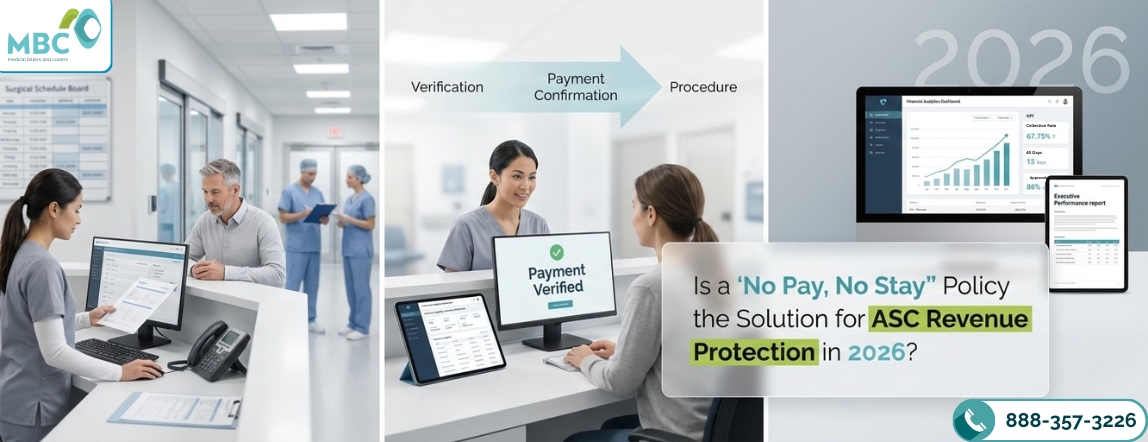
A “No Pay, No Stay” policy—requiring verified insurance eligibility and upfront patient financial clearance before elective procedure scheduling—is a partial but essential component of ASC revenue protection in 2026, because with 560 new procedures added to the ASC Covered Procedures List, a 2.6% Medicare payment update, and accelerating site-of-service migration creating $1.2M–$3.8M in new annual revenue opportunities, ASCs collecting $1M–$5M+ monthly cannot afford the 18–28% revenue leakage created by unverified eligibility, prior authorization failures, and payer variance gaps that a comprehensive financial clearance infrastructure eliminates.
For high-volume ASCs entering the 2026 expanded procedure landscape, “No Pay, No Stay” addresses front-end revenue protection—but without back-end denial root-cause engineering and payer-variance detection infrastructure, front-end clearance alone captures only 40–60% of available revenue protection.
The 2026 ASC Revenue Landscape: Why Protection Is Now Strategic
According to CMS, the 2026 Hospital Outpatient Prospective Payment System Final Rule delivers a 2.6% payment update for ASCs meeting ASCQR Program requirements—derived from a 3.3% hospital market basket increase offset by a 0.7 percentage point productivity adjustment.
Table 1: 2026 ASC Revenue Impact by Collection Volume
| Monthly Collections | 2026 Payment Increase (2.6%) | New CPL Procedures Revenue | ASCQR Compliance Penalty Risk | Net Revenue Opportunity |
| $1M–$2M | $156,000–$312,000 | $280,000–$520,000 | -$240,000–$480,000 | $1.1M–$1.4M |
| $2M–$3M | $312,000–$468,000 | $480,000–$840,000 | -$480,000–$720,000 | $1.6M–$2.4M |
| $3M–$5M+ | $468,000–$780,000 | $840,000–$1.4M | -$720,000–$1.2M | $2.4M–$3.8M |
EBITDA Alert:
ASCs failing ASCQR compliance face a two-percentage-point payment reduction—translating to $240,000–$1.2M annually, depending on collection volume. This single compliance failure eliminates more revenue than most ASCs generate from procedure volume growth.
What “No Pay, No Stay” Actually Covers (And What It Doesn’t)
Front-End Protection: What the Policy Addresses
A properly implemented “No Pay, No Stay” financial clearance policy provides risk mitigation through:
Pre-Scheduling Verification:
- Insurance eligibility confirmed before procedure booking
- Benefits verification identifies patient responsibility
- Prior authorization obtained before scheduling confirmation
- Patient financial counseling establishes payment commitment
Financial Performance Metrics Impact:
For ASC processing 300 monthly procedures:
- Unverified eligibility denial rate: 18–24%
- Monthly denied revenue without clearance: $180,000–$360,000
- With “No Pay, No Stay” implementation: Denial rate reduced to 4–6%
- Annual front-end revenue protection: $1.1M–$1.8M
What “No Pay, No Stay” Doesn’t Address
Front-end clearance eliminates eligibility-based denials, but doesn’t resolve:
- Post-service coding errorsare creating medical necessity denials
- Implant cost capture failures ($180,000–$420,000 annually for surgical ASCs)
- Payer variance detection gaps on newly added CPL procedures
- ASCQR documentation failures triggering payment penalties
The Complete Protection Equation:
“No Pay, No Stay” + Denial Root-Cause Engineering + Payer Variance Detection = Comprehensive ASC Revenue Protection in 2026
The 560 New Procedures: High-Value, High-Risk Revenue Opportunity
CMS finalized 560 surgical procedure additions to the ASC Covered Procedures List for 2026, including 285 procedures removed from the Medicare Inpatient Only (IPO) list.
Table 2: New CPL Procedure Categories and Revenue Protection Requirements
| Procedure Category | Avg. Reimbursement | Primary Denial Risk | Protection Strategy |
|---|---|---|---|
| Musculoskeletal (spine, joint) | $8,500–$24,000 | Implant cost capture failure | Real-time OR charge capture |
| Cardiovascular (new ASC-eligible) | $12,000–$38,000 | Medical necessity documentation | Payer-specific criteria templates |
| Complex excisions | $4,500–$12,000 | Coding specificity errors | ASC-certified coder review |
| Inpatient migration procedures | $15,000–$45,000 | Site-of-service authorization | Pre-service prior auth protocols |
Payer Variance Detection Requirement:
Commercial payers haven’t uniformly updated their ASC coverage policies to reflect 2026 CPL additions. Payer variance detection is critical—UnitedHealthcare, Aetna, and BCBS maintain different coverage determination timelines for newly approved ASC procedures. Billing inpatient-migrated procedures without payer-specific verification results in systematic denials, regardless of “No Pay, No Stay” front-end clearance.
Medical Billers and Coders maintains updated coverage matrices for the top 15 commercial payers, ensuring new CPL procedures are verified against payer-specific policies before scheduling confirmation.
Four-Layer ASC Revenue Protection Infrastructure for 2026
Layer 1: Financial Clearance (No Pay, No Stay)
Implementation Requirements:
- Eligibility verification 5–7 days before procedure
- Benefits breakdown documenting deductible, coinsurance, and out-of-pocket maximum
- Prior authorization confirmed with reference number documented
- Patient financial agreement signed before scheduling is locked
Layer 2: Technological Efficiency in Charge Capture
High-acuity ASC cases create charge capture complexity that manual processes can’t reliably handle:
- Implant cost documentation captured from OR logs in real-time
- Supply charges reconciled against procedure-specific expectations
- Modifier application verified before claim generation
- ASCQR quality measures documented at the point of care
Net Realized Revenue Growth from Charge Capture:
ASCs implementing automated charge capture recovery:
- Implant revenue: $180,000–$420,000 annually
- Supply charge capture: $85,000–$165,000 annually
- Total charge capture recovery: $1.1M–$2.1M for $3M–$5M monthly collections
Layer 3: Denial Root-Cause Engineering
2026 ASC Denial Pattern Analysis:
| Denial Category | Frequency | Root Cause | Prevention Protocol |
| Authorization mismatch | 28% | PA obtained for the wrong site-of-service | Site-specific auth verification |
| Medical necessity | 24% | Documentation is insufficient for high-acuity procedures | Payer-specific clinical templates |
| Bundling errors | 18% | New CPL procedures coded incorrectly | 2026 CPL coding training |
| Implant documentation | 16% | Invoice not match the claim | Real-time OR log integration |
| Timely filing | 14% | New procedure billing delays | Automated filing deadline tracking |
Layer 4: ASCQR Compliance Protection
Failing to meet ASCQR reporting eliminates the 2.6% payment update—the largest single risk-mitigation priority for 2026.
ASCQR Requirements:
- Timely submission of quality measure data
- Accurate procedure-level documentation supporting measures
- Patient-reported outcome data collection, where required
- Infection prevention and patient safety measure reporting
Medical Billers and Coders’ system-agnostic approach implements ASCQR documentation workflows within existing EMR platforms without system replacement.
Protect $1.2M–$3.8M in 2026 ASC Revenue With Comprehensive Financial Clearance Infrastructure
If your ASC, collecting $1M–$5M+ monthl,y is relying solely on “No Pay, No Stay” for ASC revenue protection in 2026, front-end clearance alone captures less than half of available revenue protection while 560 new CPL procedures, ASCQR compliance requirements, and commercial payer variance gaps create $1.2M–$3.8M in annual exposure.
Medical Billers and Coders, the leading medical billing company in the USA with 25+ years of specialized ASC billing experience, implements a complete ASC Revenue Protection infrastructure through ASC Billing Services, Medical Billing Services, Old AR Recovery, RCM Services, and Denial Management Services—all managed by a dedicated account manager using your existing EMR without system changes.
Our four-layer protection system delivers “No Pay, No Stay” financial clearance protocols, denial root-cause engineering reducing denial rates from 18–28% to 4–6%, payer variance detection across all 2026 CPL additions, technological efficiency in real-time charge capture recovering $1.1M–$2.1M annually, and ASCQR compliance protection preserving the full 2.6% payment update. With a proven 30% A/R reduction across ASC specialties, we deliver net realized revenue growth while protecting EBITDA from all 2026 payment landscape risks.
Request your 2026 ASC Revenue Protection Assessment to quantify exact revenue leakage across eligibility failures, charge capture gaps, payer variance, and ASCQR compliance. Contact Medical Billers and Coders today to implement the comprehensive ASC revenue protection in 2026. Your surgery center needs to capture every dollar the expanded procedure landscape makes available.
References
Frequently Asked Questions
No. “No Pay, No Stay” addresses front-end eligibility denials (18–24% of total denials) but doesn’t protect against post-service coding errors, implant capture failures, payer variance on 560 new CPL procedures, or ASCQR non-compliance penalties of $240,000–$1.2M annually. Complete ASC revenue protection in 2026 requires a layered infrastructure combining financial clearance, denial root-cause engineering, payer variance detection, and ASCQR compliance protocols.
CMS finalized a 2.6% payment update for ASCQR-compliant ASCs, derived from a 3.3% hospital market basket increase minus a 0.7 productivity adjustment. For practices collecting $1M–$5M+ monthly, this generates $156,000–$780,000 additional annual revenue. However, ASCQR non-compliance triggers a two-percentage-point reduction, eliminating $240,000–$1.2M, making compliance the highest-priority financial performance metrics protection strategy.
New CPL procedures create challenges for detecting payer variances because commercial payers haven’t uniformly updated their coverage policies to match the 2026 CMS additions. Billing newly eligible procedures without payer-specific verification results in systematic medical necessity and authorization denials, regardless of front-end clearance. High-acuity inpatient-migrated procedures, averaging $15,000–$45,000 each, face the highest denial risk without payer-specific clinical documentation templates.
Commercial payers maintain different coverage determination timelines for procedures migrating from the IPO list. UnitedHealthcare, Aetna, and BCBS may require 60–180 days to update internal coverage policies after CMS approval, meaning that procedures CMS permits in ASC settings may be denied by commercial payers during the transition period. Payer variance detection protocols, identifying each payer’s specific coverage effective dates, prevent systematic denials on the 285 newly approved procedures.
Key financial performance metrics for ASC revenue protection in 2026 include: First Pass Resolution Rate (target ≥95%), Days in AR (target ≤22 days for ASC), implant cost capture rate (target ≥98%), ASCQR compliance rate (target 100%), prior authorization approval rate (target ≥92%), and net collection ratio by procedure category (target ≥96%). Tracking these metrics by payer and procedure type enables denial root-cause engineering to identify the specific operational gaps with the greatest EBITDA impact.

Catering to more than 40 specialties, Medical Billers and Coders (MBC) is proficient in handling services that range from revenue cycle management to ICD-10 testing solutions. The main goal of our organization is to assist physicians looking for billers and coders, at the same time help billing specialists looking for jobs, reach the right place.