Specialities
 Services
 Resource Center
 Pricing
 About
About
 Contact
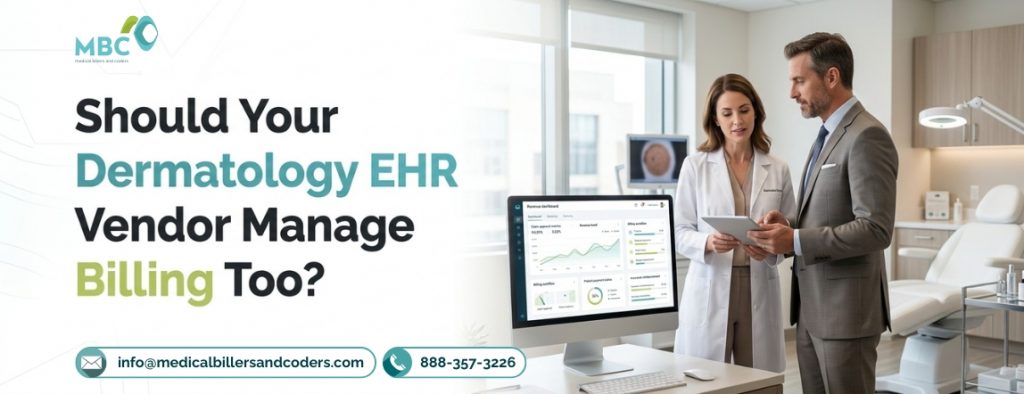
For a solo dermatologist with straightforward medical visits, a bundled EHR-and-billing platform can work well. For a multi-physician practice with real Mohs surgery volume and a meaningful cosmetic-versus-medical split, it usually falls short — and the reason has nothing to do with the EHR itself being bad.
Why Bundled Platforms Work for Simple Cases
Bundled EHR-and-billing platforms (ModMed’s RCM offering is the clearest example in dermatology) integrate documentation and charge capture tightly, reducing friction for lesion documentation and straightforward billing. For a single-physician or small-group practice with a predictable case mix, this can be enough to keep dermatology billing running smoothly.
Where the Model Breaks Down as Complexity Grows
Dermatology billing sits at the intersection of medical necessity documentation, cosmetic-versus-medical service segregation, and high-volume procedural coding. Reimbursement depends on precisely differentiating destruction, excision, and biopsy codes, accurate lesion sizing, and correct modifier application across multi-procedure visits — a level of specificity that requires medical coding expertise a generalized, platform-embedded billing team doesn’t always carry.
The Hidden Cost: Paid, But Not Paid Correctly
This gap rarely shows up as a rejected claim. It shows up as a claim that gets paid — just not at the rate it should have — because a cosmetic procedure wasn’t cleanly separated from a medically necessary one, or a multi-procedure Mohs case wasn’t mapped to its full defensible coding specificity. The EHR vendor’s billing team has little incentive to catch this: from their dashboard, the claim looks clean. It went out, it got paid, and nothing in that workflow flags whether it got paid correctly, or simply got paid. Strong denial management practices exist precisely to catch this kind of underpayment before it becomes routine.
The Real Test: Specialty Expertise, Not Software
The practical test isn’t whether the EHR vendor’s billing works. It’s whether the team behind it carries certified dermatology coding expertise, or is applying general practice-management billing knowledge to a specialty with some of the most granular, procedure-specific coding rules in outpatient medicine. A multi-physician group with significant Mohs volume should ask that question directly before assuming the bundled option is the simpler choice. This is also where credentialing services matter: a coding team that also manages payer credentialing correctly can prevent downstream claim delays tied to enrollment gaps.
Where to Look First
Pull last quarter’s Mohs and multi-procedure claims and compare the billed CPT and modifier combinations against what a dermatology-specialized coder would have applied. If there’s a gap, it’s a coding depth problem, not an EHR problem, and switching EHRs won’t fix it. A quick self-audit should cover:
- Cosmetic vs. medically necessary claim splits for the last 90 days
- Modifier usage on multi-procedure Mohs cases
- Whether underpayments are tracked separately from “claim paid” status
- Whether your current billing team holds dermatology-specific coding certification
Bringing in Dedicated Dermatology Billing Expertise
Practices that outgrow the bundled model typically move to a dedicated dermatology billing services partner that layers specialty-certified coding, proactive denial management, and credentialing oversight on top of whatever EHR the practice already uses. Full-service medical billing services aren’t tied to a single EHR’s charge-capture logic, so they can apply the same rigor across payers and procedure types — closing the exact gap bundled platforms leave open. This approach also fits into a broader revenue cycle management strategy, one that tracks not just whether a claim was paid, but whether it was paid at its full, defensible value.
Explore more dermatology billing insights, or request your free revenue diagnostic to see whether your current billing setup is capturing everything your dermatology coding is actually worth.
Frequently Asked Questions
For solo or small practices with routine visits, EHR-bundled billing can work fine. But as case complexity grows, especially with real Mohs volume, the built-in team may lack expertise in certified dermatology billing services, which shows up as underpayment rather than denials.
EHR-bundled billing focuses on charge capture within the platform’s own workflow. A dedicated medical billing services partner applies specialty-certified medical coding, active denial management, and credentialing oversight across payers, independent of any single EHR’s logic.
Modifier 25 (significant, separately identifiable E/M service) and modifier 59 (distinct procedural service) are the most frequently misapplied modifiers in dermatology, particularly on multi-procedure and Mohs surgery claims — a leading cause of underpayment.
Cosmetic and medically necessary services must be documented, coded, and billed separately, as payers reimburse only medically necessary care. Clear documentation of medical necessity at the diagnosis level is essential to avoid denials or incorrect bundling.
Mohs surgery uses stage- and specimen-based CPT codes (17311–17315) that must be reported precisely against pathology and operative notes. Multi-procedure Mohs cases require a higher level of coding specificity than routine visits, making the expertise of certified dermatology billing services especially valuable.
Reference:

A Subject Matter Expert in healthcare billing operations with nearly 10 years of experience, sharing insights on claims processing, coding support, and revenue cycle optimization. Dedicated to educating healthcare professionals on compliance, accuracy, and strategies to improve billing performance.