Specialities
 Services
 Resource Center
 Pricing
 About
About
 Contact
The direct answer: rising Gastroenterology AR is almost never a volume problem. It is a coding, denial, and follow-up problem that compounds month over month until old AR recovery becomes a full-time project instead of a routine task.
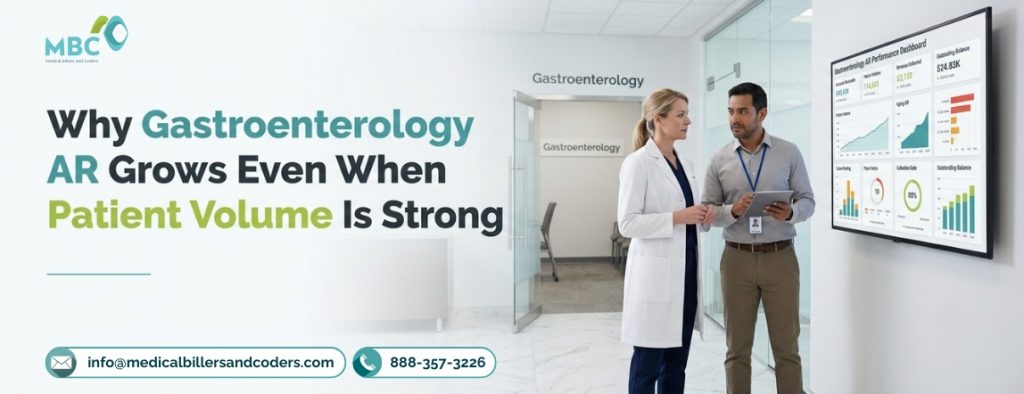
Gastroenterology AR grows even when patient volume is strong because the revenue leak usually happens after the visit, not before it. A busy schedule of colonoscopies, endoscopies, and consults creates a false sense of financial health while claims sit unpaid in 90-plus day buckets.
What Causes Gastroenterology A/R to Keep Growing?
Gastroenterology A/R rarely increases because of one isolated problem. More often, several small issues occur throughout the revenue cycle and compound over time.
Common causes include:
- Incorrect or incomplete CPT coding
- Screening-to-diagnostic colonoscopy billing issues
- Missing or delayed prior authorization
- Claim submission delays
- Payer-specific edits and denials
- Incomplete documentation
- Slow denial follow-up
- Unworked 60-, 90-, and 120-day A/R
- Underpayments that are treated as correctly paid claims
- Patient balances that remain unresolved
Common GI A/R Problems and Their Revenue Impact
| A/R Problem | What It Can Cause | Financial Risk |
| Coding errors | Claim rejections or underpayments | Lost or delayed reimbursement |
| Delayed denial follow-up | Aging claims | Higher write-off risk |
| Prior authorization gaps | Preventable denials | Uncollected procedure revenue |
| Old A/R | Claims approaching filing or appeal limits | Reduced recovery opportunity |
| Payer underpayments | Incorrectly reduced reimbursement | Hidden revenue leakage |
| Documentation gaps | Medical necessity disputes | Denials and recoupment exposur |
Denial Management Gaps That Inflate Old AR Recovery Timelines
Weak denial management is the single biggest driver of aging AR in gastroenterology. Practices without a dedicated denial workflow batch-process rejections weekly instead of within 48 hours, and by the time staff circle back, timely filing windows have closed.
Old AR recovery teams then spend hours re-verifying medical necessity documentation that should have been captured at the point of service. Common triggers include missing polyp pathology tie-ins, incomplete anesthesia crosswalks, and payer-specific prior authorization lapses on advanced endoscopic procedures.
Each one, left unresolved for more than 60 days, moves a clean claim into the old AR recovery queue where the odds of full payment drop sharply.
How RCM Services and Medical Coding Services Close the Gap
Specialty-specific RCM services and Medical coding services address the root cause instead of the symptom. Generalist billing teams treat GI claims like any other outpatient visit, missing the nuance between screening and diagnostic intent that determines whether a claim pays at 100% or gets flagged for review.
Coders who understand Medicare’s preventive-to-diagnostic conversion rules, along with commercial payer variations on the same visit, close a gap that generalist vendors routinely miss — and that gap is what quietly inflates Gastroenterology AR month after month.
A/R Aging Should Drive Different Actions
| A/R Age | Primary Concern | Recommended Focus |
| 0–30 days | Normal payment cycle | Monitor payer processing |
| 31–60 days | Emerging delays | Identify unpaid claims |
| 61–90 days | Increasing recovery risk | Prioritize follow-up |
| 91–120 days | Aging revenue | Escalate high-value claims |
| 120+ days | Potential write-off risk | Intensive recovery review |
Gastroenterology Billing Services Built for Colonoscopy and Endoscopy Volume
High-volume GI practices need Gastroenterology billing services that map every colonoscopy and endoscopy claim to current payer edits before it leaves the building. This is where MBC’s engagement-based pricing model, detailed on our revenue diagnostic and pricing page, becomes relevant.
Costs are structured around claim volume, denial complexity, and current AR age rather than a flat fee, so practices only pay for the depth of review their books actually require. That transparency matters most for groups where aging AR has already crossed the 90-day threshold and needs a targeted recovery plan, not a generic audit.
AI in Gastroenterology Billing Cuts Denials Before They Age
AI in Gastroenterology Billing is changing how claims get scrubbed before submission. Machine-driven edit checks flag mismatched modifiers, missing medical necessity documentation, and NCCI conflicts in real time, catching what manual review often misses across high volume.
Practices using AI-supported scrubbing report fewer first-pass denials, which directly slows the pace at which unpaid claims accumulate. The technology works best paired with GI-trained coders who can interpret flagged claims correctly, since automation alone cannot judge medical necessity nuance the way an experienced reviewer can.
How Gastroenterology Medical Billing Services Can Help
Specialized Medical Billing Services can help GI practices manage the complete revenue cycle, including coding, claim submission, payment posting, denial management, A/R follow-up, and reimbursement analysis.
The advantage of a specialty-focused approach is that the billing team understands the revenue risks associated with GI procedures rather than applying a generic workflow across unrelated specialties.
A stronger process can help identify recurring denial patterns, prioritize aging claims, investigate payment discrepancies, and improve the connection between clinical documentation and reimbursement.
Pricing and Request Your Free Revenue Diagnostic
The pricing of gastroenterology billing and revenue cycle support depends on claim volume, provider count, payer mix, procedure complexity, A/R aging, and the services included. Rather than applying a flat fee, the appropriate scope can be determined through a revenue diagnostic that identifies the practice’s largest financial gaps.
Request Your Revenue Diagnostic to understand where GI revenue may be delayed, underpaid, or left uncollected and determine which areas should receive priority.
Conclusion
Strong patient demand should create an opportunity for growth, not continuously expanding A/R. If a gastroenterology practice is seeing more patients but cash flow is not improving at the same pace, the problem may be somewhere between coding, claim submission, payer adjudication, denial follow-up, and old A/R recovery.
The right response is not simply to submit more claims. Practices need visibility into where revenue is being delayed, denied, underpaid, or left unworked. A focused Gastroenterology Revenue Diagnostic can help identify these gaps and determine whether stronger Medical Billing Services, Denial Management, RCM Services, or Old A/R Recovery should be prioritized.
Stop Losing revenue to aging Gastroenterology AR.
Call 888-357-3226 or email info@medicalbillersandcoders.com
Reference – CMS National Correct Coding Initiative (NCCI)
Frequently Asked Questions
Gastroenterology A/R can increase when claim volume grows faster than the practice’s ability to submit, follow up, correct, and collect claims. Coding errors, authorization problems, denials, underpayments, and older unresolved balances can accumulate even when schedules remain full. Strong patient demand therefore does not automatically translate into faster cash flow or stronger net collections.
Common causes include claim denials, incorrect CPT or modifier reporting, missing authorization, documentation issues, payer processing delays, underpayments, and insufficient follow-up on older claims. Gastroenterology practices should analyze aging A/R by payer, procedure, provider, and denial reason to determine whether the problem is isolated or part of a recurring revenue cycle pattern.
Effective denial management addresses both individual claims and the recurring reasons behind denials. A GI practice can categorize denials by payer, procedure, CPT code, authorization issue, and documentation problem. Correcting these patterns can reduce repeat denials while focused follow-up helps move existing unpaid claims toward resolution before they become more difficult to recover.
Claims that remain unpaid beyond 90 days require increased attention because recovery can become more difficult as documentation, payer follow-up, and appeal deadlines become more complicated. Reviewing 90+ day A/R separately allows practices to identify high-value claims, unresolved denials, payer issues, and potential recovery opportunities that may otherwise remain buried in the overall A/R balance.
Yes. A claim can be processed and paid while still generating a revenue loss if the reimbursement is below the expected contractual amount. Reviewing payment data against expected reimbursement can identify these discrepancies. This type of revenue integrity review is particularly useful when a practice has strong collections but still sees unexpected differences between production and realized revenue.

A Subject Matter Expert in healthcare billing operations with nearly 10 years of experience, sharing insights on claims processing, coding support, and revenue cycle optimization. Dedicated to educating healthcare professionals on compliance, accuracy, and strategies to improve billing performance.