Specialities
 Services
 Resource Center
 Pricing
 About
About
 Contact
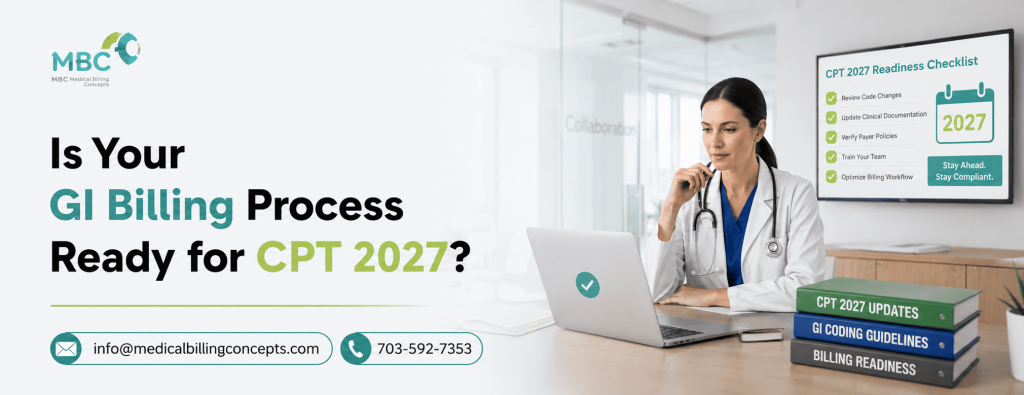
Yes, your GI Billing Process should already be under review for CPT 2027. The AMA has approved significant CPT changes taking effect January 1, 2027, including new Category I reporting for endoscopic submucosal dissection in the upper and lower GI tract. The final CPT 2027 code set is still moving through its publication cycle, so gastroenterology practices should prepare their coding, documentation, EHR, claim-edit, and denial workflows now rather than waiting until January.
For GI practices, the issue is not simply adding new codes. A successful transition requires the clinical documentation, coding rules, charge capture, claims system, payer policies, and Revenue Cycle Management workflow to work together.
What CPT 2027 Means for Gastroenterology Billing
The AMA maintains CPT as the standard language used to report physician services and procedures. CPT changes can therefore affect how services are documented, coded, submitted, and reviewed by payers.
One confirmed GI-related change for January 2027 involves endoscopic submucosal dissection (ESD). The AMA’s CPT Editorial Panel accepted two Category I codes to report ESD procedures in the upper or lower GI tract, with related coding guidelines.
That matters particularly to practices performing advanced endoscopic procedures. ESD is a technically complex procedure used for selected superficial GI lesions and early cancers, and its documentation needs to clearly support the service performed. ASGE educational material describes ESD as an advanced endoscopic technique that can provide en bloc resection for appropriate lesions.
Practices should therefore confirm that their GI Billing Services team understands the final code descriptors and guidelines before submitting 2027 claims.
Where GI Practices Could Face Billing Problems
A CPT update can create problems when the codebook changes but the surrounding revenue cycle does not. A practice may update its coding reference while leaving outdated EHR charge selections, claim edits, templates, or internal billing instructions in place.
For example, an advanced endoscopy service may be documented correctly by the physician but mapped incorrectly in the charge-capture system. The result can be a claim that requires manual correction, is rejected by the clearinghouse, or reaches the payer with coding that does not accurately represent the documented service.
| GI Billing Area | Potential CPT 2027 Risk | Recommended Action |
| Advanced endoscopy | New or revised reporting requirements | Review code mapping and documentation |
| EHR charge capture | Outdated procedure selections | Test updated charge workflows |
| Claim editing | Incorrect or missing edits | Validate clearinghouse rules |
| Documentation | Insufficient procedure detail | Update provider documentation guidance |
| Payer processing | Different payer implementation | Track payer-specific instructions |
| Denials | New or unexpected denial patterns | Create transition-specific denial tracking |
How to Prepare Your GI Billing for CPT 2027
The first step is to identify which GI services your practice performs that could be affected by the 2027 changes. Advanced endoscopy should receive particular attention because ESD reporting changes have already been approved for January 2027.
Next, your coding team should compare the current workflow with the final CPT 2027 descriptors and guidelines once the complete code set is available. The AMA has indicated that the standard CPT 2027 publication cycle includes publication of the new and deleted codes, with the 2027 code set taking effect January 1, 2027.
Your practice should also test whether the EHR and billing platform correctly connect physician documentation to the appropriate charge. This is particularly important when multiple advanced procedures, add-on services, or facility and professional components are involved.
Documentation Should Be Part of the Transition
Coding changes cannot be managed effectively if documentation remains unchanged.
For advanced GI procedures, the medical record should clearly describe the procedure performed and contain the clinical information needed to support accurate reporting. CMS coverage guidance for upper GI endoscopy, for example, addresses specific diagnostic and therapeutic indications and documentation considerations for endoscopic services.
Your gastroenterology practice should therefore review procedure templates before 2027 and determine whether physicians are consistently documenting the information needed by the applicable CPT guidelines and payer policies.
This is where experienced Gastroenterology Billing teams can provide practical support. The goal is not to document more simply for billing purposes, but to make sure the record accurately reflects the service actually performed.
Denial Management Should Track CPT 2027 Issues Separately
The transition should also change how your practice monitors denials.
Your Denial Management team should create a separate category for CPT 2027-related claim problems. That allows practice leaders to distinguish ordinary payer issues from transition-related problems.
| Metric | Why It Matters During the Transition |
| Clean claim rate | Shows whether updated coding reaches payers correctly |
| Coding-related denials | Identifies recurring CPT or documentation problems |
| Days in A/R | Shows whether transition issues are delaying payment |
| Denial overturn rate | Measures appeal effectiveness |
| Payment variance | Identifies unexpected reimbursement differences |
| 90+ day A/R | Shows whether unresolved claims are accumulating |
Reviewing these metrics weekly during the early months of 2027 can give practices a faster feedback loop. If one payer begins rejecting a particular procedure code, the billing team can investigate the payer’s policy instead of allowing the same issue to repeat across multiple claims.
How RCM Services Can Support CPT 2027 Readiness
RCM Services should extend beyond claim submission. A prepared revenue cycle team can help connect coding updates with charge capture, claim editing, payment posting, denial analysis, and A/R follow-up.
For gastroenterology practices, this means reviewing the entire workflow before the effective date. The objective is to identify potential problems before they affect cash flow.
Specialized Medical Billing Services can also help practices compare pre- and post-implementation performance. Tracking clean claim rate, denial trends, Days in A/R, and reimbursement by procedure can show whether the transition is working as expected.
What Should Your GI Billing Company Be Doing Now?
Your billing company should be able to explain how it plans to handle CPT 2027 rather than simply saying that its software will be updated.
Ask whether it will review affected GI codes, test EHR charge mappings, update claim edits, monitor payer implementation, train coding staff, and separately track transition-related denials.
The final CPT 2027 code set should remain the authority for the exact code descriptors and guidelines. Practices should also monitor AMA updates because the CPT Editorial Panel continues its work throughout the year.
Pricing and Request Your Revenue Diagnostic
The Price of Gastroenterology Billing Services varies based on claim volume, provider count, payer mix, coding requirements, and the level of denial and A/R support required. A Revenue Diagnostic can help identify workflow gaps before CPT 2027 changes affect collections.
Want to know whether your GI billing workflow is ready for CPT 2027?
Call 888-357-3226 or email info@medicalbillersandcoders.com to Request your Revenue Diagnostic.
Conclusion
Your GI Billing should not wait until January 2027 to prepare for CPT changes. Confirmed changes involving advanced GI procedures, including new ESD reporting for the upper and lower GI tract, make coding, documentation, EHR mapping, and claim-edit testing important parts of the preparation process.
The strongest approach is to review the entire revenue cycle before implementation, establish transition-specific Denial Management, and monitor reimbursement and A/R after the new codes take effect. With the final CPT 2027 code set still approaching publication, GI practices should prepare now while continuing to verify final code details against AMA guidance.
Reference – Centers for Medicare & Medicaid Services
Frequently Asked Questions
One confirmed GI-related change is the addition of Category I codes for endoscopic submucosal dissection of the upper and lower GI tract, effective January 1, 2027. GI practices should verify final code descriptors, guidelines, and payer requirements in the official CPT 2027 code set before implementation.
The CPT 2027 code set takes effect January 1, 2027. The AMA is providing advance information to help healthcare organizations prepare. GI practices should use the remaining preparation period to review coding workflows, documentation templates, billing software, and payer processes before the new code set becomes effective.
Updated codes and coding guidelines can change how GI services are reported. Reviewing documentation templates early helps ensure medical records clearly support the services reported on claims. This preparation can reduce coding errors, improve claim accuracy, and give providers time to adjust documentation habits before January 2027.
Denial Management can help GI practices separately track CPT 2027-related denials and identify recurring coding, documentation, or claim-processing problems. Reviewing these trends allows billing teams to correct underlying issues, update workflows, and reduce the risk of repeated denials as 2027 codes become part of regular billing.
Yes. GI practices should confirm that their EHR, practice-management system, clearinghouse, and billing workflows can support applicable 2027 codes before January 1. Early testing can identify mapping, claim-edit, or transmission problems and give the billing team enough time to resolve issues before claims are submitted.

A Subject Matter Expert in healthcare billing operations with nearly 10 years of experience, sharing insights on claims processing, coding support, and revenue cycle optimization. Dedicated to educating healthcare professionals on compliance, accuracy, and strategies to improve billing performance.