Specialities
 Services
 Resource Center
 Pricing
 About
About
 Contact
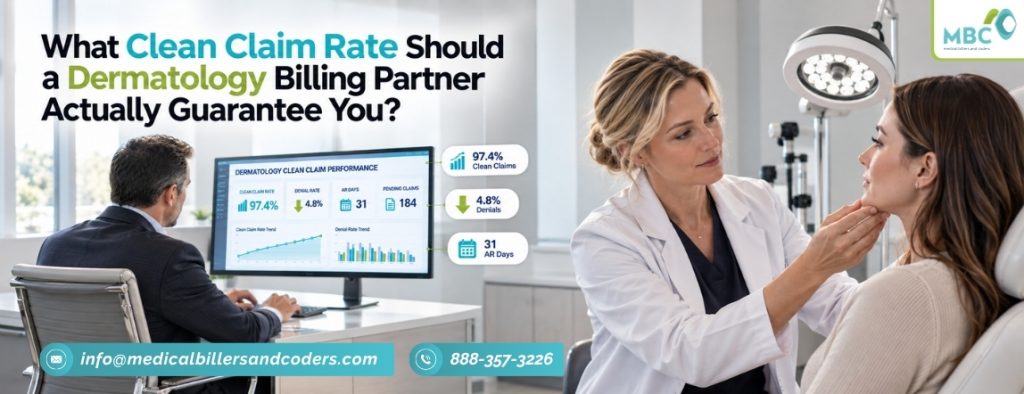
A dermatology billing partner should guarantee at least a 97% clean claim rate measured at payer acceptance, and that guarantee only means something when the contract also ties it to First-Pass Yield and Net Collection Ratio.
On its own, the clean claim rate is the easiest number in revenue cycle management to inflate. Dermatology is the specialty where that inflation hides the most revenue.
Why the Clean Claim Rate Is the Easiest Metric to Game
Most dermatology billing proposals quote a clean claim rate without defining it. Without a definition, the guarantee loses most of its value.
Three definitional choices can move the reported number by several points without a single additional dollar reaching your bank account.
Measurement point. A claim accepted by the clearinghouse has not been accepted by the payer. It can pass the scrubber and still reject at UnitedHealthcare or Aetna front-end edits.
Denominator. Vendors often leave out claims held for medical coding queries, missing documentation, or pending prior authorization. The rate looks clean because the problem claims were never counted.
Accepted versus paid. A claim billed at a lower-value code goes through cleanly. It is accepted, paid on time, and underpaid by design.
Dermatology CFOs should worry most about that third point.
Why Dermatology Billing Exposes the Gap More Than Most Specialties
Dermatology combines high claim volume with procedure families where the lower-value coding choice is also the lower-risk choice for a billing team:
- Mohs surgery (CPT 17311 through 17315): Payment depends on accurate stage and block counts. Undercounting additional stages produces a clean claim that leaves reimbursement unbilled.
- Excision plus repair (11400 to 11646 with 12031 to 12057): These claims need correct modifiers. Dropping the repair to avoid a NCCI bundling edit produces a clean claim and loses the repair line.
- Destruction codes 17000, 17003 and 17004: Payers enforce the sequencing rules differently. Collapsing them into one line avoids rejection and gives up units.
- Modifier 25 on same-day E/M and procedure encounters: This is a leading denial driver. Leaving off the E/M entirely is the fastest route to a perfect clean claim rate.
Then there is the split between cosmetic and medical services. Seborrheic keratosis removal, scar revision and certain laser procedures need medical necessity documentation specific to the LCD. A partner that routes borderline cases to self-pay protects its clean claim rate at your expense.
This is how a dermatology group can report 97% clean claims while its Net Collection Ratio declines quarter over quarter. We break down that pattern in Why Dermatology Practices Overbundle and Undercollect.
What a Defensible Dermatology Billing Guarantee Should Contain
In any medical billing services contract, a clean claim rate guarantee is only as strong as the contract language behind it. Before signing, your CFO or practice administrator should require five components in writing:
- A payer-level definition: A clean claim is one the payer accepts on first submission. Acceptance by the clearinghouse does not count.
- A full denominator: Every charge entered counts, including held and queried claims.
- Companion revenue metrics: The contract guarantees First-Pass Yield and Net Collection Ratio alongside the clean claim rate.
- Payer-level reporting: Monthly results broken out for Medicare, your MAC and your top commercial payers.
- A remedy clause: A corrective action plan, a fee credit or an exit right if targets are missed for two consecutive months.
Without components three and five, the guarantee is a marketing claim rather than a performance commitment.
Table 1: Vendor Guarantee Language vs. What It Can Hide
| Guarantee as Written | What It Can Conceal | What to Require Instead |
|---|---|---|
| “97% clean claim rate” (undefined) | Measurement at the clearinghouse | Payer first-pass acceptance |
| “Clean claims on submitted volume” | Held and queried claims left out | All charges entered as the denominator |
| “Industry-leading acceptance” | Underbilling through lower-value codes | A First-Pass Yield guarantee |
| “Monthly performance summary” | Clusters of denials at specific payers | Payer-level scorecard by CPT family |
| “Commitment to continuous improvement” | No consequence for missed targets | Fee credit or exit right after two missed months |
The Metrics That Prove the Clean Claim Rate Is Real
The three metrics measure different things:
- Clean claim rate: how accurately claims are submitted.
- First-Pass Yield: whether the claim paid in full at contracted rates.
- Net Collection Ratio: how much of what you were owed you actually collected.
When all three move together, the dermatology billing partner is performing. When the clean claim rate holds steady while the other two slide, the cause is underbilling, underpayment or payer variance that nobody is working.
Volume raises the stakes. For a group billing 4,000 dermatology claims per month, each percentage point of first-pass rejection means 40 claims reworked every month, or 480 per 12 months. That count comes before any revenue lost when those claims age past timely filing or slide into aging A/R that needs old AR recovery services.
Table 2: The Dermatology Billing Partner Scorecard
| Metric | What It Proves | Target to Put in the Contract | Dermatology Failure It Catches |
|---|---|---|---|
| Clean Claim Rate | Submission accuracy | 97% or higher at payer level | Modifier 25 errors, LCD documentation gaps |
| First-Pass Yield | Full payment on first submission | Improvement on your baseline, reported monthly | Mohs stage undercounting |
| Net Collection Ratio | Collected vs. collectible | 95% or higher | Overbundled excision and repair |
| Denial Rate by CPT Family | Where revenue breaks down | Downward trend in every CPT family | Destruction sequencing, prior auth for biologics |
| Days in AR | Speed of cash collection | Reduction against a 90-day baseline | Aged cosmetic misclassification denials |
How to Test a Dermatology Billing Partner Before You Sign
Before you commit to medical billing outsourcing, ask for a 90-day baseline built on your own data rather than a portfolio average. Ask how the partner calculated its advertised rate and which claims it left out.
Then ask to see a payer-level scorecard, built from the partner’s healthcare analytics reporting, for a current dermatology client, with identifying details removed. A partner confident in its numbers will answer all three requests without hesitation. A partner that falls back on “industry-leading” language has given you an answer too.
Key Takeaways
- A 97% clean claim rate is the right floor, but only when it is measured at payer acceptance with every charge entered in the denominator.
- Dermatology coding lets a vendor reach a high clean claim rate by underbilling Mohs, repair, destruction and E/M services.
- First-Pass Yield and Net Collection Ratio have to be guaranteed alongside the clean claim rate.
- Payer-level scorecards and a written remedy clause turn a marketing claim into an enforceable commitment.
MBC Spotlight: Clean Claims That Carry Full Reimbursement
MBC’s Dermatology Center of Excellence engineers the clean claim rate from the revenue side. We audit Mohs stage capture, excision-and-repair modifier logic, destruction sequencing and LCD documentation before submission, so claims are both accepted and paid at the correct value.
Every engagement includes:
- A dedicated RCM Principal
- Payer variance detection across your top commercial payers
- Monthly scorecards covering Clean Claim Rate, First-Pass Yield and Net Collection Ratio by CPT family
Our clients achieve a 97% clean claim rate and up to a 30% reduction in A/R within 90 days. That record rests on 25+ years of experience and 98% client retention. See how our dermatology medical billing services apply the Revenue Integrity Framework to your payer mix.
Request Your Revenue Diagnostic to get a 90-day baseline of your clean claim rate, First-Pass Yield and Net Collection Ratio, measured on your own claims before you sign anything.
FAQs
A clean claim rate of 97% or higher, measured at payer first-pass acceptance, is a strong target for multi-provider dermatology groups. HFMA benchmarks treat 98% as top-tier performance. Always confirm where the rate is measured, because a figure taken at the clearinghouse can overstate true payer acceptance by several points.
Treat it with caution until the definition is in writing. Rates that high are often measured at the clearinghouse, leave out held claims, or come from conservative coding that avoids rejections by underbilling. Ask for the denominator and the measurement point, and require a First-Pass Yield figure alongside it.
The clean claim rate shows whether a claim passed payer edits on first submission. First-Pass Yield shows whether that claim was paid in full at the contracted rate. In dermatology, the gap between the two usually reflects Mohs undercounting, dropped repair codes, or underpayments that nobody is working.
Claims coded at lower-value levels rarely reject, so they raise the clean claim rate while reducing reimbursement. Collections can also fall when cosmetic and medical borderline cases are routed to self-pay, or when payer variance goes undetected. This is why Net Collection Ratio has to be guaranteed alongside the clean claim rate.
The contract should define a corrective action plan with deadlines, a fee credit when targets are missed, and an exit right after two consecutive months below target. It should also require monthly payer-level reporting, so problems surface within one reporting cycle instead of appearing at the quarterly review.

A Subject Matter Expert in healthcare billing operations with nearly 10 years of experience, sharing insights on claims processing, coding support, and revenue cycle optimization. Dedicated to educating healthcare professionals on compliance, accuracy, and strategies to improve billing performance.