Specialities
 Services
 Resource Center
 Pricing
 About
About
 Contact
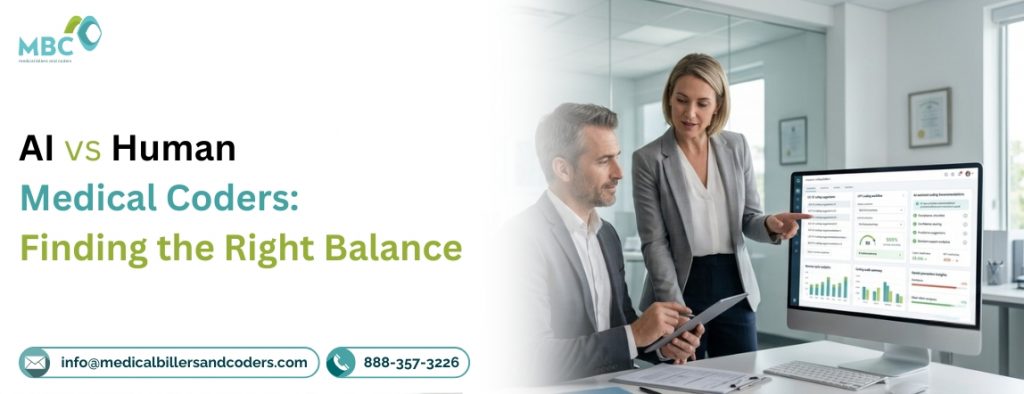
AI vs Human Medical Coders isn’t a contest with one winner. AI wins on speed and consistency for high-volume, low-complexity claims. Human coders win on judgment for complex, high-dollar, and audit-sensitive cases.
The groups seeing the best financial results in 2026 aren’t choosing one over the other — they’re building a coding model that routes each claim to whichever one performs better, then measuring both against the same accuracy and denial benchmarks.
The Real Debate Behind This Coding Shift
Most articles frame this as a replacement story: software gets smart enough, coders lose their jobs, done. That’s not what’s happening inside multi-site groups and hospital systems right now. The real question CFOs are asking isn’t “can AI code claims.” It’s “which claims should AI code, which ones need a certified human, and who’s accountable when the answer is wrong.” That’s a different problem, and it’s the one this blog actually answers.
The stakes are bigger than most organizations realize. According to CMS’s Comprehensive Error Rate Testing (CERT) program, the FY 2025 Medicare Fee-for-Service improper payment rate was 6.55%, totaling $28.83 billion in improper payments nationally, and insufficient documentation was cited as the leading cause of those errors. That’s the exact failure point both AI and human coders are supposed to close, and where they close it differently matters more than which one wins the argument on paper.
For groups still relying on outdated medical billing services to manage this shift, the gap between “technically compliant” and “audit-ready” is where real revenue gets lost. AI vs Human Medical Coders is really a question about which model closes that gap fastest without introducing new risk.
Where AI Actually Wins
AI-assisted coding tools are genuinely strong at a specific set of tasks: absorbing annual code set updates the moment they publish, flagging documentation gaps before a claim goes out, and coding repetitive, well-documented encounters at a volume no human team can match.
For routine E/M visits, standard diagnostic panels, and high-volume low-acuity claims, AI reduces per-encounter labor cost and speeds up first-pass acceptance. This is where medical coding services built around automation genuinely earn their keep, and it’s a real, measurable advantage.
What AI doesn’t do well yet is context. It can’t reliably judge medical necessity nuance, resolve conflicting documentation, or defend a coding decision to an auditor. It codes what’s written, not what was clinically intended, and when documentation is ambiguous, that gap becomes a denial or, worse, a compliance exposure nobody notices until an audit letter arrives.
Where Human Coders Still Win
Certified human coders bring something AI can’t replicate on its own: accountable judgment. When a case involves multiple procedures on the same encounter, unusual modifier combinations, workers’ comp overlap, or a payer that interprets NCCI edits differently than the manual, a trained coder can reason through it and document why a code was chosen. That reasoning is exactly what protects a facility during a payer audit or OIG inquiry.
This distinction has regulatory weight behind it now. HHS-OIG’s February 2026 Medicare Advantage Industry Compliance Program Guidance specifically flagged the practice of querying physicians through EHR platforms using AI-generated prompts to add risk-adjusting diagnoses as a potentially abusive pattern, and it made clear that human-in-the-loop review must be more than a formality.
It has to be designed to prevent automation bias. In plain terms, regulators are already watching how AI influences coding decisions, not just whether the final code was correct.
AI vs Human Medical Coders: A Side-by-Side Comparison
| Factor | AI-Assisted Coding | Human Coders |
| Speed on high-volume claims | Very high | Moderate |
| Handling ambiguous documentation | Weak | Strong |
| Cost per routine claim | Low | Moderate to high |
| Audit defensibility | Requires human sign-off | Built in |
| Adapting to new payer rules | Fast, automatic updates | Depends on training cadence |
| Complex multi-procedure cases | Limited | Strong |
| Regulatory risk (per OIG guidance) | Elevated without oversight | Lower with proper documentation |
The Compliance Risk Multi-Site Groups Can’t Ignore
Here’s the part generic coverage of AI vs Human Medical Coders tends to skip: liability doesn’t disappear because software made the call. If an auditor questions a high-level code, “the AI generated it” isn’t a defense.
The organization is still accountable for what got billed. That’s why groups running six-figure claim volumes are pairing automation with a human review layer rather than letting either one run unsupervised. It’s not caution for its own sake; it’s what keeps a facility off the next OIG audit list.
Multi-site groups also underestimate how fast this scales into a real dollar problem. A single mismanaged risk-adjustment prompt or a batch of AI-flagged diagnoses without proper clinical linkage can affect hundreds of claims before anyone notices the pattern, turning a workflow gap into a payback liability that dwarfs whatever labor cost the automation was supposed to save.
Oversight in this area is only getting sharper. HHS-OIG opened a dedicated audit of HHS’s own governance of artificial intelligence in July 2026, a signal that AI-driven decisions across the healthcare payment system, including coding and billing tools, are now a standing federal review priority rather than a one-time compliance guidance update.
This is also where the cost conversation gets misunderstood. Cutting coding staff to save money on labor sounds efficient until a documentation-driven denial spike or a post-payment audit erases the savings several times over.
The FY 2025 CERT data makes the pattern explicit: documentation gaps, not fraud, drive the majority of improper payments, and that’s a problem AI alone doesn’t fully solve without a trained reviewer validating edge cases.
What a Blended Coding Model Looks Like in Practice
The groups getting this right typically run a tiered structure: AI handles the high-volume, low-risk claims end to end; certified coders review everything above a defined complexity or dollar threshold; and a compliance layer audits a sample of AI-coded claims monthly to catch drift before it becomes a pattern.
This is the model underneath most modern medical billing and coding services today, and it’s a meaningfully different setup than either “all-AI” or “all-manual” coding.
It’s worth noting this model isn’t free, and it isn’t something most in-house teams can stand up on their own timeline. Evaluating whether your current cost structure supports this kind of tiered review is worth a direct look, and our transparent pricing model breaks down exactly where that investment goes.
For groups managing coding across several specialties or state lines, it also helps to see how coverage varies. You can browse coding support by specialty or check RCM services available in your state before deciding how to restructure your coding workflow.
If your denial rate has climbed even as your coder headcount stayed flat, or your compliance team can’t explain why AI flagged (or missed) a specific case, that’s usually the signal it’s time for outside revenue cycle management support rather than another internal hire.
Not sure whether your current mix of AI vs Human Medical Coders is costing you more in denials than it’s saving in labor?
Call MBC at 888-357-3226 or email info@medicalbillersandcoders.com for a coding workflow review. We’ll show you exactly where automation is helping and where it’s quietly creating audit risk.
Summary
AI vs Human Medical Coders comes down to matching the right method to the right claim, not picking a side. AI brings speed and consistency to high-volume, well-documented encounters. Human coders bring the judgment and audit defensibility that complex, high-dollar, and compliance-sensitive claims require.
With CMS reporting a 6.55% improper payment rate tied mostly to documentation gaps, and OIG now explicitly scrutinizing AI-influenced coding prompts, the safest and most profitable path for multi-site healthcare groups is a blended model with clear human accountability built in, not a full handoff to either side.
FAQs: AI vs Human Medical Coders
Not entirely. AI is taking over routine, high-volume, well-documented claims, but complex and ambiguous cases still need a certified human coder to review and defend the coding decision.
It’s accurate on straightforward claims but struggles with ambiguous documentation and clinical nuance, which is why regulators expect human-in-the-loop review rather than fully autonomous coding.
Yes. Regulatory guidance makes clear the billing organization remains accountable for submitted codes regardless of whether AI or a human generated them.
Rising denial rates, unexplained AI-flagged diagnoses, or an inability to document why a code was assigned are all signs your current AI-to-human ratio needs adjustment.
A tiered model, AI for high-volume routine claims, certified coders for complex and high-dollar cases, plus monthly compliance sampling, typically outperforms either an all-AI or all-manual approach on both cost and audit safety.

A Medical Coding Subject Matter Expert with over 16 years of experience in ICD-10 and CPT coding, clinical documentation, and revenue cycle management. Shares actionable insights to improve billing accuracy and support compliance-driven healthcare practices.